• Produktbild: The Teacher Evaluation Handbook
  • Produktbild: The Teacher Evaluation Handbook

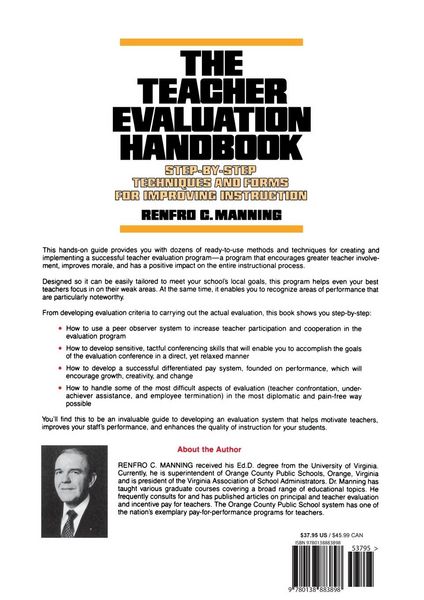
The Teacher Evaluation Handbook Step-By-Step Techniques and Forms for Improving Instruction

Fr. 53.90

inkl. gesetzl. MwSt., Versandkostenfrei


Beschreibung

Produktdetails

Einband

Taschenbuch

Erscheinungsdatum

29.06.1988

Verlag

Wiley

Seitenzahl

208

Maße (L/B/H)

29.7/21/1.2 cm

Gewicht

880 g

Sprache

Englisch

ISBN

978-0-13-888389-8

Beschreibung

Produktdetails

Einband

Taschenbuch

Erscheinungsdatum

29.06.1988

Verlag

Wiley

Seitenzahl

208

Maße (L/B/H)

29.7/21/1.2 cm

Gewicht

880 g

Sprache

Englisch

ISBN

978-0-13-888389-8

Herstelleradresse

Libri GmbH
Europaallee 1
36244 Bad Hersfeld
DE

Email: Libri GmbH

Kundinnen und Kunden meinen

0 Bewertungen

Informationen zu Bewertungen

Zur Abgabe einer Bewertung ist eine Anmeldung im Konto notwendig. Die Authentizität der Bewertungen wird von uns nicht überprüft. Wir behalten uns vor, Bewertungstexte, die unseren Richtlinien widersprechen, entsprechend zu kürzen oder zu löschen.

Die Bewertungen sind nach Format, Anzahl Sterne und Datum sortiert.

Verfassen Sie die erste Bewertung zu diesem Artikel

Helfen Sie anderen Kund*innen durch Ihre Meinung

Kundinnen und Kunden meinen

0 Bewertungen filtern

  • Produktbild: The Teacher Evaluation Handbook
  • Produktbild: The Teacher Evaluation Handbook
  • About This Book.

    Chapter 1: Evaluation-- Growth or Harassment?

    The Use of Formative and Summative Evaluation.

    Mixing Formative and Summative Evaluation.

    Eliminating the Problem of Dual Purposes.

    Eliminating Confusion.

    A Model for Evaluation.

    Motivation and Evaluation.

    Summary.

    Chapter 2: What's Worth Evaluating.

    Getting Started.

    The Responsibilities of Local Research Units.

    Examples of Professional Practices.

    Considerations for Evaluation.

    Constructing a Summative Instrument.

    The Question of Generic or Content.

    Examples of Professional Practices.

    Summary.

    Chapter 3: Peers as Evaluators.

    Peer Selection and Turnover.

    Should Peers Have Released Time?

    Peers and School Reform.

    Peer Observers and Teacher Unions.

    Peer Observers and the New Teacher.

    Summary.

    Chapter 4: Training Evaluators.

    The Training Focus.

    A Method of Training.

    Changing Traditional Reality.

    Summary.

    Chapter 5: The Evaluation Instrument as a Basis for Staff Development.

    Curriculum Delivery Systems.

    Staff Development and the Broad View.

    Making Staff Development Work.

    Making Change Permanent.

    A Long-term Commitment.

    Staff Development and the State.

    The Continuing Battle.

    Summary.

    Chapter 6: Conferencing and Setting Performance Targets.

    Determining the Purposes-- A Necessary First Step.

    Improve Conference Skills and Improve Evaluation.

    The Price of Failure.

    Summary.

    Chapter 7: Evaluation as a Terminal Activity.

    Preparing to Win.

    The No-Risk Win.

    Suggestions for Documenting.

    Helping the Administrator.

    Who Are the Incompetent?

    Documentation for E.E.O.C. Complaints.

    Some Legal Aspects of Termination.

    Summary.

    Chapter 8: Evaluation as a Basis for Merit Pay.

    Understanding Differentiated Pay.

    The Problem with Student Achievement.

    Initiating Differentiated Pay.

    Differentiated Pay-- The Promise.

    A Program that Works.

    Summary.

    Chapter 9: Summative Evaluations.

    Identifying Those Who Need Summative Evaluation.

    Designing the Summative Instrument.

    Who Evaluates Summatively?

    Valuing.

    Summary.

    Chapter 10: Putting It All Together.

    What's the Goal (Purpose)?

    What to Evaluate.

    The Human Element.

    Teaching Teachers.

    The Central Focus.

    Conferencing.

    Go for the Long Term.

    Summary.

    Appendix.

    Bibliography.

    Index.