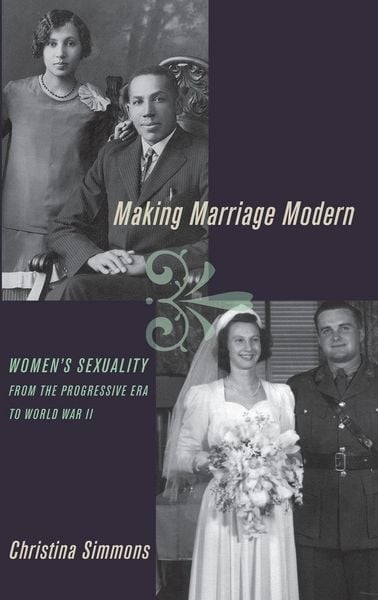
Making Marriage Modern Women's Sexuality from the Progressive Era to World War II
-
- Hardcover ausgewählt
- Taschenbuch
- eBook
-
Sprache:Englisch
Fr. 79.90
inkl. gesetzl. MwSt.,
Beschreibung
Produktdetails
Einband
Gebundene Ausgabe
Erscheinungsdatum
10.02.2011
Verlag
Oxford University PressSeitenzahl
320
Maße (L/B/H)
24/16.1/2.2 cm
Gewicht
576 g
Sprache
Englisch
ISBN
978-0-19-506411-7
The nineteenth-century middle-class ideal of the married woman was of a chaste and diligent wife focused on being a loving mother, with few needs or rights of her own. The modern woman, by contrast, was partner to a new model of marriage, one in which she and her husband formed a relationship based on greater sexual and psychological equality. In Making Marriage Modern, Christina Simmons narrates the development of this new companionate marriage ideal, which took hold in the early twentieth century and prevailed in American society by the 1940s.
The first challenges to public reticence to discuss sexual relations between husbands and wives came from social hygiene reformers, who advocated for a scientific but conservative sex education to combat prostitution and venereal disease. A more radical group of feminists, anarchists, and bohemians opposed the Victorian model of marriage and even the institution of marriage. Birth control advocates such as Emma Goldman and Margaret Sanger openly championed women's rights to acquire and use effective contraception. The "companionate marriage" emerged from these efforts. This marital ideal was characterized by greater emotional and sexuality intimacy for both men and women, use of birth control to create smaller families, and destigmatization of divorce in cases of failed unions. Simmons examines what she calls the "flapper" marriage, in which free-spirited young wives enjoyed the early years of marriage, postponing children and domesticity. She looks at the feminist marriage in which women imagined greater equality between the sexes in domestic and paid work and sex. And she explores the African American "partnership marriage," which often included wives' employment and drew more heavily on the involvement of the community and extended family. Finally, she traces how these modern ideals of marriage were promoted in sexual advice literature and marriage manuals of the period.
Though male dominance persisted in companionate marriages, Christina Simmons shows how they called for greater independence and satisfaction for women and a new female heterosexuality. By raising women's expectations of marriage, the companionate ideal also contained within it the seeds of second-wave feminists' demands for transforming the institution into one of true equality between the sexes.
The first challenges to public reticence to discuss sexual relations between husbands and wives came from social hygiene reformers, who advocated for a scientific but conservative sex education to combat prostitution and venereal disease. A more radical group of feminists, anarchists, and bohemians opposed the Victorian model of marriage and even the institution of marriage. Birth control advocates such as Emma Goldman and Margaret Sanger openly championed women's rights to acquire and use effective contraception. The "companionate marriage" emerged from these efforts. This marital ideal was characterized by greater emotional and sexuality intimacy for both men and women, use of birth control to create smaller families, and destigmatization of divorce in cases of failed unions. Simmons examines what she calls the "flapper" marriage, in which free-spirited young wives enjoyed the early years of marriage, postponing children and domesticity. She looks at the feminist marriage in which women imagined greater equality between the sexes in domestic and paid work and sex. And she explores the African American "partnership marriage," which often included wives' employment and drew more heavily on the involvement of the community and extended family. Finally, she traces how these modern ideals of marriage were promoted in sexual advice literature and marriage manuals of the period.
Though male dominance persisted in companionate marriages, Christina Simmons shows how they called for greater independence and satisfaction for women and a new female heterosexuality. By raising women's expectations of marriage, the companionate ideal also contained within it the seeds of second-wave feminists' demands for transforming the institution into one of true equality between the sexes.
Noch keine Bewertungen vorhanden
Verfassen Sie die erste Bewertung zu diesem Artikel
Helfen Sie anderen Kundinnen und Kunden durch Ihre Meinung.