• Produktbild: Human Contingency Learning
  • Produktbild: Human Contingency Learning

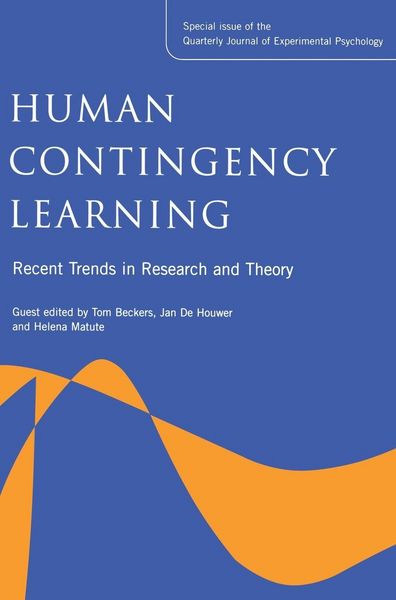
Human Contingency Learning Recent Trends in Research and Theory: A Special Issue of the Quarterly Journal of Experimental Psychology

Fr. 159.00

inkl. gesetzl. MwSt., Versandkostenfrei


Beschreibung

Produktdetails

Einband

Gebundene Ausgabe

Erscheinungsdatum

22.03.2007

Herausgeber

Beckers Tom + weitere

Verlag

Taylor and Francis

Seitenzahl

216

Maße (L/B/H)

25/17.5/1.6 cm

Gewicht

560 g

Sprache

Englisch

ISBN

978-1-84169-824-3

Beschreibung

Produktdetails

Einband

Gebundene Ausgabe

Erscheinungsdatum

22.03.2007

Herausgeber

Verlag

Taylor and Francis

Seitenzahl

216

Maße (L/B/H)

25/17.5/1.6 cm

Gewicht

560 g

Sprache

Englisch

ISBN

978-1-84169-824-3

Herstelleradresse

Libri GmbH
Europaallee 1
36244 Bad Hersfeld
DE

Email: gpsr@libri.de

Kundinnen und Kunden meinen

0 Bewertungen

Informationen zu Bewertungen

Zur Abgabe einer Bewertung ist eine Anmeldung im Konto notwendig. Die Authentizität der Bewertungen wird von uns nicht überprüft. Wir behalten uns vor, Bewertungstexte, die unseren Richtlinien widersprechen, entsprechend zu kürzen oder zu löschen.

Die Bewertungen sind nach Format, Anzahl Sterne und Datum sortiert.

Verfassen Sie die erste Bewertung zu diesem Artikel

Helfen Sie anderen Kund*innen durch Ihre Meinung

Kundinnen und Kunden meinen

0 Bewertungen filtern

  • Produktbild: Human Contingency Learning
  • Produktbild: Human Contingency Learning
  • T. Beckers, J. De Houwer, H. Matute, Editorial: Human Contingency Learning. D. R. Shanks, Associationism and Cognition: Human Contingency Learning at 25. O. Pineño, R. R. Miller, Comparing Associative, Statistical, and Inferential Reasoning Accounts Of Human Contingency Learning. Y. Hagmayer, M. R. Waldmann, Inferences About Unobserved Causes in Human Contingency Learning. S. Vandorpe, J. De Houwer, T. Beckers, Outcome Maximality and Additivity Training Also Influence Cue Competition in Causal Learning When Learning Involves Many Cues and Events. P. L. Cobos, F. J. López, D. Luque, Interference Between Cues of the Same Outcome Depends on the Causal Interpretation of the Events. S. L. Booth, M. J. Buehner, Asymmetries in Cue Competition in Forward and Backward Blocking Designs: Further Evidence for Causal Model Theory. C. J. Mitchell, E. Livesey, P. F. Lovibond, A Dissociation Between Causal Judgement and the Ease With Which a Cause is Categorised With its Effect. J. De Houwer, S. Vandorpe, T. Beckers, Statistical Contingency has a Different Impact on Preparation Judgements Than on Causal Judgements. M. A. Vadillo, H. Matute, Predictions and Causal Estimations are not Supported by the Same Associative Structure. D. M. Karazinov, R. A. Boakes, Second Order Conditioning in Human Predictive Judgements When There is Little Time to Think. R. M. Msetfi, R. A. Murphy, J. Simpson, Depressive Realism and the Effect of Inter-trial-interval on Judgements of Zero, Positive and Negative Contingencies. L. G. Allan, S. Siegel, S. Hannah, The Sad Truth About Depressive Realism.