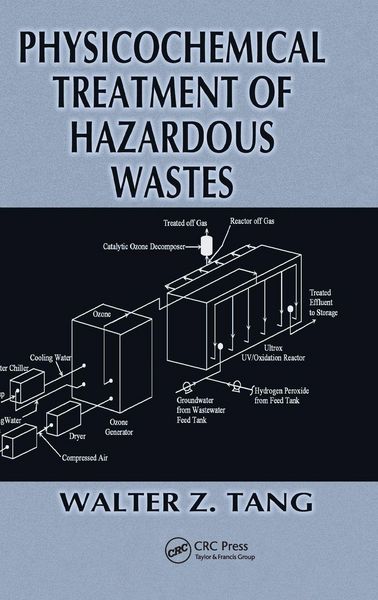
Physicochemical Treatment of Hazardous Wastes
Fr. 363.00
inkl. gesetzl. MwSt.,
Beschreibung
Produktdetails
Einband
Gebundene Ausgabe
Erscheinungsdatum
29.12.2003
Abbildungen
schwarz-weiss Illustrationen
Verlag
Taylor and FrancisSeitenzahl
610
Maße (L/B/H)
24/16.1/3.7 cm
Gewicht
978 g
Sprache
Englisch
ISBN
978-1-56676-927-3
More than 200 QSAR models show that the Energy of the Highest Occupied Molecular Orbital (EHOMO) and the Energy of the Lowest Unoccupied Molecular Orbital (ELUMO) have the excellent predictive capacity for degradation rate constants. The author delineates how to use these models to select treatment processes according to the molecular structure of organic pollutants. He covers how to use the models to predict the treatability of organic pollutants having similar molecular structures within a class by each treatment process in both homogeneous and heterogeneous media. Engineers will find the QSAR models extremely useful in selecting treatment processes. Researchers and scientists will find state-of-the-art research trends in advanced oxidation processes (AOPs). Graduate students will learn how fundamental sciences can guide the search for innovative technologies. These features and more make Physicochemical Treatment of Hazardous Wastes the perfect guide for assessing the treatability of pollutants prior to designing a treatment process and an authoritative reference on AOPs.
Noch keine Bewertungen vorhanden
Verfassen Sie die erste Bewertung zu diesem Artikel
Helfen Sie anderen Kundinnen und Kunden durch Ihre Meinung.