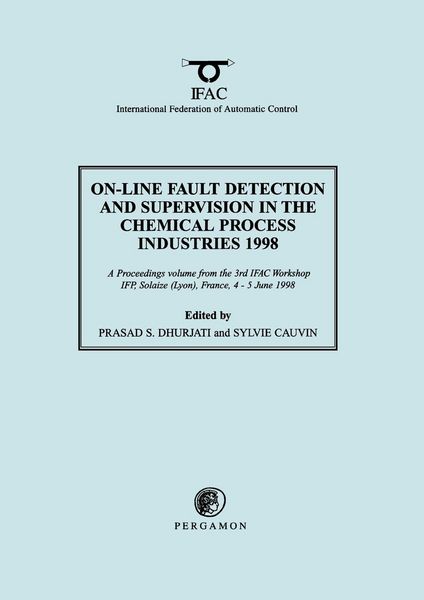
On-Line Fault Detection and Supervision in the Chemical Process Industries 1998 A Proceedings Volume From 3rd Ifac Workshop, Ifp, Solaize Lyon,
-
- Englisch ausgewählt
Fr. 115.00
inkl. gesetzl. MwSt.,
Beschreibung
Produktdetails
Einband
Taschenbuch
Erscheinungsdatum
01.10.1998
Verlag
Elsevier BvSeitenzahl
420
Maße (L/B/H)
29.7/21/2.2 cm
Gewicht
1003 g
Sprache
Englisch
ISBN
978-0-08-043233-5
The field of "On-Line Fault Detection and Supervision in the Chemical Process Industries" is relatively young. Major activity in this area has taken place only in the last fifteen years.The goals of the first workshop in Delaware were to discuss various methodologies necessary for solving industrial problems in fault diagnosis/supervision and to encourage interactions between academia and industry. This workshop also focused on development and evaluation of methodologies for on-line fault detection and supervision in the chemical process industries. It addressed theory, application, validation, performance and evaluation of methodologies such as parameter estimation, observers, parity equations, signal analysis methods, classification, rule-based systems with probabilistic approaches, fuzzy logic and neural networks.
There are several trends that make the topic of this workshop especially relevant in today's world. The first is the tremendous advances made in automation and information technology that can potentially bring in an ever-increasing amount of information on to computer screens in the operating room of a plant. Avoiding problems of information overload and converting plant data to "on-line useful knowledge" is a key challenge. In some respects, one can draw parallels here to biological evolution where, over billions of years, human beings have evolved "mental models" to interpret the huge amount of information received through their senses. In the absence of the time advantage that evolution has had, we have to rely on methodologies such as those presented in this workshop to provide assistance to operators and engineers in interpreting plant information.
A second trend that makes this field relevant in today's world is the increasing emphasis on environment and safety. Community activism and accidents such as those in Bhopal, India have caused media spotlights to be turned on the smallest of toxic releases or loss of life due to chemical accidents. The negative publicity generated by such events as well as the need to maintain the image of an environmentally conscious company make industry more sensitive to the issues of early detection of faults.
The third trend that makes this field very relevant is that of the globalization of the world economy. Increasing globalization of the chemical process industry puts pressure on economic competitiveness and higher productivity. This implies reduced down-time due to faults, quick and flexible response of production to supply and demand changes, increasing reliance on automation and reduced personnel.
Kundinnen und Kunden meinen
Verfassen Sie die erste Bewertung zu diesem Artikel
Helfen Sie anderen Kund*innen durch Ihre Meinung