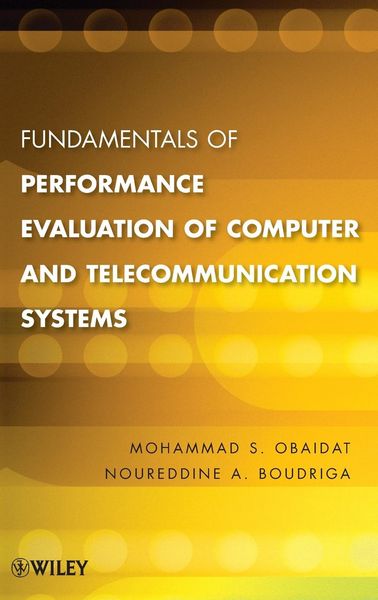
Produktbild: Fundamentals of Performance Evaluation of Computer and Telecommunication Systems

Fundamentals of Performance Evaluation of Computer and Telecommunication Systems Telecommunication System

Fr. 203.00

inkl. gesetzl. MwSt., Versandkostenfrei


Beschreibung

Produktdetails

Einband

Gebundene Ausgabe

Erscheinungsdatum

01.01.2010

Verlag

John Wiley & Sons Inc

Seitenzahl

480

Maße (L/B/H)

24/16.1/3 cm

Gewicht

883 g

Auflage

1. Auflage

Sprache

Englisch

ISBN

978-0-471-26983-0

Beschreibung

Produktdetails

Einband

Gebundene Ausgabe

Erscheinungsdatum

01.01.2010

Verlag

John Wiley & Sons Inc

Seitenzahl

480

Maße (L/B/H)

24/16.1/3 cm

Gewicht

883 g

Auflage

1. Auflage

Sprache

Englisch

ISBN

978-0-471-26983-0

Herstelleradresse

Libri GmbH
Europaallee 1
36244 Bad Hersfeld
DE

Email: gpsr@libri.de

Kundinnen und Kunden meinen

0 Bewertungen

Informationen zu Bewertungen

Zur Abgabe einer Bewertung ist eine Anmeldung im Konto notwendig. Die Authentizität der Bewertungen wird von uns nicht überprüft. Wir behalten uns vor, Bewertungstexte, die unseren Richtlinien widersprechen, entsprechend zu kürzen oder zu löschen.

Die Bewertungen sind nach Format, Anzahl Sterne und Datum sortiert.

Verfassen Sie die erste Bewertung zu diesem Artikel

Helfen Sie anderen Kund*innen durch Ihre Meinung

Kundinnen und Kunden meinen

0 Bewertungen filtern

Die Leseprobe wird geladen.
  • Produktbild: Fundamentals of Performance Evaluation of Computer and Telecommunication Systems
  • 1. Introduction and Basic Concepts.

    1.1. Background.

    1.2. Performance Evaluation Viewpoints and Concepts.

    1.3. Goals of Performance Evaluation.

    1.4. Applications of Performance Evaluation.

    1.5. Techniques.

    1.6. Metrics of Performance.

    1.7. Workload characterization.

    1.8. Benchmarking.

    1.9. Summary.

    Exercises.

    2. Probability Theory Review.

    2.1 Basic Concepts on Probability Theory.

    2.2 Sample Space and Events.

    2.3 Conditional Probability and Independence.

    2.2 Mean and Median use.

    2.3 Geometric, and Harmonic Mean.

    2.4 Variance, and Standard Deviation.

    2.5 Random Variables.

    2.6 Expectation and Variance.

    2.7 Density and Distribution Functions.

    2.8 Comparing Systems Using Sample Data.

    2.9 Regression Models.

    2.10 Summary.

    Exercises.

    3. Measurement/Testing Technique.

    3.1. Event and Measurement Strategies.

    3.2. Event Tracing.

    3.3. Hardware Monitor.

    3.4. Software Monitors.

    3.5. Hybrid Monitors.

    3.6. Traffic Issues and Solutions.

    3.7. Accounting Logs.

    3.8. Summary.

    Exercises.

    4. Benchmarking and Capacity Planning.

    4.1 Types of Benchmark Programs.

    4.2 Common Mistakes in Benchmarking.

    4.3 Example Benchmark Programs.

    4.4 Procedures of Capacity planning.

    4.5 Problems in Capacity Planning.

    4.6 Summary.

    Exercises.

    5. Data Representation and Game Ratio.

    5.1 Guidelines for Preparing Plots.

    5.2 Charts Used for Data Presentation.

    5.3 Program Profiling.

    5.4 Common Mistakes in Charts Construction.

    5.5 Errors in Experimental Measurements.

    5.6 Summary.

    Exercises.

    6. Basics of Queueing Theory.

    6.1 Introduction.

    6.2 Queueing Modeling Notations.

    6.3 Rules for all Queues.

    6.4 Single-Queue, Single (M/M/ 1) System.

    6.5. Single-Queue, Multiple Server (M/M/c) System.

    6.6 Other Queues.

    6.7. Little's Law.

    6.8. Summary.

    Exercises.

    7. Queueing Networks.

    7.1 Definitions.

    7.2 Open Queueing Networks.

    7.3 Closed Queueing Networks.

    7.4 Product-Form Queueing Networks.

    7.5 Case Studies.

    Exercises.

    8. Operational and Mean Value Analysis.

    8.1 Utilization Law.

    8.2 Little's Formula.

    8.3 Forced Flow Law.

    8.4 Interactive Response Time Law.

    8.5 Bottleneck Analysis.

    8.6 Standard Mean Value Analysis (MVA).

    8.7 Scheweitzer's Approximation of MVA.

    8.8 Balanced Job Bounds.

    9. Introduction to the Simulation Technique.

    9.1 Simulation Types.

    9.2 Terminology.

    9.3 Random Number Generation Techniques.

    9.3.1 Linear Congruential Generators.

    9.3.2 Mixed Generators.

    9.3.3 Tausworthe Generators.

    9.3.5 Extended Fibonici Generators.

    9.4 Survey of Commonly Used Random Number Generators.

    9.5 Seed Selections.

    9.6 Testing Random Number Generators.

    9.7 Random Variate Generation Techniques.

    9.7.1 Inverse Transformation.

    9.7.2 Rejection.

    9.7.3 Characterization.

    9.7.4 Convolution.

    9.7.5 Composition.

    9.8 Examples.

    Exercises.

    10. Commonly Used Distributions in Simulation and Their Applications.

    10.1 Exponential.

    10.2 Posisson.

    10.3 Uniform.

    10.5 Normal.

    10.6 Weibull.

    10.7 Pareto.

    10.8 Geometric.

    10.9 Gamma.

    10.10 Erlang.

    10.11 Beta.

    10.12 Binomial.

    10.13 Bernoulli.

    10.14 Chi-Square.

    10.15 F Distribution.

    10.16 Log Normal.

    10.17 Pascal.

    10.18 Student's t Distribution.

    10.19 Examples.

    Exercises.

    11. Analysis of Simulation Outputs.

    11.1 Introduction.

    11.2 Vérification Techniques.

    11.3 Validation techniques.

    11.4 Techniques for Transient Removal.

    11.5 Techniques for Termination of Simulation and Stopping Criteria.

    Exercises.

    12. Simulation Software.

    12.1 General Purpose Languages.

    12.2 Simulation languages.

    12.3 Object-Oriented languages.

    12.3.1 Standard Object-Oriented Languages.

    12.3.2 Objected-oriented Simulation Languages.

    12.4 Simulation Packages Used for Simulation of Computer and Telecommunications Systems.

    12.4 Case Studies.

    Exercises.