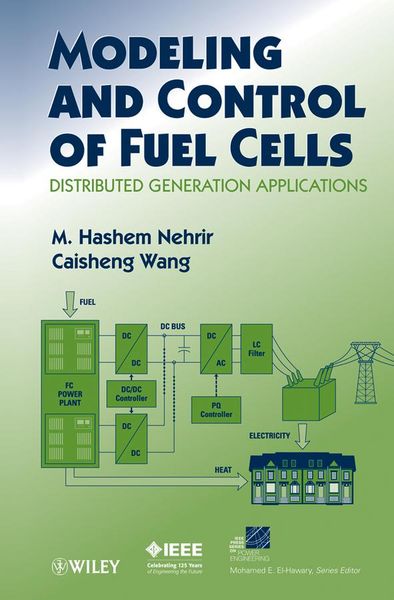
Modeling and Control of Fuel Cells Distributed Generation Applications
Aus der Reihe
IEEE Series on Power Engineering
-
- Englisch ausgewählt
Fr. 189.00
inkl. gesetzl. MwSt.,
Beschreibung
Produktdetails
Einband
Gebundene Ausgabe
Erscheinungsdatum
01.03.2009
Verlag
John Wiley & SonsSeitenzahl
296
Maße (L/B/H)
24.2/16.2/2.2 cm
Gewicht
549 g
Auflage
1. Auflage
Sprache
Englisch
ISBN
978-0-470-23328-3
The only book available on fuel cell modeling and control with distributed power generation applications
The emerging fuel cell (FC) technology is growing rapidly in its applications from small-scale portable electronics to large-scale power generation. This book gives students, engineers, and scientists a solid understanding of the FC dynamic modeling and controller design to adapt FCs to particular applications in distributed power generation.
The book begins with a fascinating introduction to the subject, including a brief history of the U.S. electric utility formation and restructuring. Next, it provides coverage of power deregulation and distributed generation (DG), DG types, fuel cell DGs, and the hydrogen economy. Building on that foundation, it covers:
* Principle operations of fuel cells
* Dynamic modeling and simulation of PEM and solid-oxide fuel cells
* Principle operations and modeling of electrolyzers
* Power electronic interfacing circuits for fuel cell applications
* Control of grid-connected and stand-alone fuel cell power generation systems
* Hybrid fuel cell-based energy system case studies
* Present challenges and the future of fuel cells
MATLAB/SIMULINK-based models and their applications are available via a companion Web site. Modeling and Control of Fuel Cells is an excellent reference book for students and professionals in electrical, chemical, and mechanical engineering and scientists working in the FC area.
The emerging fuel cell (FC) technology is growing rapidly in its applications from small-scale portable electronics to large-scale power generation. This book gives students, engineers, and scientists a solid understanding of the FC dynamic modeling and controller design to adapt FCs to particular applications in distributed power generation.
The book begins with a fascinating introduction to the subject, including a brief history of the U.S. electric utility formation and restructuring. Next, it provides coverage of power deregulation and distributed generation (DG), DG types, fuel cell DGs, and the hydrogen economy. Building on that foundation, it covers:
* Principle operations of fuel cells
* Dynamic modeling and simulation of PEM and solid-oxide fuel cells
* Principle operations and modeling of electrolyzers
* Power electronic interfacing circuits for fuel cell applications
* Control of grid-connected and stand-alone fuel cell power generation systems
* Hybrid fuel cell-based energy system case studies
* Present challenges and the future of fuel cells
MATLAB/SIMULINK-based models and their applications are available via a companion Web site. Modeling and Control of Fuel Cells is an excellent reference book for students and professionals in electrical, chemical, and mechanical engineering and scientists working in the FC area.
Kundinnen und Kunden meinen
Verfassen Sie die erste Bewertung zu diesem Artikel
Helfen Sie anderen Kund*innen durch Ihre Meinung