• Produktbild: A Toolbox for Economic Design
  • Produktbild: A Toolbox for Economic Design

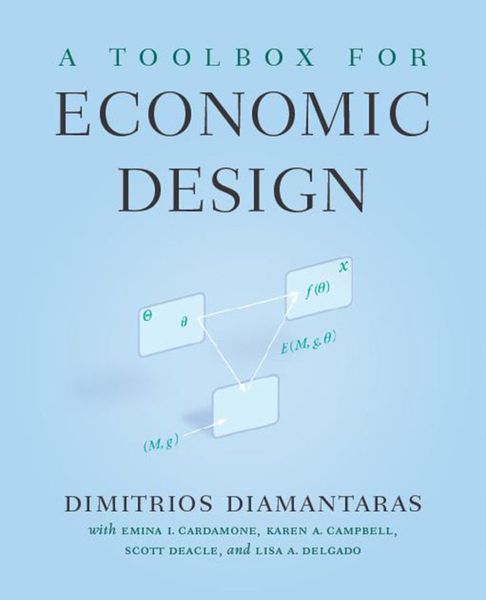
A Toolbox for Economic Design

Fr. 172.00

inkl. gesetzl. MwSt., Versandkostenfrei


Beschreibung

Produktdetails

Einband

Gebundene Ausgabe

Erscheinungsdatum

22.05.2009

Verlag

Palgrave Macmillan US

Seitenzahl

292

Maße (L/B/H)

23.6/19.1/2.3 cm

Gewicht

697 g

Auflage

2009

Sprache

Englisch

ISBN

978-0-230-61060-6

Beschreibung

Rezension

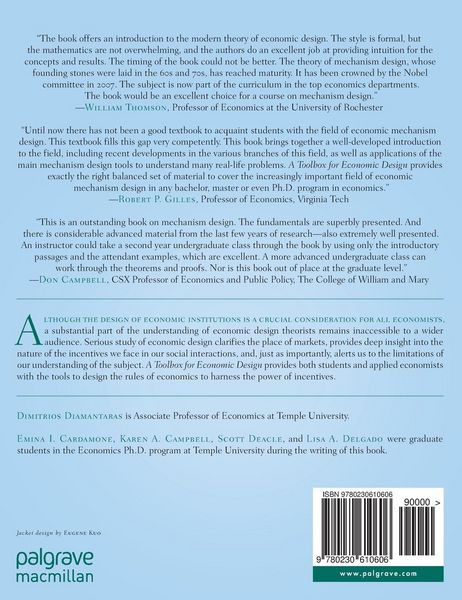
'This is an outstanding book on mechanism design. The fundamentals are superbly presented. And there is considerable advanced material from the last few years of research - also extremely well presented. An instructor could take a second year undergraduate class through the book by using only the introductory passages and the attendant examples, which are excellent. A more advanced undergraduate class can work through the theorems and proofs. Nor is this book out of place at the graduate level.' - Don Campbell, CSX Professor of Economics and Public Policy, The College of William and Mary, USA


'Until now there has not been a good textbook to acquaint students with the field of economic mechanism design. This textbook fills this gap very competently. This book brings together a well-developed introduction to the field, including recent developments in the various branches of this field, as well as applications of the main mechanism design tools to understand many real-life problems. In particular, this text provides tools to understand the proper design of economic policy, which is very welcome in view of the problematic economic policy design for our contemporary complex global economy. A Toolbox for Economic Design provides exactly the right balanced set of material to cover the increasingly important field of economic mechanism design in any bachelor, master or even Ph.D. program in economics.' - Robert P. Gilles, Professor of Economics, Virginia Tech, USA

Produktdetails

Einband

Gebundene Ausgabe

Erscheinungsdatum

22.05.2009

Verlag

Palgrave Macmillan US

Seitenzahl

292

Maße (L/B/H)

23.6/19.1/2.3 cm

Gewicht

697 g

Auflage

2009

Sprache

Englisch

ISBN

978-0-230-61060-6

Herstelleradresse

Libri GmbH
Europaallee 1
36244 Bad Hersfeld
DE

Email: gpsr@libri.de

Kundinnen und Kunden meinen

0 Bewertungen

Informationen zu Bewertungen

Zur Abgabe einer Bewertung ist eine Anmeldung im Konto notwendig. Die Authentizität der Bewertungen wird von uns nicht überprüft. Wir behalten uns vor, Bewertungstexte, die unseren Richtlinien widersprechen, entsprechend zu kürzen oder zu löschen.

Die Bewertungen sind nach Format, Anzahl Sterne und Datum sortiert.

Verfassen Sie die erste Bewertung zu diesem Artikel

Helfen Sie anderen Kund*innen durch Ihre Meinung

Kundinnen und Kunden meinen

0 Bewertungen filtern

  • Produktbild: A Toolbox for Economic Design
  • Produktbild: A Toolbox for Economic Design
  • Contents Introduction 1 A Story from Ancient Athens Institutions and Economics The Big Picture Auction Example A Taste of Social Choice Theory Arrow's Impossibility Theorem Social Choice Functions Economic Domain Exchange Economies Social Choice Correspondences on the Exchange Economy Domain The Pareto Social Choice Correspondence The Individually Rational Social Choice Correspondence The Core Social Choice Correspondence The No-Envy Social Choice Correspondence Combinations of the previous Social Choice Correspondences The Walrasian Social Choice Correspondence Quasilinear Preferences and Their Uses Appendix: Proofs Arrow's Impossibility Theorem Gibbard-Satterthwaite Theorem Exercises Dominant Strategy Implementation Definitions Revelation Principle Restricting Domains: Single-Peaked Preferences Restricted Domains: Quasilinear Domains and Groves Mechanisms Balance Problem Voluntary Participation Problem The Vickrey Auction Exercises Implementation in Nash Equilibria: A Lot of Information Assumed A Quick Lesson on Nash Equilibrium Nash Equilibrium in Mixed Strategies Nash Equilibrium in Implementation Strategy Space Reduction Two Person Cases Exercises 4 Bayesian Equilibrium and Mechanisms Preliminary: How to Represent Information Bayesian Equilibrium The Bayesian Revelation Principle The Mechanism of d'Aspremont and Gérard-Varet and of Arrow Voluntary Participation Optimal Auctions Bilateral Trading Exercises Refined Nash Implementation Implementation in Subgame Perfect Equilibrium Subgame Perfect Implementation in Quasilinear Environments Implementation using Undominated Strategies Double Implementation Definitions Ratio Correspondence Virtual Nash Implementation Applications Manipulation-Resistant Online Reputation Systems Walrasian Implementation via Market Games Implementing the Lindahl Social Choice Correspondence Implementing Fair Allocations Application to Negative Externality Problems: Pollution Abatement A Nearly Efficient Mutual Insurance Mechanism Financing the Athenian Fleet Bayesian Implementation Example of Multiple Bayesian Equilibria Bayesian Implementation and Bayesian Monotonicity Resrictiveness of Bayesian Monotonicity Virtual Bayesian Implementation Further Topics in Mechanism Design Endogenous Mechanisms Notation and Definitions An Application: Public Goods Positive Results for Endogenous Games with 3 or More Players Overcoming Incentive Constraints by Linking Decisions Notation and Definitions Results Robust Mechanism Design Notation and Definitions Results The Limits of Ex Post Implementation Notation and a Result An Illustration of the Geometric Condition Exercises Matching Models: Theory and Applications 203 What is Matching? Definitions and Notation Two-Sided Matching One-to-One Matching Many-to-One Matching One-Sided Matching The Shapley and Scarf House Market House Allocation Problems The Kidney Exchange Problem Exercises Empirical Evidence on Mechanisms Introduction Voluntary Contribution Mechanisms for Public Goods Tests of Incentive Compatibility Research on Mechanism Dynamics Tests of Implementation Concepts Applied Economic Design: Notes from the Field Conclusion A Mathematics Review and More on Economic Domains A.1 Sets, Correspondences, Functions, Intervals A.2 Derivatives and Related Notation Elements of Mathematical Optimization Envelope Theorem The Edgeworth Box Public Good Economies The Simplest Public Project Model Public Goods Models Social Choice Correspondences on Public Good Economy Domains Pareto Social Choice Correspondence Lindahl and Constrained Lindahl Social Choice Correspondences Ratio Social Choice Correspondence Exercises Notation Bibliography Index