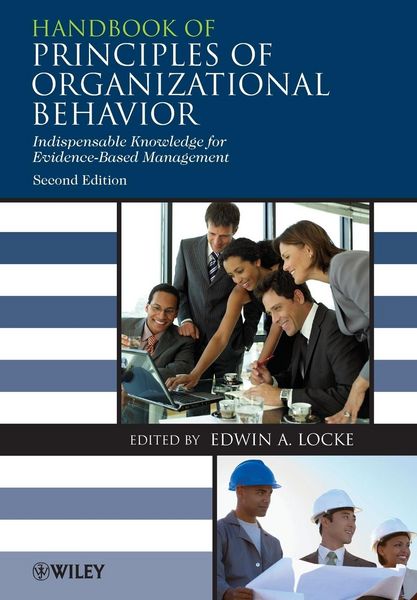
Produktbild: Handbook of Principles of Organizational Behavior

Handbook of Principles of Organizational Behavior Indispensable Knowledge for Evidence-Based Management

Fr. 69.90

inkl. gesetzl. MwSt., Versandkostenfrei


Beschreibung

Produktdetails

Einband

Taschenbuch

Erscheinungsdatum

01.08.2009

Herausgeber

Edwin Locke

Verlag

John Wiley & Sons Inc

Seitenzahl

682

Maße (L/B/H)

24.4/17/3.6 cm

Gewicht

1130 g

Auflage

2. Auflage

Sprache

Englisch

ISBN

978-0-470-74094-1

Beschreibung

Produktdetails

Einband

Taschenbuch

Erscheinungsdatum

01.08.2009

Herausgeber

Edwin Locke

Verlag

John Wiley & Sons Inc

Seitenzahl

682

Maße (L/B/H)

24.4/17/3.6 cm

Gewicht

1130 g

Auflage

2. Auflage

Sprache

Englisch

ISBN

978-0-470-74094-1

Kundinnen und Kunden meinen

0 Bewertungen

Informationen zu Bewertungen

Zur Abgabe einer Bewertung ist eine Anmeldung im Konto notwendig. Die Authentizität der Bewertungen wird von uns nicht überprüft. Wir behalten uns vor, Bewertungstexte, die unseren Richtlinien widersprechen, entsprechend zu kürzen oder zu löschen.

Die Bewertungen sind nach Format, Anzahl Sterne und Datum sortiert.

Verfassen Sie die erste Bewertung zu diesem Artikel

Helfen Sie anderen Kund*innen durch Ihre Meinung

Kundinnen und Kunden meinen

0 Bewertungen filtern

Die Leseprobe wird geladen.
  • Produktbild: Handbook of Principles of Organizational Behavior
  • Contributors and Editor.

    Preface by Denise Rousseau.

    Editor's Introduction.

    PART I SELECTION.

    1 Select on Intelligence (FRANK L. SCHMIDT).

    2 Select on Conscientiousness and Emotional Stability (MURRAY R. BARRICK AND MICHAEL K. MOUNT).

    3 Structure Interviews to Recruit and Hire the Best People (CYNTHIA KAY STEVENS).

    PART II TRAINING AND PERFORMANCE APPRAISAL.

    4 Design Training Systematically and Follow the Science of Training (EDUARDO SALAS AND KEVIN C. STAGL).

    5 Conduct Performance Appraisals to Improve Individual and Firm Performance (MARIA ROTUNDO).

    PART III TURNOVER AND SATISFACTION.

    6 Promote Job Satisfaction through Mental Challenge (TIMOTHY A. JUDGE AND RYAN KLINGER).

    7 Control Voluntary Turnover by Understanding its Causes (MARION B. EBERLY, BROOKS C. HOLTOM, THOMAS W. LEE, AND TERENCE R. MITCHELL).

    PART IV MOTIVATION.

    8 Attain Emotional Control by Understanding What Emotions Are (EDWIN A. LOCKE).

    9 Motivate Employee Performance through Goal Setting (GARY P. LATHAM).

    10 Cultivate Self-effi cacy for Personal and Organizational Effectiveness (ALBERT BANDURA).

    11 Using Empowerment to Motivate People to Engage in Effective Self- and Shared Leadership (JAY A. CONGER AND CRAIG L. PEARCE).

    12 Pay for Performance (CATHY C. DURHAM AND KATHRYN M. BARTOL).

    13 Provide Recognition for Performance Improvement (FRED LUTHANS AND ALEXANDER D. STAJKOVIC).

    14 Promote Procedural and Interactional Justice to Enhance Individual and Organizational Outcomes (JERALD GREENBERG).

    PART V TEAM DYNAMICS.

    15 Foster Team Effectiveness by Fulfi lling Key Leadership Functions (J. RICHARD HACKMAN AND RUTH WAGEMAN).

    16 Compose Teams to Assure Successful Boundary Activity (DEBORAH ANCONA AND DAVID CALDWELL).

    17 Making Group Process Work: Harnessing Collective Intuition, Task Confl ict, and Pacing (GERARDO A. OKHUYSEN AND BETH A. BECHKY).

    18 Manage Intra-team Confl ict through Collaboration (LAURIE R. WEINGART AND KAREN A. JEHN).

    PART VI LEADERSHIP.

    19 Use Power Effectively to Infl uence People (GARY YUKL).

    20 Lead through Vision and Values (SHELLEY A. KIRKPATRICK).

    21 Foster Trust through Ability, Benevolence, and Integrity (JASON A. COLQUITT AND SABRINA C. SALAM).

    PART VII ORGANIZATIONAL PROCESSES.

    22 Design Structure to Fit Strategy (LEX DONALDSON).

    23 Communicate Successfully by Seeking Balance (DEBORAH A. CAI AND EDWARD L. FINK).

    24 Use Participation to Share Information and Distribute Knowledge (JOHN A. WAGNER III).

    25 Broaden the Decision Frame to Make Effective Decisions (RICHARD P. LARRICK).

    26 Stimulate Creativity by Fueling Passion (TERESA M. AMABILE AND COLIN M. FISHER).

    27 Manage Stress at Work through Preventive and Proactive Coping (TABEA REUTER AND RALF SCHWARZER).

    28 Manage Confl ict through Negotiation and Mediation (M. SUSAN TAYLOR AND ASHLEY FIELBIG).

    29 Sustain Organizational Performance through Continuous Learning, Change and Realignment (MICHAEL BEER).

    PART VIII ENTREPRENEURSHIP.

    30 Gain Entrepreneurship Success through Swiftness and Experimentation (J. ROBERT BAUM).

    PART IX WORK, FAMILY, TECHNOLOGY, AND CULTURE.

    31 Achieve Work-Family Balance through Individual and Organizational Strategies (BORIS B. BALTES AND MALISSA A. CLARK).

    32 Use Information Technology for Organizational Change (MARYAM ALAVI AND YOUNGJIN YOO).

    33 Make Management Practice Fit National Cultures and the Global Culture (MIRIAM EREZ).

    Index.