Gutscheinbedingungen

*Gültig bis 21.06.2026 auf (fast) alles. Ausgeschlossen sind Smartboxen, Zeitschriften, Tickets, Lebensmittel, Gaming-Elektroartikel, Tinte/Toner, Gutscheine, Geschenkkarten, Blumen und Abos | Einlösbar in allen Buchhandlungen von Orell Füssli, Barth Bücher, Buchladen Rapunzel, Schuler Orell Füssli, Stauffacher und ZAP unter Vorweisung des Gutscheins, auf www.orellfüssli.ch durch Eingabe des Gutscheincodes. Beim Service „eBooks verschenken“ und bei eBook-Käufen via eReader nicht einlösbar | Mindesteinkaufswert: Fr. 30.- | Nicht mit anderen Rabatten kumulierbar.

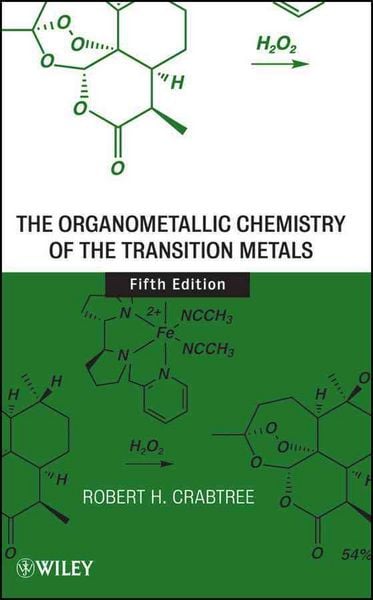
Produktbild: Organometallic Chemistry of the Transition Metals

Organometallic Chemistry of the Transition Metals

Fr. 117.00

inkl. gesetzl. MwSt., Versandkostenfrei


Beschreibung

Produktdetails

Einband

Gebundene Ausgabe

Erscheinungsdatum

April 2009

Verlag

Wiley

Seitenzahl

520

Maße (L/B/H)

2.9/16.2/24.2 cm

Gewicht

810 g

Auflage

5. Auflage

Sprache

Englisch

ISBN

978-0-470-25762-3

Beschreibung

Produktdetails

Einband

Gebundene Ausgabe

Erscheinungsdatum

April 2009

Verlag

Wiley

Seitenzahl

520

Maße (L/B/H)

2.9/16.2/24.2 cm

Gewicht

810 g

Auflage

5. Auflage

Sprache

Englisch

ISBN

978-0-470-25762-3

Kundinnen und Kunden meinen

0 Bewertungen

Informationen zu Bewertungen

Zur Abgabe einer Bewertung ist eine Anmeldung im Konto notwendig. Die Authentizität der Bewertungen wird von uns nicht überprüft. Wir behalten uns vor, Bewertungstexte, die unseren Richtlinien widersprechen, entsprechend zu kürzen oder zu löschen.

Die Bewertungen sind nach Format, Anzahl Sterne und Datum sortiert.

Verfassen Sie die erste Bewertung zu diesem Artikel

Helfen Sie anderen Kund*innen durch Ihre Meinung

Kundinnen und Kunden meinen

0 Bewertungen filtern

Die Leseprobe wird geladen.
  • Produktbild: Organometallic Chemistry of the Transition Metals
  • Acknowledgment.

    Preface.

    List of Abbreviations.

    1. Introduction.

    1.1 Why Study Organometallic Chemistry?

    1.2 Coordination Chemistry.

    1.3 Werner Complexes.

    1.4 The Trans Effect.

    1.5 Soft versus Hard Ligands.

    1.6 The Crystal Field.

    1.7 The Ligand Field.

    1.8 Back Bonding.

    1.9 Electroneutrality.

    1.10 Types of Ligand.

    2. General Properties of Organometallic Complexes.

    2.1 The 18-Electron Rule.

    2.2 Limitations of the 18-Electron Rule.

    2.3 Electron Counting in Reactions.

    2.4 Oxidation State.

    2.5 Coordination Number and Geometry.

    2.6 Effects of Complexation.

    2.7 Differences between Metals.

    2.8 Supramolecular Chemistry.

    3. Metal Alkyls, Aryls, and Hydrides and Related s-Bonded Ligands.

    3.1 Transition Metal Alkyls and Aryls.

    3.2 Related s-Bonded Ligands.

    3.3 Metal Hydride Complexes.

    3.4 ÃComplexes.

    3.5 Bond Strengths for Classical Ã-Bonding Ligands.

    4. Carbonyls, Phosphine Complexes, and Ligand Substitution Reactions.

    4.1 Metal Complexes of CO, RNC, CS, and NO.

    4.2 Phosphines and Related Ligands.

    4.3 Dissociative Substitution.

    4.4 Associative Substitution.

    4.5 Redox Effects, The I Mechanism, and Rearrangements in Substitution.

    4.6 Photochemical Substitution.

    4.7 Steric and Solvent Effects in Substitution.

    5. Complexes of p-Bound Ligands.

    5.1 Alkene and Alkyne Complexes.

    5.2 Allyl Complexes.

    5.3 Diene Complexes.

    5.4 Cyclopentadienyl Complexes.

    5.5 Arenes and Other Alicyclic Ligands.

    5.6 Metalacycles and Isolobal Replacement.

    5.7 Stability of Polyene and Polyenyl Complexes.

    6. Oxidative Addition and Reductive Elimination.

    6.1 Concerted Additions.

    6.2 SN2 Reactions.

    6.3 Radical Mechanisms.

    6.4 Ionic Mechanisms.

    6.5 Reductive Elimination.

    6.6 s-Bond Metathesis.

    6.7 Oxidative Coupling and Reductive Fragmentation.

    7. Insertion and Elimination.

    7.1 Reactions Involving CO.

    7.2 Insertions Involving Alkenes.

    7.3 Other Insertions.

    7.4 a, b, g, and d Elimination.

    8. Nucleophilic and Electrophilic Addition and Abstraction.

    8.1 Nucleophilic Addition to CO.

    8.2 Nucleophilic Addition to Polyene and Polyenyl Ligands.

    8.3 Nucleophilic Abstraction in Hydrides, Alkyls, and Acyls.

    8.4 Electrophilic Addition.

    8.5 Electrophilic Abstraction of Alkyl Groups.

    8.6 Single-Electron Transfer Pathways.

    8.7 Reactions of Organic Free Radicals with Metal Complexes.

    9. Homogeneous Catalysis.

    9.1 Alkene Isomerization.

    9.2 Alkene Hydrogenation.

    9.3 Alkene Hydroformylation.

    9.4 Hydrocyanation of Butadiene.

    9.5 Alkene Hydrosilylation and Hydroboration.

    9.6 Coupling Reactions.

    9.7 Organometallic "Oxidase" Reactions.

    9.8 Surface and Supported Organometallic Catalysis.

    10. Physical Methods in Organometallic Chemistry.

    10.1 Isolation.

    10.2 1H NMR Spectroscopy.

    10.3 13C NMR Spectroscopy.

    10.4 31P NMR Spectroscopy.

    10.5 Dynamic NMR.

    10.6 Spin Saturation Transfer.

    10.7 T1 and the Nuclear Overhauser Effect.

    10.8 Isotopic Perturbation of Resonance.

    10.9 IR Spectroscopy.

    10.10 Crystallography.

    10.11 Other Methods.

    11. Metal-Ligand Multiple Bonds.

    11.1 Carbenes.

    11.2 Carbynes.

    11.3 Bridging Carbenes and Carbynes.

    11.4 N-Heterocyclic Carbenes.

    11.5 Multiple Bonds to Heteroatoms.

    12. Applications of Organometallic Chemistry.

    12.1 Alkene Metathesis.

    12.2 Dimerization, Oligomerization, and Polymerization of Alkenes.

    12.3 Activation of CO and CO2.

    12.4 C-H Activation.

    12.5 Organometallic Materials and Polymers.

    13. Clusters, Nanoparticles, Materials, and Surfaces.

    13.1 Cluster Structures.

    13.2 Structures.

    13.3 The Isolobal Analogy.

    13.4 Nanoparticles.

    13.5 Giant Molecules.

    13.6 Organometallic Materials.

    14. Applications to Organic Synthesis.

    14.1 Catalyzed Carbon-Carbon and Carbon-Heteroatom Bond Formation.

    14.2 Metathesis.

    14.3 Rhodium Carbenes in Cyclopropanation and C-H Insertion.

    14.4 Hydrogenation and Related Reactions.

    14.5 Carbonylation.

    14.6 Oxidation.

    14.7 C?H Activation.

    14.8 Click Chemistry.

    14.9 Noncatalytic Reactions.

    15 Paramagnetic, High-Oxidation-State, and High-Coordination? Number Complexes.

    15.1 Magnetism and Spin States.

    15.2 Polyalkyls.

    15.3 Polyhydrides.

    15.4 Cyclopentadienyl Complexes.

    15.5 f-Block Complexes.

    16. Bioorganometallic Chemistry.

    16.1 Introduction.

    16.2 Coenzyme B12.

    16.3 Nitrogen Fixation.

    16.4 Nickel Enzymes.

    16.5 Biomedical Applications.

    Useful Texts on Allied Topics.

    Major Reaction Types.

    Solutions to Problems.

    Index.