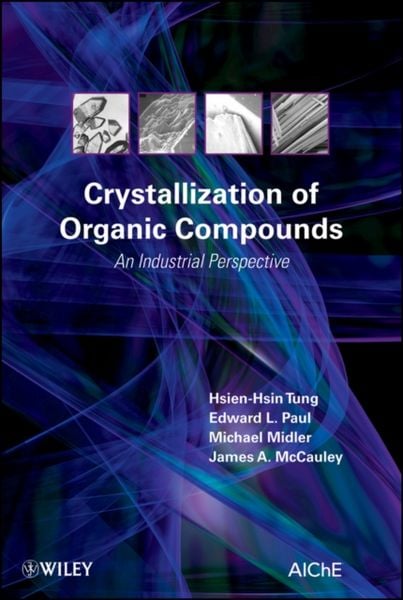
Crystallization of Organic Compounds An Industrial Perspective
-
Sprache:Englisch
-
Verlag:John Wiley & Sons Inc
Fr. 156.00
inkl. gesetzl. MwSt.,
Beschreibung
Produktdetails
Einband
Gebundene Ausgabe
Erscheinungsdatum
01.06.2009
Verlag
John Wiley & Sons IncSeitenzahl
290
Maße (L/B/H)
26/18.4/2.7 cm
Gewicht
683 g
Auflage
1. Auflage
Sprache
Englisch
ISBN
978-0-471-46780-9
Filled with industrial examples emphasizing the practical applications of crystallization methodologies
Based on the authors' hands-on experiences as process engineers at Merck, Crystallization of Organic Compounds guides readers through the practical aspects of crystallization. It uses plenty of case studies and examples of crystallization processes, ranging from development through manufacturing scale-up. The book not only emphasizes strategies that have been proven successful, it also helps readers avoid common pitfalls that can render standard procedures unsuccessful.
The goal of this text is twofold:
* Build a deeper understanding of the fundamental properties of crystallization as well as the impact of these properties on crystallization process development.
* Improve readers' problem-solving abilities by using actual industrial examples with real process constraints.
Crystallization of Organic Compounds begins with detailed discussions of fundamental thermodynamic properties, nucleation and crystal growth kinetics, process dynamics, and scale-up considerations. Next, it investigates modes of operation, including cooling, evaporation, anti-solvent, and reactive crystallization. The authors conclude with special applications such as ultrasound in crystallization and computational fluid dynamics in crystallization. Most chapters feature multiple examples that guide readers step by step through the crystallization of active pharmaceutical ingredients (APIs).
With its focus on industrial applications, this book is recommended for chemical engineers and chemists who are involved with the development, scale-up, or operation of crystallization processes in the pharmaceutical and fine chemical industries.
Based on the authors' hands-on experiences as process engineers at Merck, Crystallization of Organic Compounds guides readers through the practical aspects of crystallization. It uses plenty of case studies and examples of crystallization processes, ranging from development through manufacturing scale-up. The book not only emphasizes strategies that have been proven successful, it also helps readers avoid common pitfalls that can render standard procedures unsuccessful.
The goal of this text is twofold:
* Build a deeper understanding of the fundamental properties of crystallization as well as the impact of these properties on crystallization process development.
* Improve readers' problem-solving abilities by using actual industrial examples with real process constraints.
Crystallization of Organic Compounds begins with detailed discussions of fundamental thermodynamic properties, nucleation and crystal growth kinetics, process dynamics, and scale-up considerations. Next, it investigates modes of operation, including cooling, evaporation, anti-solvent, and reactive crystallization. The authors conclude with special applications such as ultrasound in crystallization and computational fluid dynamics in crystallization. Most chapters feature multiple examples that guide readers step by step through the crystallization of active pharmaceutical ingredients (APIs).
With its focus on industrial applications, this book is recommended for chemical engineers and chemists who are involved with the development, scale-up, or operation of crystallization processes in the pharmaceutical and fine chemical industries.
Kundinnen und Kunden meinen
Verfassen Sie die erste Bewertung zu diesem Artikel
Helfen Sie anderen Kund*innen durch Ihre Meinung