Band 1
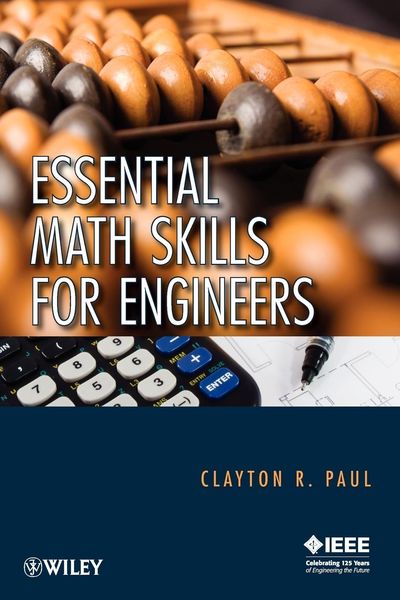
Essential Math Skills for Engineers
Aus der Reihe
IEEE Press
-
- Taschenbuch ausgewählt
- eBook
-
Sprache:Englisch
Fr. 89.90
inkl. gesetzl. MwSt.,
Beschreibung
Produktdetails
Einband
Taschenbuch
Erscheinungsdatum
03.03.2009
Verlag
John Wiley & Sons IncSeitenzahl
248
Maße (L/B/H)
23.4/15.6/1.4 cm
Gewicht
358 g
Auflage
1. Auflage
Sprache
Englisch
ISBN
978-0-470-40502-4
Just the math skills you need to excel in the study or practice of engineering
Good math skills are indispensable for all engineers regardless of their specialty, yet only a relatively small portion of the math that engineering students study in college mathematics courses is used on a frequent basis in the study or practice of engineering. That's why Essential Math Skills for Engineers focuses on only these few critically essential math skills that students need in order to advance in their engineering studies and excel in engineering practice.
Essential Math Skills for Engineers features concise, easy-to-follow explanations that quickly bring readers up to speed on all the essential core math skills used in the daily study and practice of engineering. These fundamental and essential skills are logically grouped into categories that make them easy to learn while also promoting their long-term retention. Among the key areas covered are:
* Algebra, geometry, trigonometry, complex arithmetic, and differential and integral calculus
* Simultaneous, linear, algebraic equations
* Linear, constant-coefficient, ordinary differential equations
* Linear, constant-coefficient, difference equations
* Linear, constant-coefficient, partial differential equations
* Fourier series and Fourier transform
* Laplace transform
* Mathematics of vectors
With the thorough understanding of essential math skills gained from this text, readers will have mastered a key component of the knowledge needed to become successful students of engineering. In addition, this text is highly recommended for practicing engineers who want to refresh their math skills in order to tackle problems in engineering with confidence.
Good math skills are indispensable for all engineers regardless of their specialty, yet only a relatively small portion of the math that engineering students study in college mathematics courses is used on a frequent basis in the study or practice of engineering. That's why Essential Math Skills for Engineers focuses on only these few critically essential math skills that students need in order to advance in their engineering studies and excel in engineering practice.
Essential Math Skills for Engineers features concise, easy-to-follow explanations that quickly bring readers up to speed on all the essential core math skills used in the daily study and practice of engineering. These fundamental and essential skills are logically grouped into categories that make them easy to learn while also promoting their long-term retention. Among the key areas covered are:
* Algebra, geometry, trigonometry, complex arithmetic, and differential and integral calculus
* Simultaneous, linear, algebraic equations
* Linear, constant-coefficient, ordinary differential equations
* Linear, constant-coefficient, difference equations
* Linear, constant-coefficient, partial differential equations
* Fourier series and Fourier transform
* Laplace transform
* Mathematics of vectors
With the thorough understanding of essential math skills gained from this text, readers will have mastered a key component of the knowledge needed to become successful students of engineering. In addition, this text is highly recommended for practicing engineers who want to refresh their math skills in order to tackle problems in engineering with confidence.
Kundinnen und Kunden meinen
Verfassen Sie die erste Bewertung zu diesem Artikel
Helfen Sie anderen Kund*innen durch Ihre Meinung