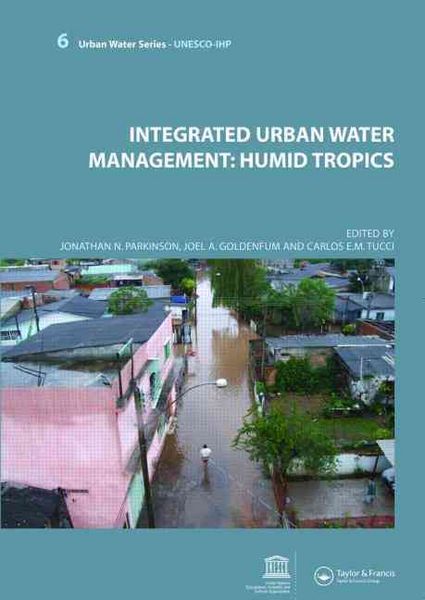
Produktbild: Parkinson, J: Integrated Urban Water Management: Humid Tropi

Parkinson, J: Integrated Urban Water Management: Humid Tropi UNESCO-IHP

Fr. 179.00

inkl. gesetzl. MwSt., Versandkostenfrei


Beschreibung

Produktdetails

Einband

Gebundene Ausgabe

Erscheinungsdatum

26.03.2010

Herausgeber

Parkinson Jonathan N. + weitere

Verlag

Taylor & Francis

Seitenzahl

180

Maße (L/B)

24.6/17.4 cm

Gewicht

534 g

Sprache

Englisch

ISBN

978-0-415-45352-3

Beschreibung

Produktdetails

Einband

Gebundene Ausgabe

Erscheinungsdatum

26.03.2010

Herausgeber

Verlag

Taylor & Francis

Seitenzahl

180

Maße (L/B)

24.6/17.4 cm

Gewicht

534 g

Sprache

Englisch

ISBN

978-0-415-45352-3

Kundinnen und Kunden meinen

0 Bewertungen

Informationen zu Bewertungen

Zur Abgabe einer Bewertung ist eine Anmeldung im Konto notwendig. Die Authentizität der Bewertungen wird von uns nicht überprüft. Wir behalten uns vor, Bewertungstexte, die unseren Richtlinien widersprechen, entsprechend zu kürzen oder zu löschen.

Die Bewertungen sind nach Format, Anzahl Sterne und Datum sortiert.

Verfassen Sie die erste Bewertung zu diesem Artikel

Helfen Sie anderen Kund*innen durch Ihre Meinung

Kundinnen und Kunden meinen

0 Bewertungen filtern

  • Produktbild: Parkinson, J: Integrated Urban Water Management: Humid Tropi
  • 1. Integrated urban water management in the humid tropics - Carlos E.M. Tucci *1.1. Urban development in humid tropics *1.2. The tropics *1.3. Water supply and sanitation *1.4. Urban drainage and floodplains *1.5. Total solids *1.6. Water quality *1.7. Water-related diseases *1.8. Urban water main issues *1.9. Integrated urban waters management (IUWM) 2. Water supply and wastewater management in the humid tropics - Antonio D. Benetti and Luiza Cintra Campos *2.1. Overview *2.2. Water supply interactions in humid tropics *2.3. Wastewater collection, treatment and reuse *2.3.1 Off-site systems *2.3.2 On-site systems *2.3.3 Water reuse *2.4. Industrial wastewater collection, treatment and reuse 3. Stormwater management in the humid tropics - Joel A. Goldenfum, Carlos E.M. Tucci and Andre L.L. da Silveira *3.1. Stormwater management principles *3.2. Climatic factors in the humid tropics *3.3. Socio-economic factors in the humid tropics *3.4. Urban drainage structural control measures *3.4.1 Storage type devices *3.4.2 Infiltration type devices *3.4.3 Floodplain and channel management *3.5. Institutional aspects *3.6. Urban drainage master plans *3.7. Participative master plans in Brazil *3.8. Conclusions 4. Total solids management - Carlos E.M. Tucci, Marllus G.F.P Neves, Jonathan N. Parkinson, Joel A. Goldenfum *4.1. Urban total solids *4.2. Socio-economic and institutional factors affecting solids in drainage systems in the humid tropics *4.3. Origins and characteristics of solid wastes *4.4. Urban sediments *4.5. Solid waste *4.5.1 Solids production and collecting *4.5.2 Classification of drainage solids *4.5.3 Factors affecting solid wastes in drains *4.6. Impacts of solids on operational performance *4.6.1 Hydraulic impacts *4.6.2 Environmental impacts of urban runoff *4.7. Solids management *4.7.1 Sediments yield *4.7.2 Domestic solid waste production *4.7.3 Engineering solutions for control of solid wastes in drains *4.7.4 Drain cleaning *4.7.5 Improved solid waste collection and disposal *4.8 Conclusions 5. Control of public health hazards in the humid tropics - Jonathan N. Parkinson and Luiza C. Campos *5.1. Introduction *5.2. Health risks associated with microbiological and chemical pollutants *5.2.1 Waterborne diseases *5.2.2 Diseases transmitted by mosquitoes *5.2.3 Diseases transmitted by animals *5.2.4 Chemicals and micro-pollutants *5.3. Transmission pathways in urban water systems *5.3.1 Contamination of water sources *5.3.2 Contamination of water distribution systems *5.3.3 Contamination of water in the domestic environment *5.3.4 Transmission pathways related to drainage *5.3.5 Wastewater disposal and reuse *5.4. Strategies for protecting urban water systems from contamination *5.4.1 Protection of water sources *5.4.2 Protection of water distribution systems *5.4.3 Sanitation and excreta management *5.4.4 In-home water storage and domestic hygiene *5.4.5 Drainage *5.4.6 Wastewater treatment *5.5. Monitoring the health benefits of urban water systems *5.5.1 Conventional approaches towards water quality monitoring *5.5.2 Limitations of conventional approaches *5.5.3 Alternative approaches for monitoring of water systems 6. Reducing vulnerability to disasters in urban areas of humid tropics -Eduardo Mario Mendiondo *6.1. Introduction *6.1.1 Urbanizations, hazards and disasters *6.1.2 Needs for lessons to be learnt *6.2. Storms, floods and cyclones *6.3. Water shortage and droughts *6.4. Landslides and mudslides *6.5. Tsunamis *6.6. Human-related hazards *6.7. Early warning and preparedness *6.7.1 Addressing the audience *6.7.2 Challenging issues *6.8. Human resources *6.9. Cases of risk assessment and management *6.9.1 Risk assessment *6.9.2 Risk management *6.9.3 Strengths and limitations: a short example *6.10. Conclusions 7. Integrated urban water management: institutional, legal and socio-economic issues - Arlindo Philippi Jr, Giuliano Marcon, Luis Eduardo Gregolin Grisotto, Tadeu Fabricio Malheiros *7.1. Bases for the formulation of urban water management policies *7.2. Environmental and water resource management in the urban environment *7.2.1 Main progresses and situation in the humid tropics *7.2.2 Actions and initiatives in Latin America and the Caribbean *7.2.3 Proposals and actions developed in Brazil *7.3. Urban water management in the humid tropics: a new paradigm 8. Education and capacity building - Jose Ochoa Iturbe *8.1. Introduction *8.2. Assessment of needs *8.3. Formal education *8.4. Target groups for training or briefing *8.5. Methods, tools, platforms (UWETT contributions to and accessibility) and dissemination *8.6. Case studies *8.7. Human resources *8.8. Role of the regional centres *8.9. Links with academic institutions for development of tools *8.10. Conclusion