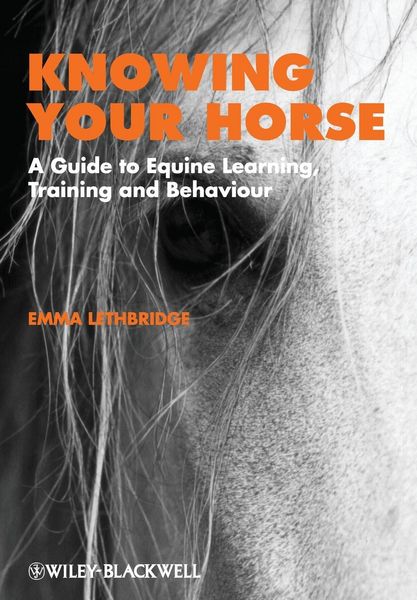
Produktbild: Knowing Your Horse

Knowing Your Horse A Guide to Equine Learning, Training and Behaviour

Fr. 73.90

inkl. gesetzl. MwSt., Versandkostenfrei


Beschreibung

Produktdetails

Einband

Taschenbuch

Erscheinungsdatum

01.06.2009

Verlag

John Wiley & Sons Inc

Seitenzahl

208

Maße (L/B/H)

24.4/17/1.1 cm

Gewicht

472 g

Auflage

1. Auflage

Sprache

Englisch

ISBN

978-1-4051-9164-7

Beschreibung

Rezension

This book is for owners who not only care about their horse, but also are willing to make a little effort to discover the true potential of their relationship. I can assure you your efforts will be more than rewarded. This book blends good science effortlessly with practice, so that the reader can soon become a more skilled trainer... If you understand the principles, then you are only limited by your imagination, and as you discover the many joys of training you will inevitably develop a deeper appreciation of horses... Emma is a passionate horse lover who genuinely takes the welfare of horses to heart, and she is also a scientist who understands both the theory and practice of learning and training. Perhaps what is less obvious is how rare it is to find this combination of characteristics in an individual who can write so clearly. She has brought together a wealth of knowledge with some of the latest research findings, to create an easy to read text.
Professor Daniel S. Mills, RCVS Recognised & European Specialist in Veterinary Behavioural Medicine, University of Lincoln, UK
 
Instead of punishing what many perceive to be the horse 'misbehaving', often it is the horse trying to communicate that he is in pain, or is being blocked by the rider. Far from being able to carry out the rider's wishes, it may be impossible for the horse to do so, but because, unlike a dog, he cannot cry out, he is punished for merely trying to communicate his pain or fear. It therefore behoves us to understand how the horse learns, and how his mind works. Scientific in thinking, Knowing Your Horse is nonetheless very readable. This book should be on the bookshelves of all who ride or train horses.
Heather Moffett, classical dressage trainer and founder of Enlightened Equitation, Devon UK

Produktdetails

Einband

Taschenbuch

Erscheinungsdatum

01.06.2009

Verlag

John Wiley & Sons Inc

Seitenzahl

208

Maße (L/B/H)

24.4/17/1.1 cm

Gewicht

472 g

Auflage

1. Auflage

Sprache

Englisch

ISBN

978-1-4051-9164-7

Kundinnen und Kunden meinen

0 Bewertungen

Informationen zu Bewertungen

Zur Abgabe einer Bewertung ist eine Anmeldung im Konto notwendig. Die Authentizität der Bewertungen wird von uns nicht überprüft. Wir behalten uns vor, Bewertungstexte, die unseren Richtlinien widersprechen, entsprechend zu kürzen oder zu löschen.

Die Bewertungen sind nach Format, Anzahl Sterne und Datum sortiert.

Verfassen Sie die erste Bewertung zu diesem Artikel

Helfen Sie anderen Kund*innen durch Ihre Meinung

Kundinnen und Kunden meinen

0 Bewertungen filtern

  • Produktbild: Knowing Your Horse
  • Foreword

    Dedication

    Acknowledgements

    Introduction

    Chapter 1 The Principles of Good Horse Training

    Ten Basic Principles of Good Horsemanship

    Learning recap

    Chapter 2 Does Classical Conditioning Ring a Bell?

    Different Stimuli and Response Terms

    Training Task: How to Classically Condition Your Horse

    Specific Training Situations

    Learning recap

    My training log

    Chapter 3 Living With the Consequences

    Operant Conditioning

    Applying Simple Operant Conditioning

    Training Task: 'Don't Mug Me' Training

    Learning recap

    My training log

    Chapter 4 All Possible Consequences

    Defining Positive and Negative Consequences

    Reinforcement

    Punishment

    Which Consequence?

    Learning recap

    Chapter 5 Other Laws and Factors in Learning

    The Final Law - Extinction

    Understanding Generalisation and Discrimination Learning in Training

    Learning recap

    Chapter 6 The Power of Positive Reinforcement

    What Can Be a Positive Reinforcer?

    Which Reinforcer Should I Use?

    When to Reward

    Training Using Positive Reinforcement

    Learning recap

    Training Task: Using Positive Reinforcement to Teach the Back, the Heel, the Stay, the Recall and the Yield

    Training Task: Teaching the Head Down and Placement using the Target Lure

    My training log

    Chapter 7 The Sound of Learning - Clicker Training

    What is Clicker Training?

    The Training Game

    Target Training

    The Secrets of Clicker Success

    Learning recap

    Training Task: Using Clicker Training

    My training log

    Chapter 8 Negative Reinforcement - Reinforcement Through Escape

    Pressure-Release Training

    The Important Factors for Applying Negative Reinforcement Ethically

    When Not to Use Negative Conditioning

    Avoidance Learning

    Is Every Physical Contact with the Horse Negative Reinforcement?

    Combining Positive and Negative Reinforcement

    Adding Cues and Commands

    Learning recap

    Training Task: Using Negative Reinforcement Through Pressure-Release

    My training log

    Chapter 9 Understanding Punishment

    The Side Effects and Problems of Punishment

    Applying Punishment (Minimising the Side Effects)

    Is it Possible to Train a Horse Without the Use of Punishment?

    Learning recap

    Chapter 10 How to Deal with Unwanted Behaviours Without Using Punishment

    The Simplest and Hardest Option - Ignoring the Horse

    Counter Conditioning

    Driven to Distraction

    A Final Note

    Learning recap

    Case Studies: Alternative Ways to Correct Unwanted Behaviour

    My training log

    Chapter 11 Step by Step

    Shaping

    Chaining

    Applying Shaping

    Training Task: Shaping

    Training Task: More Complicated Shaping - Teaching the Spanish Walk

    Applying Chaining

    Conclusion

    Learning recap

    My training log

    Chapter 12 Overcoming Fears and Phobias

    Prevention Is Better Than Cure

    Overcoming Established Fears and Phobias

    Habituation

    Flooding

    Systematic Desensitisation

    Counter Conditioning

    Combining Systematic Desensitisation and Counter Conditioning

    Learning recap

    Case Studies: Helping Horses Overcome Their Fears

    My training log

    Chapter 13 Learning with Character

    Does the Sex of the Horse Affect Learning Ability?

    The Effect of Age on Learning Ability

    Does Social Status Affect Learning?

    Nature Verses Nurture

    Learning recap

    References and Furthern Reading.

    Index