• Produktbild: Evolutionary Computation 1
  • Produktbild: Evolutionary Computation 1

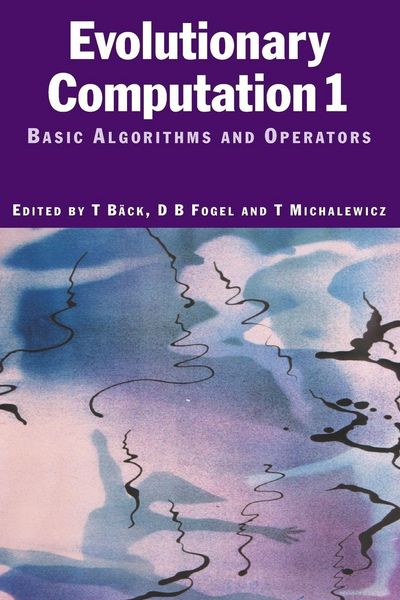
Evolutionary Computation 1 Basic Algorithms and Operators

Fr. 149.00

inkl. gesetzl. MwSt., Versandkostenfrei


Beschreibung

Produktdetails

Einband

Taschenbuch

Erscheinungsdatum

01.01.2000

Herausgeber

Baeck Thomas + weitere

Verlag

Taylor & Francis

Seitenzahl

378

Maße (L/B/H)

23.4/15.6/2 cm

Gewicht

700 g

Sprache

Englisch

ISBN

978-0-7503-0664-5

Beschreibung

Produktdetails

Einband

Taschenbuch

Erscheinungsdatum

01.01.2000

Herausgeber

Verlag

Taylor & Francis

Seitenzahl

378

Maße (L/B/H)

23.4/15.6/2 cm

Gewicht

700 g

Sprache

Englisch

ISBN

978-0-7503-0664-5

Kundinnen und Kunden meinen

0 Bewertungen

Informationen zu Bewertungen

Zur Abgabe einer Bewertung ist eine Anmeldung im Konto notwendig. Die Authentizität der Bewertungen wird von uns nicht überprüft. Wir behalten uns vor, Bewertungstexte, die unseren Richtlinien widersprechen, entsprechend zu kürzen oder zu löschen.

Die Bewertungen sind nach Format, Anzahl Sterne und Datum sortiert.

Verfassen Sie die erste Bewertung zu diesem Artikel

Helfen Sie anderen Kund*innen durch Ihre Meinung

Kundinnen und Kunden meinen

0 Bewertungen filtern

Die Leseprobe wird geladen.
  • Produktbild: Evolutionary Computation 1
  • Produktbild: Evolutionary Computation 1
  • PART 1 WHY EVOLUTIONARY COMPUTATION? 1. Introduction to evolutionary computation. 2. Possible applications of evolutationary computation. 3. Advantages (and disadvantages) of evolutionary computation over other approaches. PART 2. EVOLUTIONARY COMPUTATION: THE BACKGROUND. 4. Principles of evolutionary processes. 5. Principles of genetics. 6. A history of evolutionary computation. PART 3 EVOLUTIONARY ALGORITHMS AND THEIR STANDARD INSTANCES. 7. Introduction to evolutionary algorithms. 8. Genetic algorithms. 9. Evolution strategies. 10. Evolutionary programming. 11. Derivative methods in genetic programming. 12. Learning classifier systems. 13. Hybrid methods. PART 4. REPRESENTATIONS. 14. Introduction to representations. 15. Binary strings. 16. Real-valued vectors. 17. Permutations. 18. Finite-state representations. 19. Parse trees. 20. Guidelines for a suitable encoding. 21. Other representations. PART 5. SELECTION. 22. Introduction to selection. 23. Proportionary selection and sampling algorithms. 24. Tournament selection. 25. Rank-based selection. 26. Boltzmann selection. 27. Other selection methods. 28. Generation gap methods. 29. A comparison of selection mechanisms. 30. Interactive evolution. PART 6. SEARCH OPERATORS. 31. Introduction to search operators. 32. Mutation operators. 33. Recombination. 34. Other operators. Index.