
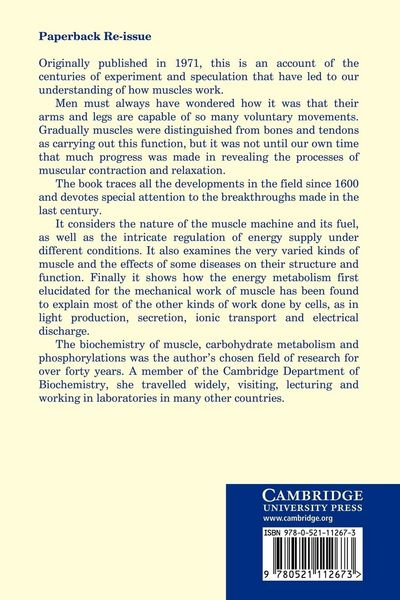
• Produktbild: Machina Carnis
  • Produktbild: Machina Carnis

Machina Carnis The Biochemistry of Muscular Contraction in Its Historical Development

Fr. 92.90

inkl. gesetzl. MwSt., Versandkostenfrei


Beschreibung

Produktdetails

Einband

Taschenbuch

Erscheinungsdatum

31.01.2009

Verlag

Cambridge Academic

Seitenzahl

820

Maße (L/B/H)

22.9/15.2/4.4 cm

Gewicht

1900 g

Sprache

Englisch

ISBN

978-0-521-11267-3

Beschreibung

Produktdetails

Einband

Taschenbuch

Erscheinungsdatum

31.01.2009

Verlag

Cambridge Academic

Seitenzahl

820

Maße (L/B/H)

22.9/15.2/4.4 cm

Gewicht

1900 g

Sprache

Englisch

ISBN

978-0-521-11267-3

Herstelleradresse

Libri GmbH
Europaallee 1
36244 Bad Hersfeld
DE

Email: gpsr@libri.de

Kundinnen und Kunden meinen

0 Bewertungen

Informationen zu Bewertungen

Zur Abgabe einer Bewertung ist eine Anmeldung im Konto notwendig. Die Authentizität der Bewertungen wird von uns nicht überprüft. Wir behalten uns vor, Bewertungstexte, die unseren Richtlinien widersprechen, entsprechend zu kürzen oder zu löschen.

Die Bewertungen sind nach Format, Anzahl Sterne und Datum sortiert.

Verfassen Sie die erste Bewertung zu diesem Artikel

Helfen Sie anderen Kund*innen durch Ihre Meinung

Kundinnen und Kunden meinen

0 Bewertungen filtern

  • Produktbild: Machina Carnis
  • Produktbild: Machina Carnis
  • Preface; 1. Bringing muscles into focus: the first two millennia; 2. Muscle metabolism after the Chemical Revolution; 3. the relationship between mechanical events, heat production and metabolism; 4. The influence of brewing science on the study of muscle glycolysis; 5. The discovery of phosphagen and adenosinetriphosphate; 6. Adenosinetriphosphate as fuel and as phosphate-carrier; 7. Early studies of msucle structure and theories of contraction; 8. Interaction of actomyosin and ATP; 9. Some theories of contraction mechanism; 10. On myosin, actin and tropomyoson; 11. The sliding mechanism; 12. How does the sliding mechanism work?; 13. Excitation, excitation-contraction coupling and relaxation; 14. Happenings in intact muscle; 15. Rigor and the chemical; changes responsible for its onset; 16. Respiration; 17. Oxidative phosphorylation; 18. The regulation of carbohydrate metabolism for energy supply to the muscle machine; 19. A comparative study of the striated muscle of vertebrates; 20. Enzymic and other effects of denervation, cross-innervation and repeated stimulation; 21. some aspects of muscle disease; 22. Contraction in muscles of invertebrates; 23. Vertebrate smooth muscle; 24. Energy provision and contactile proteins in non-muscular functions; References.