Gutscheinbedingungen

*Gültig bis 21.06.2026 auf (fast) alles. Ausgeschlossen sind Smartboxen, Zeitschriften, Tickets, Lebensmittel, Gaming-Elektroartikel, Tinte/Toner, Gutscheine, Geschenkkarten, Blumen und Abos | Einlösbar in allen Buchhandlungen von Orell Füssli, Barth Bücher, Buchladen Rapunzel, Schuler Orell Füssli, Stauffacher und ZAP unter Vorweisung des Gutscheins, auf www.orellfüssli.ch durch Eingabe des Gutscheincodes. Beim Service „eBooks verschenken“ und bei eBook-Käufen via eReader nicht einlösbar | Mindesteinkaufswert: Fr. 30.- | Nicht mit anderen Rabatten kumulierbar.

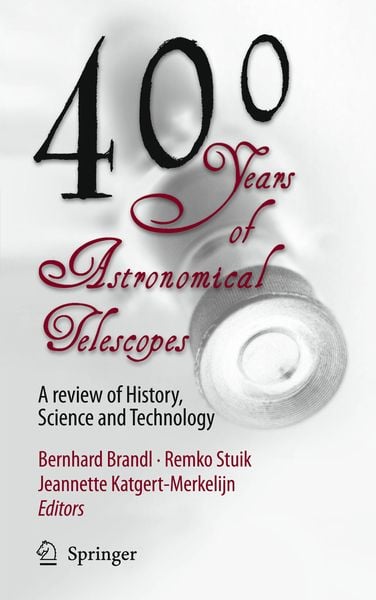
  • Produktbild: 400 Years of Astronomical Telescopes
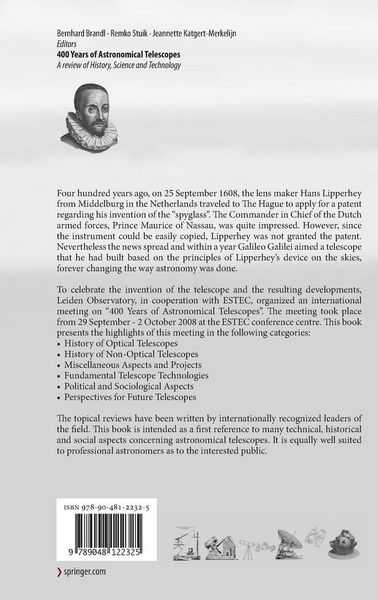
  • Produktbild: 400 Years of Astronomical Telescopes

400 Years of Astronomical Telescopes A Review of History, Science and Technology

Fr. 196.00

inkl. gesetzl. MwSt., Versandkostenfrei


Beschreibung

Produktdetails

Einband

Gebundene Ausgabe

Erscheinungsdatum

03.11.2009

Herausgeber

Bernhard R. Brandl + weitere

Verlag

Springer Netherland

Seitenzahl

535

Maße (L/B/H)

24.1/16/3.9 cm

Gewicht

1050 g

Auflage

2010

Sprache

Englisch

ISBN

978-90-481-2232-5

Beschreibung

Rezension

From the reviews:

“This wonderful book, with experts describing telescopes and related astronomical facilities from before Galileo into the twenty-first century, will stand the test of time. … 400 years of astronomical telescopes is a volume worth reading, having, and keeping.” (Jay M. Pasachoff, Journal for the History of Astronomy, Vol. 45, 2014)

Produktdetails

Einband

Gebundene Ausgabe

Erscheinungsdatum

03.11.2009

Herausgeber

Verlag

Springer Netherland

Seitenzahl

535

Maße (L/B/H)

24.1/16/3.9 cm

Gewicht

1050 g

Auflage

2010

Sprache

Englisch

ISBN

978-90-481-2232-5

Herstelleradresse

Springer-Verlag KG
Sachsenplatz 4-6
1201 Wien
AT

Email: ProductSafety@springernature.com

Kundinnen und Kunden meinen

0 Bewertungen

Informationen zu Bewertungen

Zur Abgabe einer Bewertung ist eine Anmeldung im Konto notwendig. Die Authentizität der Bewertungen wird von uns nicht überprüft. Wir behalten uns vor, Bewertungstexte, die unseren Richtlinien widersprechen, entsprechend zu kürzen oder zu löschen.

Die Bewertungen sind nach Format, Anzahl Sterne und Datum sortiert.

Verfassen Sie die erste Bewertung zu diesem Artikel

Helfen Sie anderen Kund*innen durch Ihre Meinung

Kundinnen und Kunden meinen

0 Bewertungen filtern

  • Produktbild: 400 Years of Astronomical Telescopes
  • Produktbild: 400 Years of Astronomical Telescopes
  • The beginnings, from Lipperhey to Huygens and Cassini.- Galileo’s telescope: history, scientific analysis, and replicated observations.- The Era of Newton, Herschel and Lord Rosse.- The great nineteenth century refractors.- In the grip of the big telescope age.- “Beautiful and cantankerous instruments”: telescopes, technology, and astronomy’s changing practice.- Astronomical spectroscopy in the last four decades: survival of the fittest.- The history of radio telescopes, 1945–1990.- History of infrared telescopes and astronomy.- History of X-ray telescopes and astronomy.- History of gamma-ray telescopes and astronomy.- Imaging very high energy gamma-ray telescopes.- History of solar telescopes.- History of neutrino telescope/astronomy.- 400 years of astrometry: from Tycho Brahe to Hipparcos.- History of astronomical discoveries.- Capabilities of amateur telescopes - and their development over the last 35 years.- Creation of the Hubble Space Telescope.- History of mirror casting, figuring, segmentation and active optics.- Telescope mounts and dome structures.- Adaptive optics: a breakthrough in astronomy.- The development of astronomical interferometry.- The submillimetre revolution.- Historical footnote to Ian Robson’s talk at the Leiden observatory conference—400 Years of Astronomical Telescopes—entitled “The Rise of the Submillimetre” on Wednesday 1 October 2008.- Back to the future: science and technology directions for radio telescopes of the twenty-first century.- Realization of X-ray telescopes–from design to performance.- Gamma-ray telescopes.- Past and future of ESO.- The role of observatories in underdeveloped countries.- Telescopes in the mirror of scientometrics.- Early history space astronomy.- Conceiving and marketing NASA’s Great Observatories.- Future technologies for optical and infrared telescopes and instruments.- Perspectives and challenges for future telescopes.