• Produktbild: Visual Dysfunction in Diabetes
  • Produktbild: Visual Dysfunction in Diabetes

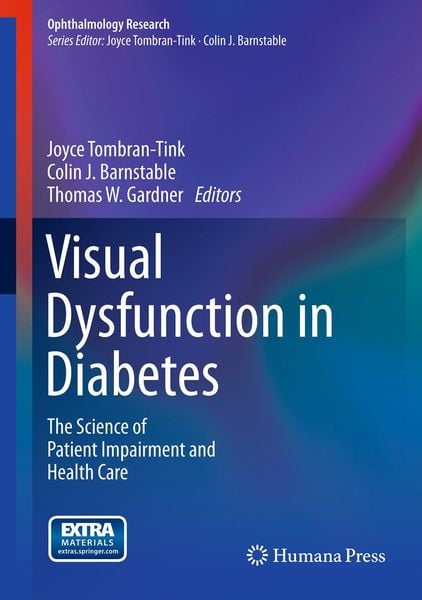
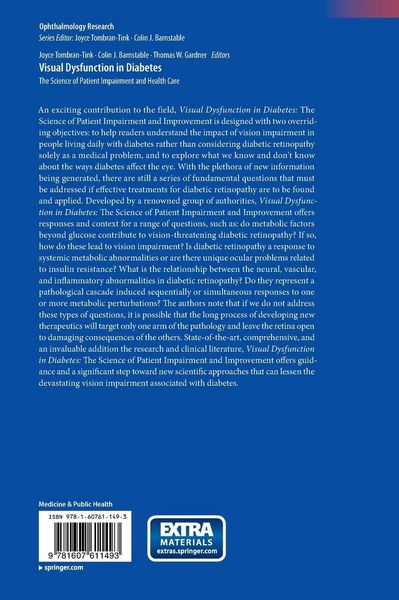
Visual Dysfunction in Diabetes The Science of Patient Impairment and Health Care

Aus der Reihe Ophthalmology Research

Fr. 192.00

inkl. gesetzl. MwSt., Versandkostenfrei


Beschreibung

Produktdetails

Einband

Gebundene Ausgabe

Erscheinungsdatum

15.12.2011

Herausgeber

Joyce Tombran-Tink + weitere

Verlag

Humana Press

Seitenzahl

379

Maße (L/B/H)

26/18.3/2.6 cm

Gewicht

940 g

Auflage

2012

Sprache

Englisch

ISBN

978-1-60761-149-3

Beschreibung

Rezension

“It succeeds in summarizing recent advancements in our knowledge in the field with a well illustrated presentation, up-to-date references, and an authorship selected from an international group of respected investigators with proven contributions to the field. … It could be recommended as a reference for anyone interested in the basic mechanisms of the disease, its ocular manifestations, and treatment options.” (Radouil Tzekov, Graefe's Archive for Clinical and Experimental Ophthalmology, Vol. 253 (6), June, 2015)

Produktdetails

Einband

Gebundene Ausgabe

Erscheinungsdatum

15.12.2011

Herausgeber

Verlag

Humana Press

Seitenzahl

379

Maße (L/B/H)

26/18.3/2.6 cm

Gewicht

940 g

Auflage

2012

Sprache

Englisch

ISBN

978-1-60761-149-3

Herstelleradresse

Springer-Verlag GmbH
Tiergartenstr. 17
69121 Heidelberg
DE

Email: ProductSafety@springernature.com

Kundinnen und Kunden meinen

0 Bewertungen

Informationen zu Bewertungen

Zur Abgabe einer Bewertung ist eine Anmeldung im Konto notwendig. Die Authentizität der Bewertungen wird von uns nicht überprüft. Wir behalten uns vor, Bewertungstexte, die unseren Richtlinien widersprechen, entsprechend zu kürzen oder zu löschen.

Die Bewertungen sind nach Format, Anzahl Sterne und Datum sortiert.

Verfassen Sie die erste Bewertung zu diesem Artikel

Helfen Sie anderen Kund*innen durch Ihre Meinung

Kundinnen und Kunden meinen

0 Bewertungen filtern

  • Produktbild: Visual Dysfunction in Diabetes
  • Produktbild: Visual Dysfunction in Diabetes
  • Introduction

    Diabetic Retinopathy – what we know, don’t know, and need to know – Tom Gardner

    Living with Diabetic Retinopathy

    Ch. 1 A Patient’s viewpoint: Heather Stuckey

    Ch. 2 What patients with diabetes see—and don’t see: subjective and objective visual function

    changes - Shelly Boyd

    Ch. 3 How do I know I have diabetic retinopathy – a clinician’s view? - David Quillen

    Prevalence, Public Awareness, and Screening Methods

    Ch. 4 Epidemiology & Economics - John Javitt

    Ch. 5 Correlation between the presence and severity of diabetic retinopathy in families with diabetes

    - Victor Gonzalez

    Ch. 6 Increasing public awareness of the diabetes endemic – Ian Constable

    Ch. 7 Nutrition and diabetes– David Nathan

    Ch. 8 Diabetic retinopathy screening – progress and complications - Peter Scanlon


    Diagnosing Diabetic Retinopathy

    Ch. 9 Measurements of retinal blood flow, vascular leakage, and oxygenation – Einer Stefansson

    Ch. 10 Optical imaging - Confocal microscopy to detect retinal vasculature – Martin Friedlander

    Ch. 11 Structural imaging – OCT – M. Larsen

    Ch. 12 Functional imaging - ERG - Anthony Adams


    How Diabetes Affects the Eye

    Ch. 13 Clinical phenotypes (reclassification) – J. Cunha-Vaz

    Ch. 14 Vascular changes – David Antonetti & Tom Gardiner (Belfast)

    Ch. 15 Neuronal ch

    anges - Alistair Barber/Greg Jackson

    Ch. 16 Inflammatory changes - Mark Tso

    Ch. 17 Other Ocular Complications of Diabetes - Shoja MR


    New Approaches to Diabetic Retinopathy

    Ch. 18 New insights in the pathogenesis of diabetic retinopathy using a proteomic approach – Retina -

    Quin GG

    Ch. 19 Vitreous proteomics – Ed Feener

    Ch. 20 Genomics - Bill Freeman

    Ch. 21 Genome-wide linkage analyses to identify Loci for diabetic retinopathy - Kang Zhang (Utah)

    Risk Factors

    Ch. 22 Diabetic retinopathy correlates with increased incidence of cardiovascular events -Cheung N

    Ch. 23 Pregnancy and rate of progression of diabetic retinopathy – Sheth BP


    Molecular Mechanisms that Could Trigger Visual Dysfunction in Diabetes

    Introduction - Tom Gardner

    Ch. 24 Inflammation in the early pathogenesis of diabetic retinopathy —beauty and beast. - Chris Norbury (Hershey)

    Ch. 25 Oxidative stress and diabetic retinopathy. - Catherine Whiteside

    Ch. 26 Glucose induced cellular signaling in diabetic retinopathy – Chakrabarti S

    Ch. 27 The AGE/RAGE axis in early diabetic retinopathy - Schmidt AM

    Ch. 28 Proteases and the retinal vasculature (and maybe the whole retina!) – Arup Das.

    Ch. 29 IGFBP3 and retinal vessel growth. Smith LE

    Ch. 30 PEDF, VEGF, CTGF review – JX Ma

    Ch. 31 A decrease in the expression of somatosta

    tin is an early event in diabetic retinopathy -

    Carrasco E

    Ch. 32 Connective tissue and connective tissue growth factor in diabetic retinopathy - Schlingemann

    RO

    Ch. 33 Molecular regulation of endothelial cell tight junctions and the blood retinal barrier - Antonetti

    DA

    Ch. 34 Pericytes and diabetic retinopathy - Puro DG

    Ch. 35 Leukostasis - Adamis, AP

    Ch. 36 Adhesion molecules (ICAM-1 and VCAM-1) and diabetic retinopathy in type 2 diabetes. -

    Khalfaoui T,

    Ch. 37 Azurocidin as a Permeability Factor in the Retina - Hafezi-Moghadam A

    Ch. 38 Retinal arteriolar hemodynamic response to a combined isocapnic hyperoxia and glucose

    provocation in early sight-threatening diabetic retinopathy. - Devenyi RG.

    Ch. 39 Urinary 8-hydroxydeoxyguanosine (8-OHdG) levels in diabetic retinopathy patients. - Steve

    Abcouwer

    Ch. 40 Tyrosine nitration in the molecular mechanisms of diabetic retinopathy. - Crabb JW

    Limiting Vision Loss - Experimental Therapies


    Introduction - Tom Gardner

    Vascular Control

    Ch. 41 Ranibizumab for macular edema in diabetes – Quan Dong Nguyen

    Ch. 42 Bevacizumab for PDR - Qin H

    Ch. 43 Capillary degeneration in the early stages of diabetic retinopathy. Kern TS

    Ch. 44 Renin-angiotensin system in the eye - Jennifer Wilkinson-Berka

    Ch. 45 Statins and the BRB –Ruth Caldwell


    Neuro

    nal Control

    Ch. 46 Treatment of hypoxia-induced retinopathy with targeted proapoptotic peptidomimetic in a

    mouse model of disease. Lahdenranta J

    Ch. 47 Intravitreal Injection of Erythropoietin Protects both Retinal Vascular and Neuronal Cells in

    Early Diabetes - Zhang J and Xu GT

    Inflammatory Control

    Ch. 48 Glial cell-derived cytokines attenuate the breakdown of vascular integrity in diabetic

    retinopathy. Sawada N

    Ch. 49 Ruboxistaurin shows promise as an oral treatment for diabetic retinopathy - Clarke M, Dodson

    PM.

    Ch. 50 Intravitreal triamcinolone acetonide for diabetic retinopathy - Jonas JB

    Ch. 51 Aptamers that bind PDGF-B are a potential treatment for proliferative retinopathies. Akiyama H

    Ch. 52 Effect of R-(+)-alpha-lipoic acid on experimental diabetic retinopathy - Lin J

    Regenerative Approaches

    Ch. 53 Islet Cell/stem cell transplantation - Warnock GL (Canada)

    Future Directions

    Ch. 54 How do we improve the translational research process? What do we need to know? Barbara

    Araneo


    Conclusion – Tom Gardner