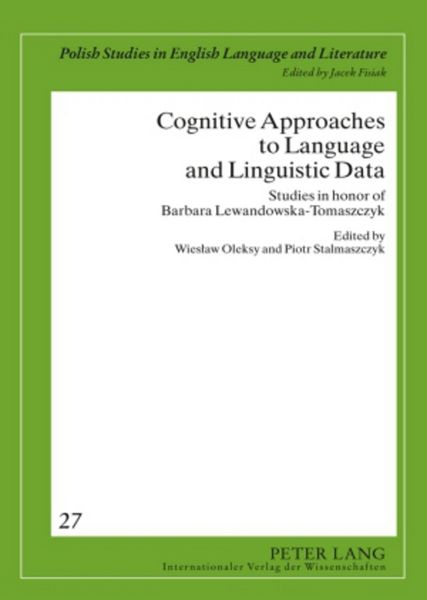
Produktbild: Cognitive Approaches to Language and Linguistic Data
Band 27

Cognitive Approaches to Language and Linguistic Data Studies in honor of Barbara Lewandowska-Tomaszczyk

Fr. 118.00

inkl. gesetzl. MwSt., Versandkostenfrei


Beschreibung

Produktdetails

Einband

Gebundene Ausgabe

Erscheinungsdatum

16.02.2009

Herausgeber

Wieslaw Oleksy + weitere

Verlag

Peter Lang GmbH, Internationaler Verlag der Wissenschaften

Seitenzahl

528

Maße (L/B/H)

21.9/15.1/4 cm

Gewicht

767 g

Sprache

Englisch

ISBN

978-3-631-58861-1

Beschreibung

Produktdetails

Einband

Gebundene Ausgabe

Erscheinungsdatum

16.02.2009

Herausgeber

Verlag

Peter Lang GmbH, Internationaler Verlag der Wissenschaften

Seitenzahl

528

Maße (L/B/H)

21.9/15.1/4 cm

Gewicht

767 g

Sprache

Englisch

ISBN

978-3-631-58861-1

EU-Ansprechpartner

Zeitfracht Medien GmbH
Ferdinand-Jühlke-Straße 7
99095 Erfurt
DE
produktsicherheit@zeitfracht.de

Herstelleradresse

Peter Lang
Avenue du Théâtre 7
1005 Lausanne
CH
orders@peterlang.com

Kundinnen und Kunden meinen

0 Bewertungen

Informationen zu Bewertungen

Zur Abgabe einer Bewertung ist eine Anmeldung im Konto notwendig. Die Authentizität der Bewertungen wird von uns nicht überprüft. Wir behalten uns vor, Bewertungstexte, die unseren Richtlinien widersprechen, entsprechend zu kürzen oder zu löschen.

Die Bewertungen sind nach Format, Anzahl Sterne und Datum sortiert.

Verfassen Sie die erste Bewertung zu diesem Artikel

Helfen Sie anderen Kund*innen durch Ihre Meinung

Kundinnen und Kunden meinen

0 Bewertungen filtern

  • Produktbild: Cognitive Approaches to Language and Linguistic Data
  • Contents: Piotr Stalmaszczyk/Wiesław Oleksy: Barbara Lewandowska-Tomaszczyk’s research output – Antonio Barcelona: Social clubs or sticks? Metonymic chaining in discourse – Eugene H. Casad: Much ado about nothing in Cora – Dirk Geeraerts: Prisms and blends. ‘Digging one’s grave’ from two perspectives – Laura A. Janda: «What is the role of semantic maps in cognitive linguistics?» – Roman Kalisz: Nothing and nothingness in English and their equivalents in Polish and other languages. A cognitive semantic study – Henryk Kardela: The case of smart: semantic underdeterminacy, or how words get their meanings from context – Ronald W. Langacker: On AND and OR and OR as AND – Aleksander Szwedek: Are prepositions metaphorical? – Piotr Cap: Legitimization of the War-on-Terror within the proximization model – Kenneth Holmqvist/Jarosław Płuciennik: Empathy, stereotypes, negation and creativity. Towards a linguistic model of intersubjectivity – Katarzyna M. Jaszczolt: Where cognitive and truth-conditional semantics meet: the case of concept shift – Alexander V. Kravchenko: Speech, writing, and cognition: the rise of communicative dysfunction – Jean-Rémi Lapaire: The meaning of meaningless grams - or emptiness revisited – Danilo Marcondes: Towards a pragmatic analysis of language: Speech Act Theory and Critical Philosophy – Miguel A. Martínez-Cabeza: Dangerous words: threats, perlocutions and strategic actions – Daniël Van Olmen/Tanja Mortelmans/Johan van der Auwera: Grammaticalization and subjectification of the future. The case of English, Dutch and German – Larisa Piotrovskaya: Description, expression and reflection of emotions in language behaviour – Marcel Thelen: The structure of the lexicon in a «Two-Cycle Model of Grammar» (TCM): prototypicality and frames – Olena I. Vashchenko: Cognitive-semantic aspects of metaphorical lexical/phraseological nominations of lying/deception in the present-day English language – Andrew Wilson: Barrier and penetration imagery in altered states of consciousness discourse: replicating the five-stage model of Christian mysticism in the Bible – Łukasz Bogucki: Translating and subtitling wordplay - between domestication and foreignisation – Sally Burgess/Carmen Toledano: Explicitation in the collaborative translation into Spanish of two modern American poets – Elżbieta Tabakowska: Enjambment, conceptual blending and translation of poetry – Zdzisław Wąsik: Epistemological consequences of translating the sign-related terms of Ferdinand de Saussure’s Cours de Linguistique générale – Lut Baten/Michael Goethals: Lexical frequency as a criterion and a tool in teaching and learning ESP: On the use of WordClassifier, more specifically for Business English – Michael P. Oakes: Computer-aided discovery of regular sound changes in Spanish and Galician – Rosa Rabadán: The present tenses in English and in Spanish: a corpus-based approach to cross-linguistic meaning and grammatical transfer – Christoph Haase: Causation in contrast: transitivity, inchoativity, and L2 learner models – Ewa Waniek-Klimczak: Category implementation in non-native speech: the case of aspirated plosives in Polish-English bilinguals.