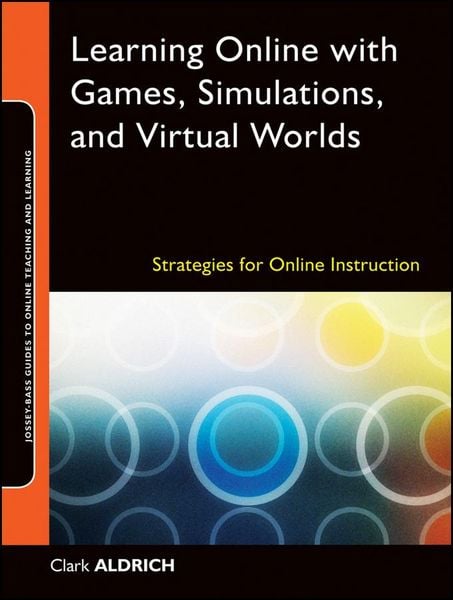
Learning Online with Games, Simulations, and Virtual Worlds Strategies for Online Instruction
-
- Taschenbuch ausgewählt
- eBook
-
Sprache:Englisch
Fr. 51.90
inkl. gesetzl. MwSt.,
Beschreibung
Produktdetails
Einband
Taschenbuch
Erscheinungsdatum
22.09.2009
Verlag
WileySeitenzahl
144
Maße (L/B/H)
23.3/17.8/1.3 cm
Gewicht
250 g
Sprache
Englisch
ISBN
978-0-470-43834-3
Jossey-Bass Guides to Online Teaching and Learning
Learning Online with Games, Simulations, and Virtual Worlds
Strategies for Online Instruction
Clark Aldrich
Learning Online with Games, Simulations, and Virtual Worlds
The infusion of games, simulations, and virtual worlds into online learning can be a transforming experience for both the instructor and the student. This practical guide, written by education game expert Clark Aldrich, shows faculty members and instructional designers how to identify opportunities for building games, simulations, and virtual environments into the curriculum; how to successfully incorporate these interactive environments to enhance student learning; and how to measure the learning outcomes. It also discusses how to build institutional support for using and financing more complex simulations. The book includes frameworks, tips, case studies and other real examples, and resources.
Praise for Learning Online with Games, Simulations, and Virtual Worlds
"Clark Aldrich provides powerful insights into the dynamic arena of games, simulations, and virtual worlds in a simultaneously entertaining and serious manner as only he can. If you are involved with educating anyone, from your own children to classrooms full of students, you need to devour this book."
-- Karl Kapp, assistant director, Institute for Interactive Technologies, Bloomsburg University
"At a time when the technologies for e-learning are evolving faster than most people can follow, Aldrich successfully bridges the perceptual gap between virtual worlds, digital games, and educational simulations, and provides educators with all they really need to use this technology to enhance and enrich their e-learning experiences."
-- Katrin Becker, instructor, Department of Computer Science and Information Systems, Mount Royal College, and adjunct professor of education, University of Calgary
"I consider this a must-read for anyone engaged in or contemplating using these tools in their classrooms or designing their own tools."
-- Rick Van Sant, professor of learning and technology, Ferris State University
Noch keine Bewertungen vorhanden
Verfassen Sie die erste Bewertung zu diesem Artikel
Helfen Sie anderen Kundinnen und Kunden durch Ihre Meinung.