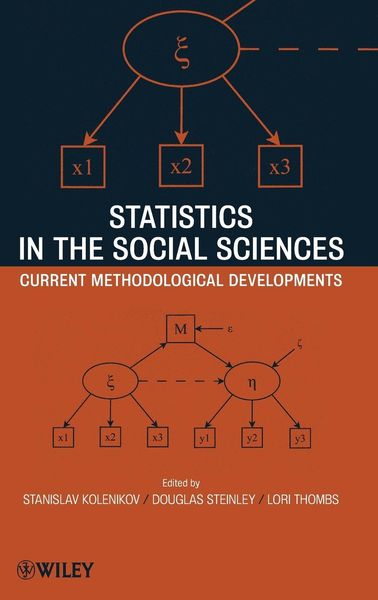
Statistics in the Social Sciences Current Methodological Developments
Fr. 153.00
inkl. gesetzl. MwSt.,
Beschreibung
Produktdetails
Einband
Gebundene Ausgabe
Erscheinungsdatum
08.02.2010
Verlag
John Wiley & Sons IncSeitenzahl
198
Maße (L/B/H)
24/16.1/1.7 cm
Gewicht
504 g
Auflage
1. Auflage
Sprache
Englisch
ISBN
978-0-470-14874-7
A one-of-a-kind compilation of modern statistical methods designed to support and advance research across the social sciences
Statistics in the Social Sciences: Current Methodological Developments presents new and exciting statistical methodologies to help advance research and data analysis across the many disciplines in the social sciences. Quantitative methods in various subfields, from psychology to economics, are under demand for constant development and refinement. This volume features invited overview papers, as well as original research presented at the Sixth Annual Winemiller Conference: Methodological Developments of Statistics in the Social Sciences, an international meeting that focused on fostering collaboration among mathematical statisticians and social science researchers.
The book provides an accessible and insightful look at modern approaches to identi-fying and describing current, effective methodologies that ultimately add value to various fields of social science research. With contributions from leading international experts on the topic, the book features in-depth coverage of modern quantitative social sciences topics, including:
* Correlation Structures
* Structural Equation Models and Recent Extensions
* Order-Constrained Proximity Matrix Representations
* Multi-objective and Multi-dimensional Scaling
* Differences in Bayesian and Non-Bayesian Inference
* Bootstrap Test of Shape Invariance across Distributions
* Statistical Software for the Social Sciences
Statistics in the Social Sciences: Current Methodological Developments is an excellent supplement for graduate courses on social science statistics in both statistics departments and quantitative social sciences programs. It is also a valuable reference for researchers and practitioners in the fields of psychology, sociology, economics, and market research.
Statistics in the Social Sciences: Current Methodological Developments presents new and exciting statistical methodologies to help advance research and data analysis across the many disciplines in the social sciences. Quantitative methods in various subfields, from psychology to economics, are under demand for constant development and refinement. This volume features invited overview papers, as well as original research presented at the Sixth Annual Winemiller Conference: Methodological Developments of Statistics in the Social Sciences, an international meeting that focused on fostering collaboration among mathematical statisticians and social science researchers.
The book provides an accessible and insightful look at modern approaches to identi-fying and describing current, effective methodologies that ultimately add value to various fields of social science research. With contributions from leading international experts on the topic, the book features in-depth coverage of modern quantitative social sciences topics, including:
* Correlation Structures
* Structural Equation Models and Recent Extensions
* Order-Constrained Proximity Matrix Representations
* Multi-objective and Multi-dimensional Scaling
* Differences in Bayesian and Non-Bayesian Inference
* Bootstrap Test of Shape Invariance across Distributions
* Statistical Software for the Social Sciences
Statistics in the Social Sciences: Current Methodological Developments is an excellent supplement for graduate courses on social science statistics in both statistics departments and quantitative social sciences programs. It is also a valuable reference for researchers and practitioners in the fields of psychology, sociology, economics, and market research.
Kundinnen und Kunden meinen
Verfassen Sie die erste Bewertung zu diesem Artikel
Helfen Sie anderen Kund*innen durch Ihre Meinung