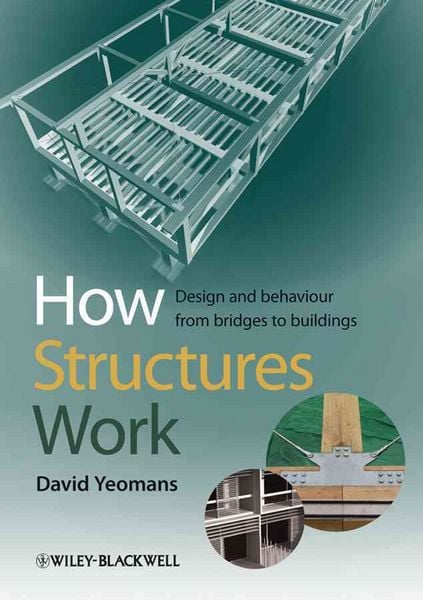
How Structures Work Design and Behaviour from Bridges to Buildings
-
- Taschenbuch ausgewählt
- eBook
-
Sprache:Englisch
-
Auflage:1. Auflage
- 2. Auflage Fr. 73.90
- 1. Auflage Fr. 61.90 ausgewählt
Fr. 61.90
inkl. gesetzl. MwSt.,
Beschreibung
Produktdetails
Einband
Taschenbuch
Erscheinungsdatum
10.07.2009
Verlag
John Wiley & Sons IncSeitenzahl
262
Maße (L/B/H)
24.3/17.3/1.8 cm
Gewicht
470 g
Auflage
1. Auflage
Sprache
Englisch
ISBN
978-1-4051-9017-6
The alliance between architecture and structural engineering is fundamental to the design of the buildings and bridges around us. Anyone who needs or wants to "understand" a building must have a good understanding of the structural concepts involved. Yet "structure" is often cloaked in mathematics - which many find difficult to get to grips with.
How Structures Work has been written to explain the behaviour of structures in a clear way without resorting to complex mathematics. Using the minimum of mathematics it explains the structural concepts clearly, illustrated by many historical and contemporary examples, allowing readers to build up a general understanding of structures. In this way they can easily comprehend the structural aspects of buildings for themselves.
Primarily aimed at students who require a good qualitative understanding of the behaviour of structures and their materials, it will be of particular interest to students of architecture and building surveying, plus architectural historians and conservationists. The straightforward, non-mathematical approach ensures it will also be suitable for a wider audience including building administrators, archaeologists and the interested layman.
How Structures Work has been written to explain the behaviour of structures in a clear way without resorting to complex mathematics. Using the minimum of mathematics it explains the structural concepts clearly, illustrated by many historical and contemporary examples, allowing readers to build up a general understanding of structures. In this way they can easily comprehend the structural aspects of buildings for themselves.
Primarily aimed at students who require a good qualitative understanding of the behaviour of structures and their materials, it will be of particular interest to students of architecture and building surveying, plus architectural historians and conservationists. The straightforward, non-mathematical approach ensures it will also be suitable for a wider audience including building administrators, archaeologists and the interested layman.
Kundinnen und Kunden meinen
Verfassen Sie die erste Bewertung zu diesem Artikel
Helfen Sie anderen Kund*innen durch Ihre Meinung