
Band 11
Dao Companion to Korean Confucian Philosophy
Aus der Reihe
Dao Companions to Chinese Philosophy
Fr. 219.00
inkl. gesetzl. MwSt.,
Beschreibung
Produktdetails
Einband
Gebundene Ausgabe
Erscheinungsdatum
02.09.2019
Abbildungen
XII, 2 illus., schwarz-weiss Illustrationen
Herausgeber
Young-chan RoVerlag
Springer NetherlandSeitenzahl
422
Maße (L/B/H)
24.1/16/2.9 cm
Gewicht
816 g
Auflage
1st ed. 2019
Sprache
Englisch
ISBN
978-90-481-2932-4
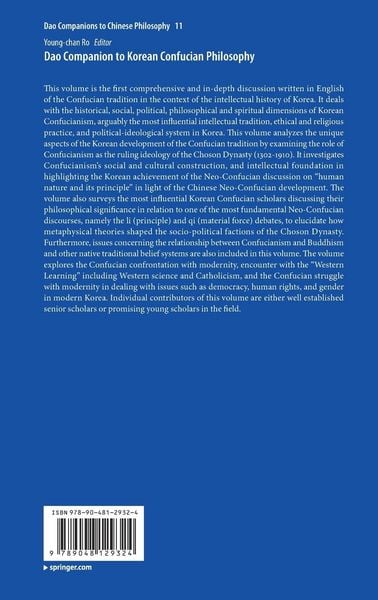
Deals with the historical, social, political, philosophical and spiritual dimensions of Korean Confucianism, arguably the most influential intellectual tradition, ethical and religious practice, and political-ideological system in Korea Surveys the most influential Korean Confucian scholars discussing their philosophical significance in relation to one of the most fundamental Neo-Confucian discourses, namely the "li" (principle) and "qi" (material force) debates
Kundinnen und Kunden meinen
Verfassen Sie die erste Bewertung zu diesem Artikel
Helfen Sie anderen Kund*innen durch Ihre Meinung