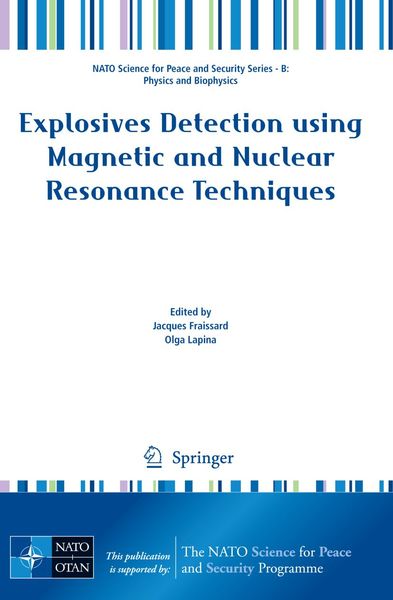
Explosives Detection using Magnetic and Nuclear Resonance Techniques
-
- Hardcover
- Taschenbuch ausgewählt
- eBook
-
Sprache:Englisch
Fr. 192.00
inkl. gesetzl. MwSt.,
Beschreibung
Produktdetails
Einband
Taschenbuch
Erscheinungsdatum
02.11.2009
Herausgeber
Jacques Fraissard + weitereVerlag
Springer NetherlandSeitenzahl
292
Maße (L/B/H)
23.7/15.6/2 cm
Gewicht
464 g
Auflage
1. Auflage
Sprache
Englisch
ISBN
978-90-481-3061-0
Nuclear quadrupole resonance (NQR) a highly promising new technique for bulk explosives detection: relatively inexpensive, more compact than NMR, but with considerable selectivity. Since the NQR frequency is insensitive to long-range variations in composition, mixing explosives with other materials, such as the plasticizers in plastic explosives, makes no difference. The NQR signal strength varies linearly with the amount of explosive, and is independent of its distribution within the volume monitored. NQR spots explosive types in configurations missed by the X-ray imaging method.
But if NQR is so good, why it is not used everywhere? Its main limitation is the low signal-to-noise ratio, particularly with the radio-frequency interference that exists in a field environment, NQR polarization being much weaker than that from an external magnetic field. The distinctive signatures are there, but are difficult to extract from the noise. In addition, the high selectivity is partly a disadvantage, as it is hard to build a multichannel system necessary to cover a wide range of target substances. Moreover, substances fully screened by metallic enclosures, etc. are difficult to detect. A workshop was held at St Petersburg in July 2008 in an attempt to solve these problems and make NQR the universal technique for the detection of bombs regardless of type. This book presents the essentials of the papers given there.
Kundinnen und Kunden meinen
Verfassen Sie die erste Bewertung zu diesem Artikel
Helfen Sie anderen Kund*innen durch Ihre Meinung