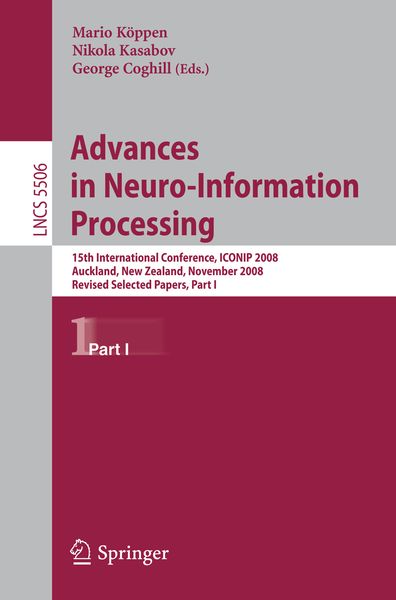
Produktbild: Advances in Neuro-Information Processing
Band 5506

Advances in Neuro-Information Processing 15th International Conference, ICONIP 2008, Auckland, New Zealand, November 25-28, 2008, Revised Selected Papers, Part I

Fr. 192.00

inkl. gesetzl. MwSt., Versandkostenfrei


Beschreibung

Produktdetails

Einband

Set mit diversen Artikeln

Erscheinungsdatum

10.07.2009

Abbildungen

mit Illustrationen

Herausgeber

Mario Köppen + weitere

Verlag

Springer Berlin

Seitenzahl

1257

Maße (L/B/H)

23.9/15.7/4.6 cm

Gewicht

1464 g

Auflage

2009

Sprache

Englisch

ISBN

978-3-642-02489-4

Beschreibung

Produktdetails

Einband

Set mit diversen Artikeln

Erscheinungsdatum

10.07.2009

Abbildungen

mit Illustrationen

Herausgeber

Verlag

Springer Berlin

Seitenzahl

1257

Maße (L/B/H)

23.9/15.7/4.6 cm

Gewicht

1464 g

Auflage

2009

Sprache

Englisch

ISBN

978-3-642-02489-4

Herstelleradresse

Springer-Verlag GmbH
Heidelberger Platz 3
14197 Berlin
Deutschland
Email: sdc-bookservice@springer.com
Url: www.springer.com
Telephone: +49 6221 3454301
Fax: +49 30 8214091

Noch keine Bewertungen vorhanden

Verfassen Sie die erste Bewertung zu diesem Artikel

Helfen Sie anderen Kundinnen und Kunden durch Ihre Meinung.

Kundinnen und Kunden meinen

Bewertungen (0)

  • Produktbild: Advances in Neuro-Information Processing
  • INNS Symposium “New Directions in Neural Networks”.- Integrative Probabilistic Evolving Spiking Neural Networks Utilising Quantum Inspired Evolutionary Algorithm: A Computational Framework.- A Spiking Network of Hippocampal Model Including Neurogenesis.- NeuroEvolution Based on Reusable and Hierarchical Modular Representation.- A Common-Neural-Pattern Based Reasoning for Mobile Robot Cognitive Mapping.- Identifying Emotions Using Topographic Conditioning Maps.- A Gene Regulatory Model for the Development of Primitive Nervous Systems.- Real-Time Epileptic Seizure Detection on Intra-cranial Rat Data Using Reservoir Computing.- Learning of Subgoals for Goal-Oriented Behavior Control of Mobile Robots.- Coding Mechanisms in Hippocampal Networks for Learning and Memory.- Developmental Stereo: Topographic Iconic-Abstract Map from Top-Down Connection.- An Analysis of Synaptic Transmission and its Plasticity by Glutamate Receptor Channel Kinetics Models and 2-Photon Laser Photolysis.- A Biologically Inspired Neural CPG for Sea Wave Conditions/Frequencies.- Feature Subset Selection Using Differential Evolution.- Topology of Brain Functional Networks: Towards the Role of Genes.- Hybrid Design Principles and Time Constants in the Construction of Brain-Based Robotics: A Real-Time Simulator of Oscillatory Neural Networks Interacting with the Real Environment via Robotic Devices.- Neurodynamics.- First Spiking Dynamics of Stochastic Neuronal Model with Optimal Control.- BCM and Membrane Potential: Alternative Ways to Timing Dependent Plasticity.- A Novel Hybrid Spiking Neuron: Response Analysis and Learning Potential.- Event-Related Desynchronisation/Synchronisation of Spontaneous Motor Actions.- Competition between Synapses Located in Proximal and Distal Dendrites of the Dentate Granule Cell through STDP.- An Analysis of the Autonomic Cardiac Activity by Reducing the Interplay between Sympathetic and Parasympathetic Information.- On Similarity Measures for Spike Trains.- Relationship between an Input Sequence and Asymmetric Connections Formed by Theta Phase Precession and STDP.- Analysis of Microelectrographic Neuronal Background in Deep Brain Nuclei in Parkinson Disease.- Gating Echo State Neural Networks for Time Series Forecasting.- A Novel Artificial Model of Spiral Ganglion Cell and Its Spike-Based Encoding Function.- Evolution of Neural Organization in a Hydra-Like Animat.- Improved Sparse Bump Modeling for Electrophysiological Data.- Classify Event-Related Motor Potentials of Cued Motor Actions.- A Neural Network Based Hierarchical Motor Schema of a Multi-finger Hand and Its Motion Diversity.- Cognitive Neuroscience.- Biological Plausibility of Spectral Domain Approach for Spatiotemporal Visual Saliency.- A “Global Closure” Effect in Contour Integration.- Modeling of Associative Dynamics in Hippocampal Contributions to Heuristic Decision Making.- Tracking with Depth-from-Size.- Training Recurrent Connectionist Models on Symbolic Time Series.- Computational Modeling of Risk–Related Eye Movement of Car Drivers.- Robust Detection of Medial-Axis by Onset Synchronization of Border-Ownership Selective Cells and Shape Reconstruction from Its Medial-Axis.- Synaptic Cooperation and Competition in STDP Learning Rule.- An Exemplar-Based Statistical Model for the Dynamics of Neural Synchrony.- Towards a Comparative Theory of the Primates’ Tool-Use Behavior.- Artifact Removal Using Simultaneous Current Estimation of Noise and Cortical Sources.- Significance for Hippocampal Memory of Context-Like Information Generated in Hippocampal CA3c.- Bio-signal Integration for Humanoid Operation: Gesture and Brain Signal Recognition by HMM/SVM-Embedded BN.- Interpreting Dopamine Activities in Stochastic Reward Tasks.- Epileptogenic ECoG Monitoring and Brain Stimulation Using a Multifunctional Microprobe for Minimally Invasive Brain Microsurgery.- Generalization in Linguistic Category Formation Based on the Prototype Effect.- Model of the Activity of Hippocampal Neurons Based on the Theory of Selective Desensitization.- EEG-Based Classification of Brain Activity for Brightness Stimuli.- Steady State Visual Evoked Potentials in the Delta Range (0.5-5 Hz).- Using Optimality to Predict Photoreceptor Distribution in the Retina.- Optical Imaging of Plastic Changes Induced by Fear Conditioning in the Auditory Cortex of Guinea Pig.- Possibility of Cantor Coding by Spatial Input Patterns.- A Neural Network Model for a Hierarchical Spatio-temporal Memory.- Time-Varying Synchronization of Visual ERP during Sentences Identification.- Neural Mechanism of Synchronous Firing of Inferior Temporal Cortex in Face Perception.- Bioinformatics.- Clustering of Spectral Patterns Based on EMD Components of EEG Channels with Applications to Neurophysiological Signals Separation.- Consensus Clustering Using Spectral Theory.- On the Synchrony of Morphological and Molecular Signaling Events in Cell Migration.- MISCORE: Mismatch-Based Matrix Similarity Scores for DNA Motif Detection.- Ensembles of Pre-processing Techniques for Noise Detection in Gene Expression Data.- FES Position Control of Forearm Using EOG.- Reduction of FPs for Lung Nodules in MDCT by Use of Temporal Subtraction with Voxel-Matching Technique.- Improved Mass Spectrometry Peak Intensity Prediction by Adaptive Feature Weighting.- An Improved Genetic Algorithm for DNA Motif Discovery with Public Domain Information.- A Hybrid Model for Prediction of Peptide Binding to MHC Molecules.- Special Session: Data Mining Methods for Cybersecurity.- An Evaluation of Machine Learning-Based Methods for Detection of Phishing Sites.- Detecting Methods of Virus Email Based on Mail Header and Encoding Anomaly.- Faster Parameter Detection of Polymorphic Viral Code Using Hot List Strategy.- G-Means: A Clustering Algorithm for Intrusion Detection.- Anomaly Intrusion Detection for Evolving Data Stream Based on Semi-supervised Learning.- An Incident Analysis System NICTER and Its Analysis Engines Based on Data Mining Techniques.- Multi-layered Hand and Face Tracking for Real-Time Gesture Recognition.- Towards a Reliable Evaluation Framework for Message Authentication in Web-Based Transactions Based on an Improved Computational Intelligence and Dynamical Systems Methodology.- Special Session: Computational Models and Their Applications in Machine Learning and Pattern Recognition.- A Neuro-GA Approach for the Maximum Fuzzy Clique Problem.- Hybrid Feature Selection: Combining Fisher Criterion and Mutual Information for Efficient Feature Selection.- Sensibility-Aware Image Retrieval Using Computationally Learned Bases: RIM, JPG, J2K, and Their Mixtures.- An Analysis of Generalization Error in Relevant Subtask Learning.- Intelligent Automated Guided Vehicle with Reverse Strategy: A Comparison Study.- Neural Networks for Optimal Form Design of Personal Digital Assistants.- Firing Rate Estimation Using an Approximate Bayesian Method.- Sampling Curve Images to Find Similarities among Parts of Images.- Improving the State Space Organization of Untrained Recurrent Networks.- Online Multibody Factorization Based on Bayesian Principal Component Analysis of Gaussian Mixture Models.- Experimental Study of Ergodic Learning Curve in Hidden Markov Models.- Design of Exchange Monte Carlo Method for Bayesian Learning in Normal Mixture Models.- Image Filling-In: A Gestalt Approach.- Sports Video Segmentation Using a Hierarchical Hidden CRF.- Learning Manifolds for Bankruptcy Analysis.- Information Geometry of Interspike Intervals in Spiking Neurons with Refractories.- Convolutive Blind Speech Separation by Decorrelation.- Special Session: Recent Advances in Brain-Inspired Technologies for Robotics.- Cognitive Representation and Bayeisan Model of Spatial Object Contexts for Robot Localization.- Learning of Action Generation from Raw Camera Images in a Real-World-Like Environment by Simple Coupling of Reinforcement Learning and a Neural Network.- Brain-Inspired Emergence of Behaviors Based on the Desire for Existence by Reinforcement Learning.- A Neural Network Based Controller for an Outdoor Mobile Robot.- Depth Perception Using a Monocular Vision System.- Trajectory Planning with Dynamics Constraints for an Underactuated Manipulator.- Neural Networks That Mimic the Human Brain: Turing Machines versus Machines That Generate Conscious Sensations.- Special Session: Lifelong Incremental Learning for Intelligent Systems.- A Vector Quantization Approach for Life-Long Learning of Categories.- An Integrated System for Incremental Learning of Multiple Visual Categories.- A Neural Network Model for Sequential Multitask Pattern Recognition Problems.- Automatic Discovery of Subgoals in Reinforcement Learning Using Strongly Connected Components.- Special Session: Dynamics of Neural Networks.- Bifurcation and Windows in a Simple Piecewise Linear Chaotic Spiking Neuron.- Bifurcation between Superstable Periodic Orbits and Chaos in a Simple Spiking Circuit.- Application of Higher Order Neural Network Dynamics to Distributed Radio Resource Usage Optimization of Cognitive Wireless Networks.- Synchronized Rhythmic Signals Effectively Influence Ongoing Cortical Activity for Decision-Making: A Study of the Biological Plausible Neural Network Model.- Synchronization Transition in a Pair of Coupled Non-identical Oscillators.- Parameter Analysis for Removing the Local Minima of Combinatorial Optimization Problems by Using the Inverse Function Delayed Neural Network.- Fractional-Order Hopfield Neural Networks.- Special Session: Applications of Intelligent Methods in Ecological Informatics.- Classification and Prediction of Lower Troposphere Layers Influence on RF Propagation Using Artificial Neural Networks.- Predicting the Distribution of Fungal Crop Diseases from Abiotic and Biotic Factors Using Multi-Layer Perceptrons.- Using Time Lagged Input Data to Improve Prediction of Stinging Jellyfish Occurrence at New Zealand Beaches by Multi-Layer Perceptrons.- Modelling Climate Change Effects on Wine Quality Based on Expert Opinions Expressed in Free-Text Format: The WEBSOM Approach.- Special Session: Pattern Recognition from Real-World Information by SVM and Other Sophisticated Techniques.- A Support Vector Machine with Forgetting Factor and Its Statistical Properties.- Improved Parameter Tuning Algorithms for Fuzzy Classifiers.- Accelerated Classifier Training Using the PSL Cascading Structure.- Imitation Learning from Unsegmented Human Motion Using Switching Autoregressive Model and Singular Vector Decomposition.- Vision Based Mobile Robot for Indoor Environmental Security.- Multiobjective Multiclass Soft-Margin Support Vector Machine Maximizing Pair-Wise Interclass Margins.- Functional Networks Based on Pairwise Spike Synchrony Can Capture Topologies of Synaptic Connectivity in a Local Cortical Network Model.- Prediction of the O-Glycosylation by Support Vector Machines and Semi-supervised Learning.- Practical Approach to Outlier Detection Using Support Vector Regression.- A Variant of Adaptive Mean Shift-Based Clustering.- Special Session: Neural Information Processing in Cooperative Multi-robot Systems.- Using Spiking Neural Networks for the Generation of Coordinated Action Sequences in Robots.- Neuro-Evolutive System for Ego-Motion Estimation with a 3D Camera.- Neuro Granular Networks with Self-learning Stochastic Connections: Fusion of Neuro Granular Networks and Learning Automata Theory.- An Incremental Learning Algorithm for Optimizing High-Dimensional ANN-Based Classification Systems.- Towards the Adaptive Control of a Multirobot System for an Elastic Hose.- Economical Implementation of Control Loops for Multi-robot Systems.- WORKSHOP: Hybrid and Adaptive Systems for Real-Time Robotics Vision and Control.- An Improved Modular Neural Network Model for Adaptive Trajectory Tracking Control of Robot Manipulators.- Variable Colour Depth Look-Up Table Based on Fuzzy Colour Processing.- Towards a Generalised Hybrid Path-Planning and Motion Control System with Auto-calibration for Animated Characters in 3D Environments.- Cultivated Microorganisms Control a Real Robot: A Model of Dynamical Coupling between Internal Growth and Robot Movement.- Stream Processing of Geometric and Central Moments Using High Precision Summed Area Tables.- Bayesian Fusion of Auditory and Visual Spatial Cues during Fixation and Saccade in Humanoid Robot.- Solving the Online SLAM Problem with an Omnidirectional Vision System.- WORKSHOP: Neurocomputing and Evolving Intelligence – NCEI 2008.- A Notable Swarm Approach to Evolve Neural Network for Classification in Data Mining.- FPGA Implementation of an Evolving Spiking Neural Network.- HyFIS-Yager-gDIC: A Self-organizing Hybrid Neural Fuzzy Inference System Realizing Yager Inference.- Parallel Ant Colony Optimizer Based on Adaptive Resonance Theory Maps.- Covariate Shift and Incremental Learning.- A Novel Incremental Linear Discriminant Analysis for Multitask Pattern Recognition Problems.- Soft Sensor Based on Adaptive Local Learning.- Directly Optimizing Topology-Preserving Maps with Evolutionary Algorithms.- RBF NN Based Adaptive PI Control of Brushless DC Motor.- Incremental Principal Component Analysis Based on Adaptive Accumulation Ratio.- Ontology Based Personalized Modeling for Chronic Disease Risk Analysis: An Integrated Approach.- Frost Prediction Characteristics and Classification Using Computational Neural Networks.- Personalized Modeling Based Gene Selection for Microarray Data Analysis.- Integrated Feature and Parameter Optimization for an Evolving Spiking Neural Network.- Personalised Modelling for Multiple Time-Series Data Prediction: A Preliminary Investigation in Asia Pacific Stock Market Indexes Movement.- Dynamic Neural Fuzzy Inference System.