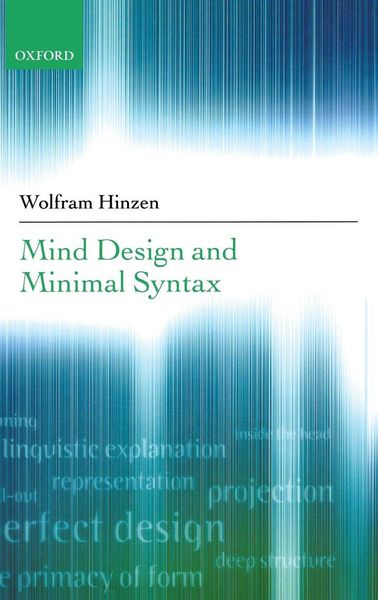
Mind Design and Minimal Syntax
-
- Hardcover ausgewählt
- Taschenbuch
-
Sprache:Englisch
Fr. 44.90
inkl. gesetzl. MwSt.,
Beschreibung
Produktdetails
Einband
Gebundene Ausgabe
Erscheinungsdatum
03.12.2007
Verlag
Oxford University PressSeitenzahl
314
Maße (L/B/H)
24/16.1/2.1 cm
Gewicht
623 g
Sprache
Englisch
ISBN
978-0-19-927441-3
This book introduces generative grammar as an area of study and asks what it tells us about the human mind. Wolfram Hinzen lays the foundation for the unification of modern generative linguistics with the philosophies of mind and language. He introduces Chomsky's program of a 'minimalist' syntax as a novel explanatory vision of the human mind. He explains how the Minimalist Program originated in work in cognitive science, biology, linguistics, and philosophy, and examines its implications for work in these fields. He considers the way the human mind is designed when seen as an arrangement of structural patterns in nature, and argues that its design is the product not so much of adaptive evolutionary history as of principles and processes that are ahistorical and internalist in character. Linguistic meaning, he suggests, arises in the mind as a consequence of structures emerging on formal rather than functional grounds. From this he substantiates an unexpected and deeply unfashionable notion of human nature. _ Clearly written in nontechnical language and assuming a limited knowledge of the fields it examines and links, Minimal Mind Design will appeal to a wide range of scholars in linguistics, philosophy, and cognitive science. It also provides an exceptionally clear insight into the nature and aims of Chomsky's Minimalist Program.
Kundinnen und Kunden meinen
Verfassen Sie die erste Bewertung zu diesem Artikel
Helfen Sie anderen Kund*innen durch Ihre Meinung