
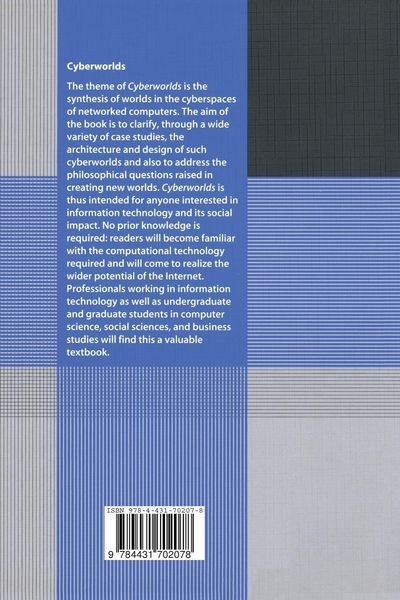
• Produktbild: Cyberworlds
  • Produktbild: Cyberworlds

Cyberworlds

Fr. 72.90

inkl. gesetzl. MwSt., Versandkostenfrei


Beschreibung

Produktdetails

Einband

Taschenbuch

Erscheinungsdatum

01.07.1998

Herausgeber

Tosiyasu L. Kunii + weitere

Verlag

Springer Tokyo

Seitenzahl

354

Maße (L/B/H)

23.5/15.5/2.1 cm

Gewicht

600 g

Auflage

1. Auflage

Sprache

Englisch

ISBN

978-4-431-70207-8

Beschreibung

Produktdetails

Einband

Taschenbuch

Erscheinungsdatum

01.07.1998

Herausgeber

Verlag

Springer Tokyo

Seitenzahl

354

Maße (L/B/H)

23.5/15.5/2.1 cm

Gewicht

600 g

Auflage

1. Auflage

Sprache

Englisch

ISBN

978-4-431-70207-8

Herstelleradresse

Springer-Verlag GmbH
Tiergartenstr. 17
69121 Heidelberg
DE

Email: ProductSafety@springernature.com

Noch keine Bewertungen vorhanden

Verfassen Sie die erste Bewertung zu diesem Artikel

Helfen Sie anderen Kundinnen und Kunden durch Ihre Meinung.

Kundinnen und Kunden meinen

Bewertungen (0)

  • Produktbild: Cyberworlds
  • Produktbild: Cyberworlds
  • I Foundation.- Theme 1 Philosophy.- 1. The Philosophy of Synthetic Worlds.- 1.1 Synthetic Worlds and the Real World.- 1.2 Visual Abstraction for Complexity Modeling.- 1.3 Material and Information.- 1.4 Multimedia and Synthetic Worlds.- 1.5 Topological Modeling for Visualization.- 1.6 Mental Modeling of Shapes.- Theme 2 Architecture.- 2. The Architecture of Synthetic Worlds.- 2.1 Architecture.- 2.2 Science of Worlds and World Architecture.- 2.3 Assembling Synthetic Worlds and the Design Problem.- 2.4 Architectural Bases of Synthetic Worlds.- 2.5 Emotion Computation.- 3. Influence of Emerging Synthetic Worlds on System Architecture.- II Design and Implementation: Case Studies.- Theme 1 Artificial Life.- 4. The Meaning of Life — Real and/or Artificial.- 4.1 Introduction.- 4.2 The Distinction between Living and Nonliving.- 4.3 Life “as it could be”.- 4.4 Morality: the Rights of Life.- 4.5 Conclusions and Future Directions.- 5. Artificial Life as Synthetic Biology.- 5.1 Introduction.- 5.2 Artificial Life and Synthetic Biology.- 5.3 Synthetic Biology and Emergence.- 5.4 Artificial Life as a Framework to Study Autonomy.- 5.5 Conclusion.- 6. Simulation of the Growth of Plants.- 6.1 Introduction.- 6.2 Botanical Concepts, Basis for Modeling.- 6.3 The Notion of Reference Axis.- 6.4 Evolution of the Growth Engine.- 6.5 Influence of Climate on Annual Growth.- 6.6 Simulation of the Tree/Environment Interactions.- 6.7 Technical Aspects.- 6.8 Conclusion.- 7. Synthetic Animals in Synthetic Worlds.- 7.1 Introduction.- 7.2 Preprogrammed Behaviors.- 7.3 Learned Behaviors.- 7.4 Evolved Behaviors.- 7.5 Behavioral Development.- 7.6 Discussion and Conclusion.- 8. Simulating Autonomous Life for Virtual Actors.- 8.1 Introduction.- 8.2 Creation of Virtual Humans.- 8.3 Simulation of Facial Expressions and Talk.- 8.4 Simulating 3D Clothes.- 8.5 Interaction with Virtual Humans.- 8.6 Communication between the Virtual Human and the Animator.- 8.7 Conclusion.- 9. Towards Autonomous Synthetic Actors.- 9.1 Introduction.- 9.2 An Architecture for Animating Autonomous Synthetic Actors.- 9.3 Vision-based Navigation.- 9.4 Tennis Playing.- 9.5 Conclusion.- Theme 2 Synthetic Art.- 10. Sound Synthesis in Computer Music.- 10.1 Introduction.- 10.2 Sound Synthesis.- 10.3 Analysis/synthesis.- 10.4 Abstract Model.- 10.5 Creative Synthesis and Application to Computer Music System.- 10.6 Evaluation of Creative Synthesis.- 10.7 Future Direction of Sound Synthesis Study.- 10.8 Conclusion.- 11. Virtual Revisiting of Architectural Masterpieces and the Problem of Lighting Simulation.- 11.1 Introduction.- 11.2 General Objectives.- 11.3 Lighting Simulation.- 11.4 Storage and Reconstruction of Lighting Distribution.- 11.5 Texture Mapping.- 11.6 Walkthrough Animation.- 11.7 Parallel Processing.- 11.8 Results.- 11.9 Conclusion.- 12. Performance Facial Animation Cloning.- 12.1 Introduction.- 12.2 Background.- 12.3 Approach and Motivation.- 12.4 A Parametric Differential Interpolation Facial Animation.- 12.5 Human Face Cloning by Chromakey Analysis.- 12.6 Modelling the Neutral Face.- 12.7 Cannonical Models.- 12.8 Conclusion.- Theme 3 Synthetic Factories.- 13. Towards the Synthetic Factories: Requirements and Components.- 13.1 Introduction.- 13.2 Requirements for Synthetic Factories.- 13.3 ANIMENGINE: An Engineering Animation System.- 13.4 SYDEM: An Approach to Computer-Aided Assemblability Testing.- 13.4.1 Assemblability.- 13.4.2 Testing Assemblability.- 13.5 Process Visualization.- 13.5.1 Process Modeling.- 13.5.2 Process Scheduling.- 13.6 Discussions.- 14. Virtual Manufacturing.- 14.1 Introduction.- 14.2 Conventional Design’s Problems.- 14.3 Concurrent Engineering.- 14.4 Researches at the University of Aizu.- 14.5 Conclusions.- Theme 4 Synthetic Communication.- 15. Virtual Space Teleconferencing System.- 15.1 Introduction.- 15.2 Networked Virtual Environment Classification.- 15.3 Implementation Considerations.- 15.4 Virtual Space Teleconferencing System.- 15.5 Summary.- 16. Real Time Image Processing and Real Time Image Rendering for Televirtuality Application.- 16.1 Introduction.- 16.2 Analysis an Suntesis of “Clone”.- 16.3 Virtual Communities.- 16.4 The “Cluny” Televirtuality Experiment.- 16.5 Towards a General Real Time Analysis / Synthesis Televirtuality System.- Theme 5 Synthetic Perception.- 17. Towards a Complete Representation by Means of Computer.- 17.1 The Concept of “Complete Representation”.- 17.2 Acting with Feeling.- 17.3 Gestures and Sounds.- 17.4 Gestures and Images.- 17.5 Physically Based Models.- 17.6 Physically Based Icons.- 17.7 Conclusions.- 18. Virtual Space Decision Support System Using Kansei Engineering.- 18.1 Introduction.- 18.2 VSDSS (Virtual Space Decision Support System).- 18.3 Kansei Engineering.- 18.4 Application of VSDSS Using Kansei Engineering to the PS/US System.- 18.5 Conclusion.- 19. Quantity of Presence: Beyond Person, Number, and Pronouns.- 19.1 Introduction.- 19.2 Duality and Synthesis of Self/Other: Beyond Person.- 19.3 Shared and Split Perception: Beyond Number.- 19.3.1 Video.- 19.3.2 Audio.- 1.9.3.3 Shared Perspective: Sink Fusion.- 19.3.4 Split Perspective: Sink Fission.- 19.3.5 Non-atomic Sinks and Sources: Clusters.- 19.4 Grammatical Blur: Beyond Pronouns.- 19.5 Conclusion.- 20. The STV-Synthetic TV System.- 20.1 Introduction.- 20.2 Dynamic Coupling and Initializing.- 20.3 STV-Synthetic TV Procedure in a Nutshell.- 20.4 The System Decelopped by INA.- 20.5 Some Production Examples.- 20.6 Further Extensions.- 21. Teaching the English [r] sound to Japanese Through Sound and Image Understanding.- 21.1 Introduction.- 21.2 The English Semivowel: [r].- 21.2.1 Various instruction of the /r/ sound.- 21.2.2 Acoustic Features of the /r/ sound.- 21.3 A Model of the Ideal American [r] Sound in the Initial Position.- 21.3.1 Various [r] sounds.- 21.3.2 A model of the ideal [r] sound.- 21.4 The Development of the Ideal Pronunciation Training Tools.- 21.4.1 The Language Media Laboratory English Education System.- 21.4.2 Three dimensional (3-D) graphical displays of ideal interior facial movements in virtual reality.- 21.4.3 Superimposed 3-D images of the inaccurate portion of the speakers articulation organ movements.- 21.5 Conclusion.- Theme 6 Applications to Real Worlds.- 22. A Geological Model for Landscape Simulation.- 22.1 Introduction.- 22.2 Previous Work.- 22.3 Terrain Modelling.- 22.4 Simulation of Erosion and Deposition Processes.- 22.5 Rendering.- 22.6 Conclusion.- Key Word Index.