Beschreibung
Produktdetails
Einband
Gebundene Ausgabe
Erscheinungsdatum
10.10.2011
Abbildungen
2010. 139 schwarzweisse Abbildungen 235 mm
Verlag
Springer BerlinSeitenzahl
368
Maße (L/B/H)
24.3/16.9/3.3 cm
Gewicht
684 g
Auflage
2012
Sprache
Englisch
ISBN
978-3-642-11346-8
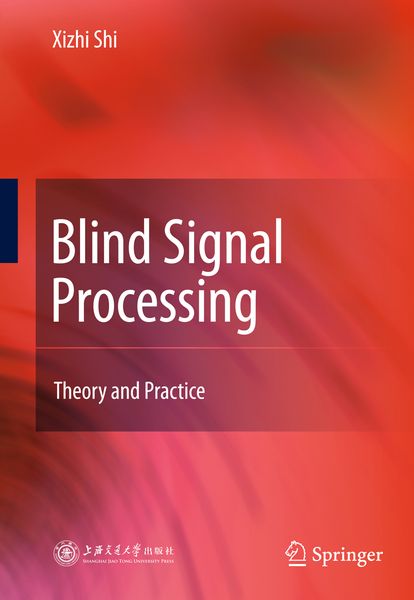
"Blind Signal Processing: Theory and Practice" not only introduces related fundamental mathematics, but also reflects the numerous advances in the field, such as probability density estimation-based processing algorithms, underdetermined models, complex value methods, uncertainty of order in the separation of convolutive mixtures in frequency domains, and feature extraction using Independent Component Analysis (ICA). At the end of the book, results from a study conducted at Shanghai Jiao Tong University in the areas of speech signal processing, underwater signals, image feature extraction, data compression, and the like are discussed.
This book will be of particular interest to advanced undergraduate students, graduate students, university instructors and research scientists in related disciplines. Xizhi Shi is a Professor at Shanghai Jiao Tong University.
Noch keine Bewertungen vorhanden
Verfassen Sie die erste Bewertung zu diesem Artikel
Helfen Sie anderen Kundinnen und Kunden durch Ihre Meinung.