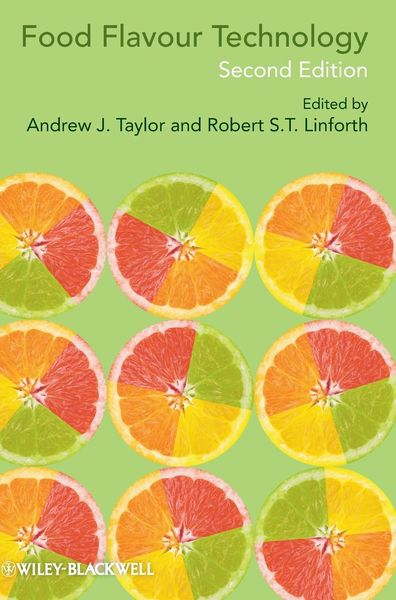
Food Flavour Technology
Fr. 279.00
inkl. gesetzl. MwSt.,
Beschreibung
Produktdetails
Einband
Gebundene Ausgabe
Erscheinungsdatum
08.03.2010
Herausgeber
Taylor Andrew J. + weitereVerlag
John Wiley & Sons IncSeitenzahl
360
Maße (L/B/H)
25/17.5/2.5 cm
Gewicht
957 g
Auflage
2. Auflage
Sprache
Englisch
ISBN
978-1-4051-8543-1
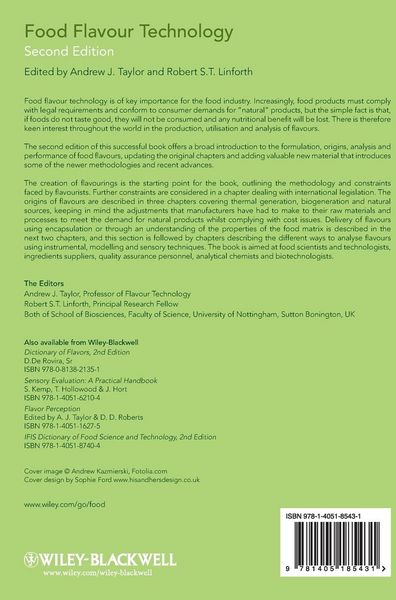
Food flavour technology is of key importance for the food industry. Increasingly, food products must comply with legal requirements and conform to consumer demands for "natural" products, but the simple fact is that, if foods do not taste good, they will not be consumed and any nutritional benefit will be lost. There is therefore keen interest throughout the world in the production, utilisation and analysis of flavours.
The second edition of this successful book offers a broad introduction to the formulation, origins, analysis and performance of food flavours, updating the original chapters and adding valuable new material that introduces some of the newer methodologies and recent advances.
The creation of flavourings is the starting point for the book, outlining the methodology and constraints faced by flavourists. Further constraints are considered in a chapter dealing with international legislation. The origins of flavours are described in three chapters covering thermal generation, biogeneration and natural sources, keeping in mind the adjustments that manufacturers have had to make to their raw materials and processes to meet the demand for natural products whilst complying with cost issues. Delivery of flavours using encapsulation or through an understanding of the properties of the food matrix is described in the next two chapters, and this section is followed by chapters describing the different ways to analyse flavours using instrumental, modelling and sensory techniques. The book is aimed at food scientists and technologists, ingredients suppliers, quality assurance personnel, analytical chemists and biotechnologists.
The second edition of this successful book offers a broad introduction to the formulation, origins, analysis and performance of food flavours, updating the original chapters and adding valuable new material that introduces some of the newer methodologies and recent advances.
The creation of flavourings is the starting point for the book, outlining the methodology and constraints faced by flavourists. Further constraints are considered in a chapter dealing with international legislation. The origins of flavours are described in three chapters covering thermal generation, biogeneration and natural sources, keeping in mind the adjustments that manufacturers have had to make to their raw materials and processes to meet the demand for natural products whilst complying with cost issues. Delivery of flavours using encapsulation or through an understanding of the properties of the food matrix is described in the next two chapters, and this section is followed by chapters describing the different ways to analyse flavours using instrumental, modelling and sensory techniques. The book is aimed at food scientists and technologists, ingredients suppliers, quality assurance personnel, analytical chemists and biotechnologists.
Noch keine Bewertungen vorhanden
Verfassen Sie die erste Bewertung zu diesem Artikel
Helfen Sie anderen Kundinnen und Kunden durch Ihre Meinung.