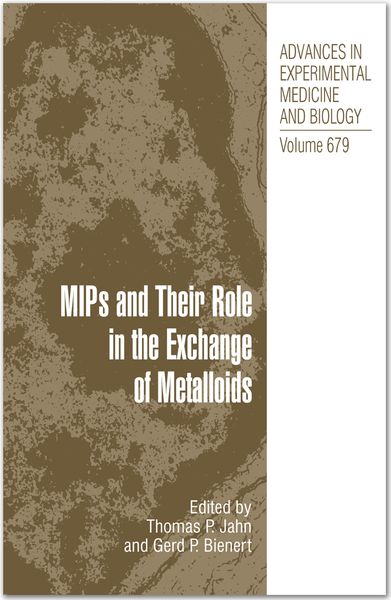
Produktbild: MIPs and Their Roles in the Exchange of Metalloids
Band 679

MIPs and Their Roles in the Exchange of Metalloids

Fr. 192.00

inkl. gesetzl. MwSt., Versandkostenfrei


Beschreibung

Produktdetails

Einband

Gebundene Ausgabe

Erscheinungsdatum

05.05.2010

Herausgeber

Thomas P. Jahn + weitere

Verlag

Springer Us

Seitenzahl

145

Maße (L/B/H)

26.2/17.4/1.5 cm

Gewicht

428 g

Auflage

2010

Sprache

Englisch

ISBN

978-1-4419-6314-7

Beschreibung

Produktdetails

Einband

Gebundene Ausgabe

Erscheinungsdatum

05.05.2010

Herausgeber

Verlag

Springer Us

Seitenzahl

145

Maße (L/B/H)

26.2/17.4/1.5 cm

Gewicht

428 g

Auflage

2010

Sprache

Englisch

ISBN

978-1-4419-6314-7

Herstelleradresse

Libri GmbH
Europaallee 1
36244 Bad Hersfeld
DE

Email: GPSR Kontakt

Noch keine Bewertungen vorhanden

Verfassen Sie die erste Bewertung zu diesem Artikel

Helfen Sie anderen Kundinnen und Kunden durch Ihre Meinung.

Kundinnen und Kunden meinen

Bewertungen (0)

Weitere Artikel finden Sie in

  • Produktbild: MIPs and Their Roles in the Exchange of Metalloids
  • 1. Aquaporins: A Family of Highly Regulate d Multifunctional Channels
    Charles Hachez and François Chaumont
    Abstract
    Introduction—The Discovery of Aquaporins
    Topology of Aquaporins
    Selectivity of Aquaporins
    Measurement of Aquaporin Activity and Water Movement
    Aquaporin Inhibition
    Phenotype Analysis Reveals Involvement of Aquaporins in Key Physiological Processes
    Aquaporin Regulation: Gating and Localization
    Conclusion
    2. Phylogeny of Major Intrinsic Proteins
    Jonas Å.H. Danielson and Urban Johanson
    Abstract
    Introduction
    A Historical Account of the MIP Phylogeny
    Plant MIPs
    Phylogenetic Analysis of NIPs
    Solute Transport
    NIP?Like Bacterial MIPs and Ancestral State of ar/R Filter
    Conclusion
    3. Metalloids, Soil Chemistry and the Environment
    Enzo Lombi and Peter E. Holm
    Abstract
    Introduction
    Historical Perspective
    Environmental Relevance
    Factors Controlling Bioavailability
    Assessing Soil Bioavailability of Metalloids
    Conclusion
    4. Arsenic Transport in Prokaryotes and Eukaryotic Microbes
    Barry P. Rosen and Markus J. Tamás
    Abstract
    Introduction
    Metalloid Transport in Prokaryotes
    Metalloid Transport in Eukaryotic Microbes
    Conclusion
    5. Metalloid Transport by Aquaglyceroporins: Consequences in the Treatment of Human Diseases
    Rita Mukhopadhyay and Eric Beitz
    Abstract
    Introduction
    Metalloids and Cancer
    Uptake of Metalloids via Human Aquaglyceroporins
    Metalloids in Protozoan Parasitic Infections
    Parasite Aquaglyceroporins Facilitate Metalloid Transport
    Therapeutic Modulation of AQP Permeability
    Conclusion
    6. Roles of Vertebrate Aquaglyceroporins in Arsenic Transport and Detoxification
    Zijuan Liu
    Abstract
    Introduction
    Expression of Vertebrate Aquaglyceroporins
    Arsenic Is Both an Environmental Toxin and Human Carcinogen
    Uptake of Organic and Inorganic Arsenic via Aquaglyceroporins
    Molecular Mechanisms for Arsenic Translocation by Aquaglyceroporins
    Arsenic Toxicity in Relation of Aquaglyceroporins Regulation
    Perspectives
    Conclusion
    7. Molecular Mechanisms of Boron Transportin Plants: Involvement of Arabidopsis NIP5;1 and NIP6;1
    Kyoko Miwa, Mayuki Tanaka, Takehiro Kamiya and Toru Fujiwara
    Abstract
    Physiological Function of Boron in Plants
    Physiological Analysis of B Transport
    Molecular Mechanisms of B Transport
    Improvement of Plant Growth Property through BOR and NIP Transporters
    Conclusion and Foresights
    8. Silicon Transporters in Higher Plants
    Jian Feng Ma
    Abstract
    Introduction
    Silicon Transporters
    Influx Si Transporters
    Efflux Transporter of Silicon
    Difference in Si Uptake System between Paddy and Field Crops
    Silicon Transporters for Xylem Unloading
    Conclusion
    9. Major Intrinsic Proteins and Arsenic Transport in Plants: New Players and Their Potential Roles
    Gerd P. Bienert and Thomas P. Jahn
    Abstract
    Introduction
    The Challenge of As Speciation in Plants
    Transport of As in Plants
    What Do the Different “Omics” Tell Us About NIP?Mediated As Transmembrane Transport?
    The Physiological Role of NIPs
    Plant NIPs Transport Trivalent Antimony
    Conclusion
    10. Major Intrinsic Proteins in Biomimetic Membranes
    Claus Hélix Nielsen
    Abstract
    Introduction
    Biomimetic Membranes
    MIP Biomimetic Membranes and Osmotic Processes
    Conclusion
    Index