• Produktbild: Manufacturing Systems
  • Produktbild: Manufacturing Systems

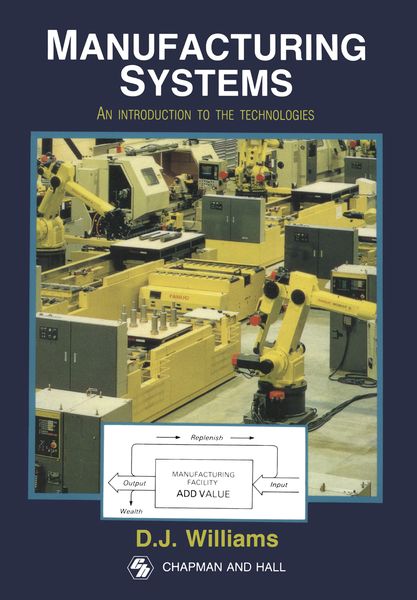
Manufacturing Systems An introduction to the technologies

Fr. 72.90

inkl. gesetzl. MwSt., Versandkostenfrei


Beschreibung

Produktdetails

Einband

Taschenbuch

Erscheinungsdatum

30.06.1988

Verlag

Springer Us

Seitenzahl

208

Maße (L/B/H)

24.4/17/1.3 cm

Gewicht

402 g

Sprache

Englisch

ISBN

978-0-412-38480-6

Beschreibung

Produktdetails

Einband

Taschenbuch

Erscheinungsdatum

30.06.1988

Verlag

Springer Us

Seitenzahl

208

Maße (L/B/H)

24.4/17/1.3 cm

Gewicht

402 g

Sprache

Englisch

ISBN

978-0-412-38480-6

Herstelleradresse

Springer-Verlag KG
Sachsenplatz 4-6
1201 Wien
AT

Email: ProductSafety@springernature.com

Kundinnen und Kunden meinen

0 Bewertungen

Informationen zu Bewertungen

Zur Abgabe einer Bewertung ist eine Anmeldung im Konto notwendig. Die Authentizität der Bewertungen wird von uns nicht überprüft. Wir behalten uns vor, Bewertungstexte, die unseren Richtlinien widersprechen, entsprechend zu kürzen oder zu löschen.

Die Bewertungen sind nach Format, Anzahl Sterne und Datum sortiert.

Verfassen Sie die erste Bewertung zu diesem Artikel

Helfen Sie anderen Kund*innen durch Ihre Meinung

Kundinnen und Kunden meinen

0 Bewertungen filtern

  • Produktbild: Manufacturing Systems
  • Produktbild: Manufacturing Systems
  • 1 Introduction — manufacturing systems approaches.- 1.1 Introduction.- 1.2 The structure of the book.- 1.3 Single machines.- 1.4 Cells, assembly and systems.- 1.5 The manufacturing process.- 1.6 Business drives for manufacturing.- 1.7 Manufacturing systems approaches.- 1.8 Top down approaches.- 1.9 Bottom up approaches.- 1.10 Automation and people.- 2 More conventional approaches to factory layout.- 2.1 Introduction.- 2.2 Traditional factory layouts.- 2.3 Static build.- 2.4 Process-based layout.- 2.5 Product-based layouts.- 2.6 Techniques of factory layout.- 2.7 More recent advances on traditional approaches.- 2.8 Group technology.- 2.9 Dedicated automation.- 2.10 Kanban.- 3 The machining centre — a servo-controlled machine tool.- 3.1 Introduction.- 3.2 Feedback control.- 3.3 The horizontal machining centre.- 3.4 Constraints on the operation of machine tools.- 3.5 Elastic and thermal effects in machine tools.- 3.6 Regenerative chatter in machine tools.- 3.7 Programmable processes.- 4 The robot — a handling device, a manipulator.- 4.1 Introduction.- 4.2 A definition of the industrial robot.- 4.3 Discussion of the definition.- 4.4 Robot types.- 4.5 Robot construction.- 4.6 Manipulation with robots.- 4.7 The robot skeleton.- 4.8 Cartesian-to-Joint-Space transformation.- 4.9 The practical application of robots.- 4.10 Grippers.- 4.11 Sensory robots.- 5 Sensing.- 5.1 Sensors for manufacturing.- 5.2 Sensors to monitor position.- 5.3 Proximity sensors.- 5.4 Tough trigger probes.- 5.5 Tool breakage sensing.- 5.6 Torque and power monitoring.- 5.7 Force sensing.- 5.8 Machine vision.- 5.9 Image generation.- 5.10 Image enhancement.- 5.11 Image processing.- 5.12 Image analysis and object recognition.- 5.13 Use of image information.- 5.14 An example of vision linked with a robot.- 6 Software for single machines.- 6.1 Introduction.- 6.2 Machine tool programming.- 6.3 Manual part programming — machine tool code programming.- 6.4 Computer-assisted part programming.- 6.5 Conversational part programming.- 6.6 NC Programming from a CAD system, CADCAM.- 6.7 Representation of 3D (three-dimensional) shapes.- 6.8 CADCAM and CIM (Computer Integrated Manufacturing).- 6.9 Robot programming.- 6.10 Teach-by-showing.- 6.11 High level languages.- 6.12 Robot programming from CAD systems.- 6.13 Flow of control.- 7 The manufacturing cell — the building block of systems.- 7.1 Introduction.- 7.2 Cells of factory automation.- 7.3 Advantages and disadvantages of cellular approaches.- 7.4 Applications of the cellular philosophy.- 7.5 A prismatic machining cell.- 7.6 A turning cell.- 7.7 Differences between prismatic and rotational cells.- 7.8 A robot welding cell.- 7.9 A cell with automatic changeover.- 7.10 Cell simulation.- 7.11 The Petri net.- 7.12 Cell justification.- 8 Assembly.- 8.1 Introduction.- 8.2 Parts mating theory.- 8.3 Jamming.- 8.4 Wedging.- 8.5 Remote centre compliance.- 8.6 SCARA robots.- 8.7 Design for assembly.- 8.8 Rules for product design.- 8.9 Rules for the design of parts.- 8.10 Manual assembly.- 8.11 Dedicated assembly automation.- 8.12 Programmable assembly automation.- 9 The automated factory and systems.- 9.1 Introduction.- 9.2 Flexibility and reconfigurability.- 9.3 A hierarchical view of manufacturing.- 9.4 Generic elements of manufacturing systems.- 9.5 Direct numerical control.- 9.6 Flexible cells.- 9.7 Flexible transfer lines.- 9.8 A robot transfer line.- 9.9 A CNC machine tool transfer line.- 9.10 A SMD assembly transfer line.- 9.11 Flexible manufacturing systems.- 9.12 A monolithic FMS.- 9.13 Cell based systems.- 9.14 Virtual systems.- 9.15 Hybrid systems.- 9.16 People in systems.- 9.17 Simulation in system design.- 9.18 Application areas.- 10 Computer control of manufacturing systems.- 10.1 Introduction.- 10.2 Computer requirements for process control.- 10.3 A multivariable servomechanism.- 10.4 Hierarchical control.- 10.5 Control networks.- 10.6 Interfacing.- 10.7 Data transmission.- 10.8 Open Systems Interconnection (OSI) and LAN’s.- 10.9 Problems with Local Area Networks.- 10.10 Ethernet.- 10.11 Token rings.- 10.12 The Manufacturing Automation Protocol (MAP).- 10.13 Databases in control.- 10.14 Control hierarchy embodiment.- 10.15 Control computer embodiment.- 10.16 Host and mini computers.- 10.17 Microcomputers.- 10.18 Programmable Logic Controllers.- 10.19 Machine controllers.- 10.20 Heterarchic architectures.- 11 System software.- 11.1 Introduction.- 11.2 Software tasks in manufacturing systems.- 11.3 Scheduling.- 11.4 Generation of management information.- 11.5 Part program communication.- 11.6 Data and databases.- 11.7 Interfaces to other sub-systems.- 11.8 Control of closely co-operating machines.- 11.9 Machine monitoring.- 11.10 High level sensor interfaces.- 11.11 Design requirements of real-time languages.- 11.12 Programming languages for system control.- 11.13 Cell control computer languages.- 11.14 Programming Programmable Logic Controllers.- 11.15 Flow of control commands in robots.- 11.16 Rule driven systems.- 11.17 The future.- Further Reading.