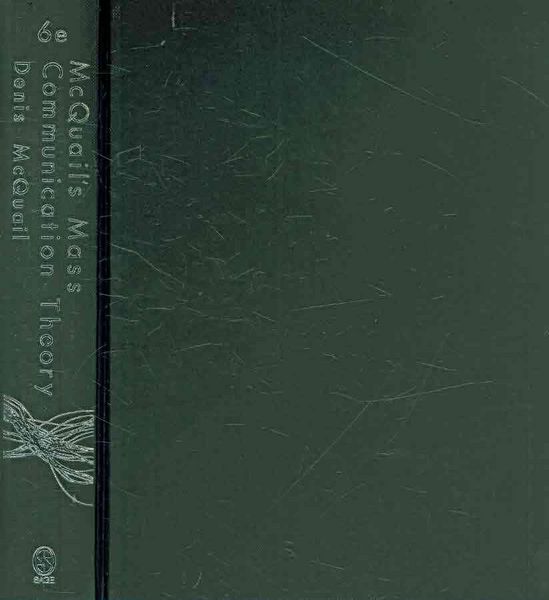
Produktbild: Mcquail, D: McQuail's Mass Communication Theory

Mcquail, D: McQuail's Mass Communication Theory

Fr. 188.00

inkl. gesetzl. MwSt., Versandkostenfrei


Beschreibung

Produktdetails

Einband

Gebundene Ausgabe

Erscheinungsdatum

18.02.2010

Verlag

Sage Publications

Seitenzahl

632

Maße (L/B/H)

23.9/19.5/4.1 cm

Gewicht

1260 g

Auflage

6 Revised edition

Sprache

Englisch

ISBN

978-1-84920-291-6

Beschreibung

Produktdetails

Einband

Gebundene Ausgabe

Erscheinungsdatum

18.02.2010

Verlag

Sage Publications

Seitenzahl

632

Maße (L/B/H)

23.9/19.5/4.1 cm

Gewicht

1260 g

Auflage

6 Revised edition

Sprache

Englisch

ISBN

978-1-84920-291-6

Kundinnen und Kunden meinen

0 Bewertungen

Informationen zu Bewertungen

Zur Abgabe einer Bewertung ist eine Anmeldung im Konto notwendig. Die Authentizität der Bewertungen wird von uns nicht überprüft. Wir behalten uns vor, Bewertungstexte, die unseren Richtlinien widersprechen, entsprechend zu kürzen oder zu löschen.

Die Bewertungen sind nach Format, Anzahl Sterne und Datum sortiert.

Verfassen Sie die erste Bewertung zu diesem Artikel

Helfen Sie anderen Kund*innen durch Ihre Meinung

Kundinnen und Kunden meinen

0 Bewertungen filtern

  • Produktbild: Mcquail, D: McQuail's Mass Communication Theory
  • PART ONE: PRELIMINARIES
    1. Introduction to the Book
    Our object of study
    The structure of the book
    Themes and issues in mass communication
    Manner of treatment
    How to use the book
    Limitations of coverage and perspective
    Different kinds of theory
    Communication science and the study of mass communication
    Alternative traditions of analysis: structural, behavioural and cultural
    Conclusion
    2. The Rise of Mass Media
    From the beginning to mass media
    Print media: the book
    Print media: the newspaper
    Other print media
    Film as a mass medium
    Broadcasting
    Recorded music
    The communications revolution: new media versus old
    Differences between media
    Conclusion
    PART TWO: THEORIES
    3. Concepts and Models for Mass Communication
    Early perspectives on media and society
    The 'mass' concept
    The mass communication process
    The mass audience
    The mass media as an institution of society
    Mass culture and popular culture
    The rise of a dominant paradigm for theory and research
    An alternative, critical paradigm
    Four models of communication
    Conclusion
    4. Theory of Media and Society
    Media, society and culture: connections and conflicts
    Mass communication as a society-wide process: the mediation of social relations and experience
    A frame of reference for connecting media with society
    Theme I: power and inequality
    Theme II: social integration and identity
    Theme III: social change and development
    Theme IV: space and time
    Media-society theory I: the mass society
    Media-society theory II: Marxism and political economy
    Media-society theory III: functionalism
    Media-society theory IV: social constructionism
    Media-society theory V: communication technology determinism
    Media-society theory VI: the information society
    Conclusion
    5. Mass Communication and Culture
    Communication and culture
    The beginnings: the Frankfurt School and critical cultural theory
    The redemption of the popular
    Gender and the mass media
    Commercialization
    Communication technology and culture
    Mass media and postmodern culture
    Conclusion
    6. New Media - New Theory?
    New media and mass communication
    What is new about the new media?
    The main themes of new media theory
    Applying medium theory to the new media
    New patterns of information traffic
    Computer-mediated community formation
    Political participation, new media and democracy
    Technologies of freedom?
    New equalizer or divider?
    Conclusion
    7. Normative Theory of Media and Society
    Sources of normative obligation
    The media and the public interest
    Main issues for social theory of the media
    Early approaches to theory: the press as 'fourth estate'
    The 1947 Commission on Freedom of the Press and the social theory of responsibility
    Professionalism and media ethics
    Four Theories of the Press and beyond
    The public service broadcasting alternative
    Mass media, civil society and the public sphere
    Response to the discontents of the public sphere
    Alternative visions
    Normative media theory: four models
    Conclusion
    PART THREE: STRUCTURES
    8. Media Structure and Performance: Principles and Accountability
    Media freedom as a principle
    Media equality as a principle
    Media diversity as a principle
    Truth and information quality
    Social order and solidarity
    Cultural order
    The meaning of accountability
    Two alternative models of accountability
    Lines and relations of accountability
    Frames of accountability
    Conclusion
    9. Media Economics and Governance
    Media 'not just any other business'
    The basics of media structure and levels of analysis
    Some economic principles of media structure
    Ownership and control
    Competition and concentration
    Mass media governance
    The regulation of mass media: alternative models
    Media policy paradigm shifts
    Media systems and political systems
    Conclusion
    10. Global Mass Communication
    Origins of globalization
    Driving forces: technology and money
    Global media structure
    Multinational media ownership and control
    Varieties of global mass media
    International media dependency
    Cultural imperialism and beyond
    The media transnationalization process
    International news flow
    The global trade in media culture
    Towards a global media culture?
    Global media governance
    Conclusion
    PART FOUR: ORGANIZATIONS
    11. The Media Organization: Pressures and Demands
    Research methods and perspectives
    The main issues
    Levels of analysis
    The media organization in a field of social forces
    Relations with society
    Relations with pressure and interest groups
    Relations with owners and clients
    Relations with the audience
    Aspects of internal structure and dynamics
    The influence of personal characteristics of mass communicators
    Role conflicts and dilemmas
    Conclusion
    12. The Production of Media Culture
    Media-organizational activities: gatekeeping and selection
    Influences on news selection
    The struggle over access between media and society
    The influence of sources on news
    Media-organizational activity: processing and presentation
    The logic of media culture
    Alternative models of decision-making
    The coming of convergence culture: consumers as producers
    Conclusion
    PART FIVE: CONTENT
    13. Media Content: Issues, Concepts and Methods of Analysis
    Why study media content?
    Critical perspectives on content
    Structuralism and semiology
    Media content as information
    Media performance discourse
    Objectivity and its measurement
    Questions of research method
    Traditional content analysis
    Quantitative and qualitative analysis compared
    Conclusion
    14. Media Genres and Texts
    Questions of genre
    Genre and the internet
    The news genre
    The structure of news: bias and framing
    News as narrative
    Television violence
    The cultural text and its meanings
    Conclusion
    PART SIX: AUDIENCES
    15. Audience Theory and Research Traditions
    The audience concept
    The original audience
    From mass to market
    Goals of audience research
    Alternative traditions of research
    Audience issues of public concern
    Types of audience
    The audience as a group or public
    The gratifi cation set as audience
    The medium audience
    Audience as defi ned by channel or content
    Questions of audience reach
    Activity and selectivity
    Conclusion
    16. Audience Formation and Experience
    The 'why' of media use
    A structural approach to audience formation
    The uses and gratifi cations approach
    An integrated model of audience choice
    Public and private spheres of media use
    Subculture and audience
    Lifestyle
    Gendered audiences
    Sociability and uses of the media
    Normative framing of media use
    Audience norms for content
    The view from the audience
    Media fandom
    The end of the audience?
    The 'escape' of the audience
    The future of the audience
    The audience concept again
    Conclusion
    PART SEVEN: EFFECTS
    17. Processes and Models of Media Effects
    The premise of media effect
    The natural history of media effect research and theory: four phases
    Types of communicative power
    Levels and kinds of effects
    Processes of media effect: a typology
    Individual response and reaction: the stimulus-response model
    Mediating conditions of effect
    Source-receiver relations and effect
    The campaign
    Conclusion
    18. Social-Cultural Effects
    A model of behavioural effect
    The media, violence and crime
    Media, children and young people
    Collective reaction effects
    Diffusion of innovation and development
    The social distribution of knowledge
    Social learning theory
    Socialization
    Social control and consciousness formation
    Cultivation
    Media and long-term social and cultural change
    Entertainment effects
    Conclusion
    19. News, Public Opinion and Political Communication
    Learning from news
    News diffusion
    Framing effects
    Agenda-setting
    Effects on public opinion and attitudes
    The elaboration-likelihood model of infl uence
    The spiral of silence: the formation of climates of opinion
    Structuring reality and unwitting bias
    The communication of risk
    Political communication effects in democracies
    Effects on the political institution and process
    Media influence on event outcomes
    Propaganda and war
    Internet news effects
    Conclusion
    EPILOGUE
    20. The Future of Mass Communication
    Origins of the mass communication idea
    The end of mass communication?
    The survival of mass communication
    The consequences of new media for mass communication
    Conclusion