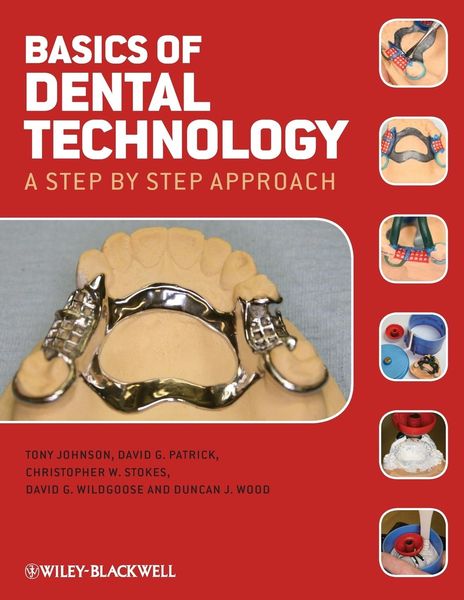
Produktbild: Basics of Dental Technology

Basics of Dental Technology A Step by Step Approach

Fr. 68.90

inkl. gesetzl. MwSt., Versandkostenfrei


Beschreibung

Produktdetails

Einband

Taschenbuch

Erscheinungsdatum

01.12.2010

Verlag

John Wiley & Sons Inc

Seitenzahl

256

Maße (L/B/H)

28/21.6/1 cm

Gewicht

550 g

Auflage

1. Auflage

Sprache

Englisch

ISBN

978-1-4051-7875-4

Beschreibung

Rezension

"Johnson et al. (restorative dentistry, U. of Sheffield, UK) offer a resource for trainee dental technicians and undergraduate students to current techniques and materials used in dental technology. Using a task-based approach and color photos, they outline step-by-step instructions, equipment, procedures, safety tips, and explanations of impression handling, model production, tray construction, articulators and facebows, complete and partial dental prosthetics, fixed prosthodontics, orthodontic work, occlusion and implants, and aesthetics." ( Reference and Research Book News , February 2011)

Produktdetails

Einband

Taschenbuch

Erscheinungsdatum

01.12.2010

Verlag

John Wiley & Sons Inc

Seitenzahl

256

Maße (L/B/H)

28/21.6/1 cm

Gewicht

550 g

Auflage

1. Auflage

Sprache

Englisch

ISBN

978-1-4051-7875-4

Noch keine Bewertungen vorhanden

Verfassen Sie die erste Bewertung zu diesem Artikel

Helfen Sie anderen Kundinnen und Kunden durch Ihre Meinung.

Kundinnen und Kunden meinen

Bewertungen (0)

Die Leseprobe wird geladen.
  • Produktbild: Basics of Dental Technology
  • Chapter 1 INTRODUCTION.

    1.1 Introduction.

    1.2 How to use this book.

    1.3 Equipment and Instruments.

    1.4 Health and safety in the dental laboratory.

    1.5 Sterilisation and impression handling.

    1.6 Introduction to model making.

    1.7 Models for prosthodontics - casting primary impressions.

    1.8 Models for prosthodontics - boxing-in impressions.

    1.9 Models for prosthodontics - casting working (secondary) impressions.

    1.10 Models for prosthodontics - models for cobalt-chromium frameworks.

    1.11 Orthodontic study models.

    1.12 Introduction to sectional models.

    1.13 Producing a sectional model using a tray system.

    1.14 Producing a sectional model using a pinned system.

    1.15 Sectioning the model.

    1.16 Introduction to articulating models.

    1.17 Articulating models on a simple hinge articulator.

    1.18 Articulating dentate models using the average position.

    1.19 Articulating edentulous models using the average position.

    1.20 Articulating models using a facebow.

    Chapter 2 COMPLETE PROSTHETICS.

    2.1 Introduction to complete prosthetics.

    2.2 Construction of a close-fi tting custom impression tray.

    2.3 Construction of a tray with spacer for edentulous cases.

    2.4 Construction of a tray for dentate or partially dentate cases.

    2.5 Construction of a windowed close-fi tting tray.

    2.6 Construction of occlusal registration rims.

    2.7 Setting up denture teeth.

    2.8 Denture processing.

    2.9 Grinding and finishing the dentures.

    2.10 Denture repair.

    2.11 Relining a denture in the laboratory.

    2.12 Copy dentures.

    Chapter 3 PARTIAL PROSTHETICS.

    3.1 Introduction to partial prosthetics.

    3.2 Classifi cation.

    3.3 Component parts of partial dentures.

    3.4 Surveying.

    3.5 Designing partial dentures.

    3.6 Partial denture construction - acrylic resin.

    3.7 Partial denture construction - cobalt-chromium.

    Chapter 4 FIXED PROSTHODONTICS.

    4.1 Restoration design.

    4.2 Metal restorations.

    4.3 Ditching the die.

    4.4 Producing a wax pattern.

    4.5 Investing the wax pattern.

    4.6 Casting and de-vesting the pattern.

    4.7 Finishing the casting.

    4.8 Metal-ceramic restorations.

    4.9 Producing a wax pattern for a metal bonded to ceramic framework.

    4.10 Investing the wax pattern.

    4.11 Casting the pattern.

    4.12 De-vesting and surface preparation.

    4.13 Ceramic application and build-up.

    4.14 Ceramic restorations.

    4.15 Producing a high-strength ceramic substructure.

    4.16 Veneering a high-strength ceramic substructure.

    4.17 Producing a resin-bonded crown on a refractory die.

    4.18 Post crowns.

    4.19 Bridges.

    4.20 Producing a cast metal fi xed-fi xed restoration.

    4.21 Producing a soldered metal fi xed-fi xed restoration.

    4.22 Soldering.

    4.23 Minimal preparation bridges.

    4.24 Producing a minimal preparation bridge (Maryland technique).

    4.25 CEREC CAD-CAM.

    4.26 CEREC - producing a single-unit substructure.

    4.27 CEREC - producing a posterior single-unit substructure or restoration using a reduction technique.

    4.28 CEREC - producing a bridge substructure.

    4.29 Implant-supported prosthodontics.

    Chapter 5 ORTHODONTICS.

    5.1 Introduction to orthodontics.

    5.2 Classifi cation of malocclusions.

    5.3 Theory of tooth movement.

    5.4 Basic wire bending techniques.

    5.5 Making passive components.

    5.6 Producing ball-ended clasps.

    5.7 The Adams clasp.

    5.8 Producing a Southend clasp.

    5.9 Active appliances.

    5.10 Palatal fi nger spring (guarded).

    5.11 Making a T-spring.

    5.12 Double cantilever or Z-spring.

    5.13 Buccal canine retractor.

    5.14 The Roberts retractor.

    5.15 Producing baseplates.

    5.16 Producing biteplanes.

    5.17 Extra-oral anchorage.

    5.18 Functional appliance design.

    5.19 Producing an Andresen appliance.

    5.20 Twin-block appliance.

    5.21 Fixed orthodontic appliances.

    5.22 Retainer appliance design.

    5.23 Repair and modifi cation of orthodontic appliances.

    Chapter 6 OCCLUSION.

    6.1 Introduction to occlusion.

    6.2 Occlusal schemes.

    6.3 Articulators.

    6.4 Facebows.

    6.5 Summary.

    Chapter 7 SHADE AND COLOUR.

    7.1 Introduction to aesthetics.

    7.2 Colour terminology.

    7.3 Shade guides.

    Appendix TOOTH MORPHOLOGY.

    GLOSSARY.

    INDEX