Gutscheinbedingungen

*Gültig bis 05.07.2026 auf (fast) alles. Ausgeschlossen sind Smartboxen, Zeitschriften, Tickets, Lebensmittel, Gaming-Elektroartikel, Tinte/Toner, Gutscheine, Geschenkkarten, Blumen und Abos | Einlösbar in allen Buchhandlungen von Orell Füssli, Barth Bücher, Buchladen Rapunzel, Papeterie Köhler, Schuler Orell Füssli, Stauffacher und ZAP unter Vorweisung des Gutscheins, auf www.orellfüssli.ch durch Eingabe des Gutscheincodes. Beim Service „eBooks verschenken“ und bei eBook-Käufen via eReader nicht einlösbar | Mindesteinkaufswert: Fr. 30.- | Nicht mit anderen Rabatten kumulierbar.

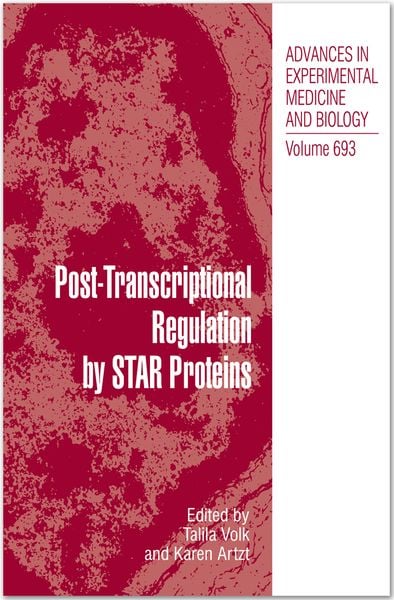
Produktbild: Post‑Transcriptional Regulation by STAR Proteins
Band 693

Post‑Transcriptional Regulation by STAR Proteins Control of RNA Metabolism in Development and Disease

Fr. 242.00

inkl. gesetzl. MwSt., Versandkostenfrei


Beschreibung

Produktdetails

Einband

Gebundene Ausgabe

Erscheinungsdatum

01.09.2010

Herausgeber

Talila Volk + weitere

Verlag

Springer Us

Seitenzahl

162

Maße (L/B/H)

25.7/17/1.5 cm

Gewicht

508 g

Auflage

2010

Sprache

Englisch

ISBN

978-1-4419-7004-6

Beschreibung

Portrait

Talila Volk is an associate professor in the field of Developmental Biology and the incumbent of the Sir Ernest B. Chain Professional Chair. Her major research interest is in tissue morphogenesis and organogenesis during embryonic development. She has been studying the function and activity of the STAR family member Held Out Wing (HOW) in the fruit fly Drosophila since 1999. She served as the chair for the Society of Developmental Biology in Israel (ISDB). Dr. Volk has gained her BSc from Tel‑Aviv University, and her MSc and PhD degrees from the Weizmann Institute of Science, Rehovot, Israel.

Karen Artzt is an Ashbel Smith Professor Emeritus at the University of Texas at Austin where she directed a research laboratory for 20 years. There she was a member of the Section of Molecular Genetics and Microbiology. Prior to that she was an associate Member of the Memorial Sloan Kettering Cancer Center in New York. Her main research interests include developmental genetics with an emphasis on cancer biology. In collaboration with Tom Ebersole she identified and cloned the mouse gene quaking that was one of the founding members of the STAR family. Dr. Artzt received her academic degrees from Cornell university; a BA from the Ithaca campus and a PhD from the Medical College School of Graduate Sciences in New York City. In 1972 she spent a year as a postdoctoral fellow at the Pasteur Institute in Paris under the direction of the Nobel Prize winner, Francois Jacob.

Produktdetails

Einband

Gebundene Ausgabe

Erscheinungsdatum

01.09.2010

Herausgeber

Verlag

Springer Us

Seitenzahl

162

Maße (L/B/H)

25.7/17/1.5 cm

Gewicht

508 g

Auflage

2010

Sprache

Englisch

ISBN

978-1-4419-7004-6

Herstelleradresse

Springer-Verlag KG
Sachsenplatz 4-6
1201 Wien
AT

Email: GPSR Kontakt

Noch keine Bewertungen vorhanden

Verfassen Sie die erste Bewertung zu diesem Artikel

Helfen Sie anderen Kundinnen und Kunden durch Ihre Meinung.

Kundinnen und Kunden meinen

Bewertungen (0)

  • Produktbild: Post‑Transcriptional Regulation by STAR Proteins
  • 1. STAR TREK: An Introduction to STAR Family Proteins and Review of QKI
    Karen Artzt and Jiang I. Wu
    Abstract
    History of the STAR Family
    The Domain Structure and Alternate Splicing of STAR Proteins
    STAR Proteins Have a Multitude of Developmental Functions
    Diverse Molecular Functions of STAR Proteins in RNA Processing
    Qk Expression in the Adult Nervous System and Disease
    Qk 3? UTR Conservation and a High Theoretical Number of miRNA Binding Sites
    Discussion and Conclusion
    Future Applications, New Research, Anticipated Developments
    2. THE STAR FAMILY MEMBER: QUAKING (QKI) AND CEL SIGNALING
    Yue Feng and Andrew Bankston
    Abstract
    Introduction
    QKI Is Essential for Embryonic and Postnatal Development
    Phosphorylation of QKI Isoforms by Src?PTKS Regulates the Cellular Fate of QKI mRNA Targets at Multiple Post?Transcriptional Steps
    Numerous Extracellular Signals Can Be Linked to the Src?PTK?QKI Pathway
    Potential Role of QKI And Src?PTK Signaling in Tumorigenesis and Cognitive Diseases
    Conclusion
    3. INSIGHTS INTO THE STRUCTURAL BASIS OF RNA RECOGNITION BY STAR DOMAIN PROTEINS
    Sean P. Ryder and Francesca Massi
    Abstract
    Introduction
    The STAR Domain
    RNA Recognition By STAR Proteins
    Star Domain Structure
    Conclusion
    Note Added in Proof
    4. Post?translat ional Regulat ion of STAR Proteins and Effects on Their Biological Functions
    Claudio Sette
    Abstract
    Introduction
    Sam68: A Brief Overview
    Regulation of Sam68 Functions by Tyrosine Phosphorylation
    Regulation of Sam68 Functions by Serine/Threonine Phosphorylation
    Regulation of Sam68 Functions by Methylation
    Regulation of Sam68 Functions by Acetylation and Sumoylation
    Post?Translational Modifications of SLM?1 and SLM?2
    Post?Translational Modifications of the QKI Proteins
    Post?Translational Modifications of SF1
    Conclusion
    5. EXPRESSION AND FUNCTIONS OF THE star PROTEINS Sam68 AND t?star IN MAMMALIAN SPERMATOGENESIS
    Ingrid Ehrmann and David J. Elliott
    Abstract
    Gene Expression Control in Spermatogenesis
    Expression ofSTAR Proteins during Spermatogenesis
    Protein Structure and Modifications
    Mouse Knockout Models Define the Roles of STAR Proteins in Testis Function
    The STAR Protein Sam68 Is Involved in Translational Control in Spermatogenesis
    STAR Proteins Might Play Roles in Pre?mRNA Splicing Control in Spermatogenesis
    Other Potential Roles of STAR Proteins in Spermatogenesis
    Conclusion
    6. The role of quaking in mammalian embryonic development
    Monica J. Justice and Karen K. Hirschi
    Abstract
    Introduction
    Quaking Is Required for the Formation of Embryonic Vasculature
    QKI5 Regulates QKI6 and QKI7 in Visceral Endoderm
    Molecular Basis of Blood Vessel Formation
    Quaking Is Required for Visceral Endoderm Differentiated Function
    Other Possible Roles for Quaking in Cardiovascular Development
    The Evolving Roles of Quaking Function
    Conclusion
    7. Drosophila STAR Proteins: What Can Be Learned from Flies?
    Talila Volk
    Abstract
    STAR Proteins in Drosophila
    HOW Regulates Differentiation of Diverse Tissues
    HOW and Kep1 Regulate Cell Division and Apoptosis in Drosophila
    Conclusion
    Note Added in Proof
    8. C. ELEGANS STAR PROTEINS, GLD?1 AND ASD?2, REGULATE SPECIFIC RNA TARGETS TO CONTROL DEVELOPMENT
    Min?Ho Lee and Tim Schedl
    Abstract
    Multiple Functions of GLD?1 in Germline Development
    GLD?1 Molecular Analysis
    mRNA Targets: GLD?1 Is a Translational Repressor
    mRNA Targets: Further Insights into GLD?1 Function in Germline Development
    mRNA Targets: Towards Defining the GLD?1 RNA Binding Motif and Mechanism of Translational Repression
    How Is GLD?1 Expression Regulated?
    ASD?2, Another C. elegans Star Protein, Functions in Alternative Splicing
    Conclusion
    9. THE BRANCHPOINT BINDING PROTEIN: In and Out of the Spliceosome Cycle
    Brian C. Rymond
    Abstract
    Bbp and Sf1 Are Site?Specific Rna Binding Proteins
    A Bbp?Mud2 Heterodimer Functions in Branchpoint Recognition
    Bbp?Mud2 and the Dynamics of Early Spliceosome Assembly
    Co?Transcriptional Pre?mRNA Splicing
    But Is Bbp Really an