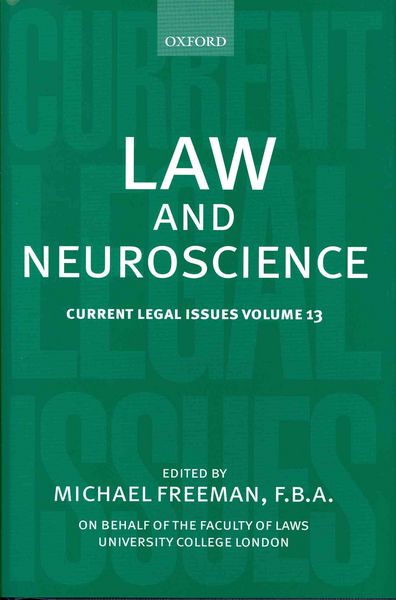
Produktbild: Law & Neuroscience Vol 13 Cli C

Law & Neuroscience Vol 13 Cli C Current Legal Issues Volume 13

Fr. 179.00

inkl. gesetzl. MwSt., Versandkostenfrei


Beschreibung

Produktdetails

Einband

Gebundene Ausgabe

Erscheinungsdatum

10.02.2011

Herausgeber

Michael Freeman

Verlag

Oxford Academic

Seitenzahl

586

Maße (L/B/H)

24/16.1/3.6 cm

Gewicht

1024 g

Sprache

Englisch

ISBN

978-0-19-959984-4

Beschreibung

Produktdetails

Einband

Gebundene Ausgabe

Erscheinungsdatum

10.02.2011

Herausgeber

Michael Freeman

Verlag

Oxford Academic

Seitenzahl

586

Maße (L/B/H)

24/16.1/3.6 cm

Gewicht

1024 g

Sprache

Englisch

ISBN

978-0-19-959984-4

Herstelleradresse

Libri GmbH
Europaallee 1
36244 Bad Hersfeld
DE

Email: gpsr@libri.de

Noch keine Bewertungen vorhanden

Verfassen Sie die erste Bewertung zu diesem Artikel

Helfen Sie anderen Kundinnen und Kunden durch Ihre Meinung.

Kundinnen und Kunden meinen

Bewertungen (0)

  • Produktbild: Law & Neuroscience Vol 13 Cli C
    • 1: M. Freeman: Introduction

    • 2: W. Glannon: What Neuroscience can (and cannot) tell us about criminal responsibility

    • 3: G-J Lokhorst: Mens Rea, Logic and The Brain

    • 4: J. Fischer: Indeterminism and Control: An approach to the problem of luck

    • 5: H. T. Greely: Neuroscience and Criminal Responsibility: Proving "Can't Help Himself" as a narrow bar to criminal liability

    • 6: N. Vincent: Madness, Badness and Neuro-imagining-based responsibility assessments

    • 7: A. L. Roskies and W. Sinnott-Armstrong: Brain Images as Evidence in the Criminal Law

    • 8: J. Buckholtz et al: The Neural Correlates of Third-Party Punishment

    • 9: L. Claydon: Law, Neuroscience and Criminal Culpability

    • 10: T. Y. Blumoff: How (some) Criminals are Made

    • 11: D. Terracina: Neuroscience and Penal Law: Ineffectiveness of the penal systems and flawed perception of the underevaluation of behaviour constituting crime

    • 12: B. J. Grey: Neuroscience and Emotional Harm in Tort Law: Rethinking the American approach to freestanding emotional distress claims

    • 13: J. Carbone: Neuroscience and Ideology: Why science can never supply a complete answer for adolescent immaturity

    • 14: T. Maroney: Adolescent Brain Science and Juvenile Justice

    • 15: R. MacKenzie and M. Sakel: The Neuroscience of Cruelty as Brain Damage: Legal framings of capacity and ethical issues in the neurorehabilitation of Motor Neurone Disease

    • 16: D. Wilkinson and C . Foster: The Carmentis Machine: Legal and ethical issues in the use of neuroimaging to guide treatment withdrawal in newborn infants

    • 17: D. Fox: The Right to Silence as Protecting Mental Control

    • 18: J. J. Fins: Minds Apart: Severe brain injury, citizenship and civil rights

    • 19: A. M. Viens: Reciprocity and Neuroscience in Public Health Law

    • 20: C. Boudreau, S Coulson and M. D. McCubbins: Pathways to Persuasion: How neuroscience can inform the study and practice of law

    • 21: L. Capraro: The Juridical Rise of Emotions in the Decisional Process of Popular Juries

    • 22: D. W. Pfaff: Possible Neural Mechanisms Underlying Ethical Behaviour

    • 23: J. D. Duffy: What Hobbes Left Out: The neuroscience of comparison and its implications for a new Commonwealth

    • 24: S. Goldberg: Neuroscience and the Free Exercise of Religion

    • 25: E. Cárceres: Steps toward a Constructivist and Coherentist Theory of Judicial Reasoning in Civil Law Tradition

    • 26: M. B. Hoffman: Evolutionary Jurisprudence: The end of the naturalistic fallacy and the beginning of natural reform?

    • 27: D. S. Goldberg: The History of Scientific and Clinical Images in Mid-to-Late 19th Century American Legal Culture: Implications for contemporary law and neuroscience

    • 28: S. J. Morse: Lost in Translation? An essay on law and neuroscience