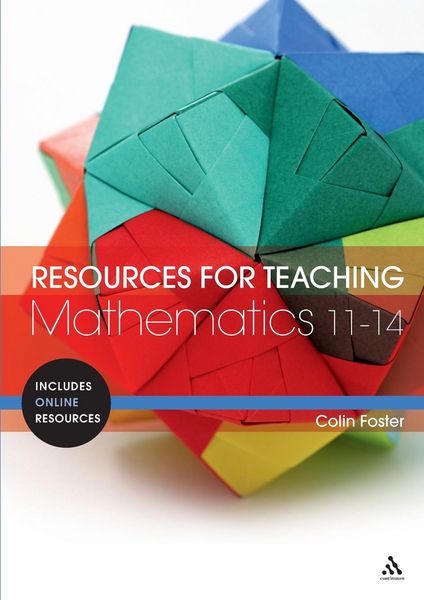
Produktbild: Resources for Teaching Mathematics

Resources for Teaching Mathematics 11-14

Fr. 61.90

inkl. gesetzl. MwSt., Versandkostenfrei


Beschreibung

Produktdetails

Einband

Taschenbuch

Erscheinungsdatum

22.09.2011

Verlag

Bloomsbury Academic

Seitenzahl

226

Maße (L/B/H)

29.7/21/1.2 cm

Gewicht

554 g

Sprache

Englisch

ISBN

978-1-4411-4227-6

Beschreibung

Produktdetails

Einband

Taschenbuch

Erscheinungsdatum

22.09.2011

Verlag

Bloomsbury Academic

Seitenzahl

226

Maße (L/B/H)

29.7/21/1.2 cm

Gewicht

554 g

Sprache

Englisch

ISBN

978-1-4411-4227-6

Herstelleradresse

Libri GmbH
Europaallee 1
36244 Bad Hersfeld
DE

Email: gpsr@libri.de

Noch keine Bewertungen vorhanden

Verfassen Sie die erste Bewertung zu diesem Artikel

Helfen Sie anderen Kundinnen und Kunden durch Ihre Meinung.

Kundinnen und Kunden meinen

Bewertungen (0)

Weitere Artikel finden Sie in

  • Produktbild: Resources for Teaching Mathematics
  • Introduction
    1. Amazing Ways: Counting the numbers of routes through a word maze
    2. Dividing Cakes: Partitioning fractions in different ways
    3. Draw a Picture: Drawing pictures using mathematical graphs
    4. Ever-Increasing Circles: Approximating the area of a circle by counting dots
    5. Factor Trees: Exploring patterns in prime factor trees
    6. Fiddling Averages: Investigating how averages can be manipulated
    7. Folding: Finding connections relating to flat folds
    8. Four Numbers: Generating and solving linear equations
    9. Four Weights: Making as many values as possible from four numbers
    10. Four-Star Hotels: Deducing the contents of a grid from the sums of columns and rows
    11. Fuel: Maximizing the amount of fuel that can be transferred across a desert
    12. Have a Megaday!: Converting time units and using standard prefixes
    13. How Far?: Devising a statistical experiment
    14. Infinity: Exploring a converging sequence
    15. Investigating Mirrors: Finding out what happens when you reflect more than once
    16. Journey Through a Word: Using bearings and distance to describe a route
    17. Ladders: Solving simultaneous equations and drawing straight-line graphs
    18. Make Twenty-Four: Using priority of operations to construct calculations
    19. Meeting Up: Finding out how straight lines relate to their equations
    20. Mystery Messages: Using frequency analysis to crack a substitution code
    21. Newspaper Pages: Investigating the pagination of newspapers and books
    22. One Cut: Categorizing the outcomes from one fold and one cut of a square
    23. Palindromic Numbers: Solving problems relating to palindromic numbers
    24. Percentage Puzzles: Practising mental percentage calculations
    25. Pizza Slices: Finding the areas and perimeters of circular sectors
    26. Rectilinear Shapes: Exploring angles and line segments in rectilinear shapes
    27. Regular Polygons: Understanding necessary and sufficient conditions in geometry
    28. Seven Divided by Three: Partitioning integers and finding patterns
    29. Shape Riddles: Understanding inclusive definitions
    30. Shapes Within Shapes: Relating numerical sequences to geometrical properties
    31. Sharing Camels: Using fractions to solve a remainder problem
    32. Simultaneous Investigation: Finding simultaneous equations with integer solutions
    33. Sinusoids: Examining the sine and cosine graphs
    34. Squares and Remainders: Exploring the divisibility properties of square numbers
    35. Squares and Roots: Finding out how square numbers and surds behave
    36. Star Polygons: Calculating angles in star polygons and drawing them
    37. Street Race: Using travel graphs to solve problems
    38. Symmetrical Possibilities: Finding examples of shapes with specified symmetries
    39. Take a Breath: Estimating and calculating using large numbers
    40. The Playground Problem: Solving a practical minimization problem
    41. The Tailor's Rule of Thumb: Testing statistical hypotheses relating to body proportions
    42. The Totient Function: Investigating patterns in reducible fractions
    43. Three Consecutive Numbers: Using algebra to prove relationships
    44. Transforming Graphs: Carrying out transformations on straight-line graphs
    45. Transport Problems: Solving complicated problems in the best possible way
    46. Trapped Squares: Exploring patterns relating to straight-line graphs
    47. Travel Arrangements: Making and interpreting travel graphs
    48. Triangle Angles: Using simple trigonometry to solve not-so-simple triangles
    49. Vanishing Lines: Explaining an optical illusion using gradient
    50. Water: Calculating volumes and lengths and finding connections
    Other Resources
    Index