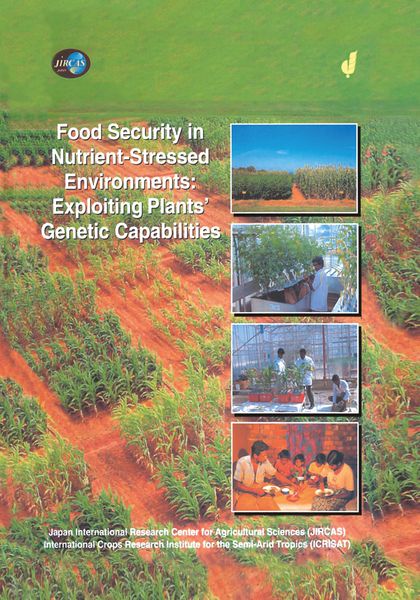
• Produktbild: Food Security in Nutrient-Stressed Environments: Exploiting Plants’ Genetic Capabilities
  • Produktbild: Food Security in Nutrient-Stressed Environments: Exploiting Plants’ Genetic Capabilities
Band 95

Food Security in Nutrient-Stressed Environments: Exploiting Plants’ Genetic Capabilities

Fr. 242.00

inkl. gesetzl. MwSt., Versandkostenfrei


Beschreibung

Produktdetails

Einband

Taschenbuch

Erscheinungsdatum

29.01.2011

Herausgeber

J.J. Adu-Gyamfi

Verlag

Springer Netherland

Seitenzahl

344

Maße (L/B/H)

25.4/17.8/2 cm

Gewicht

670 g

Auflage

2002

Sprache

Englisch

ISBN

978-90-481-6013-6

Beschreibung

Produktdetails

Einband

Taschenbuch

Erscheinungsdatum

29.01.2011

Herausgeber

J.J. Adu-Gyamfi

Verlag

Springer Netherland

Seitenzahl

344

Maße (L/B/H)

25.4/17.8/2 cm

Gewicht

670 g

Auflage

2002

Sprache

Englisch

ISBN

978-90-481-6013-6

Herstelleradresse

Springer-Verlag GmbH
Tiergartenstr. 17
69121 Heidelberg
DE

Email: ProductSafety@springernature.com

Kundinnen und Kunden meinen

0 Bewertungen

Informationen zu Bewertungen

Zur Abgabe einer Bewertung ist eine Anmeldung im Konto notwendig. Die Authentizität der Bewertungen wird von uns nicht überprüft. Wir behalten uns vor, Bewertungstexte, die unseren Richtlinien widersprechen, entsprechend zu kürzen oder zu löschen.

Die Bewertungen sind nach Format, Anzahl Sterne und Datum sortiert.

Verfassen Sie die erste Bewertung zu diesem Artikel

Helfen Sie anderen Kund*innen durch Ihre Meinung

Kundinnen und Kunden meinen

0 Bewertungen filtern

  • Produktbild: Food Security in Nutrient-Stressed Environments: Exploiting Plants’ Genetic Capabilities
  • Produktbild: Food Security in Nutrient-Stressed Environments: Exploiting Plants’ Genetic Capabilities
  • 1. Welcome address.- 2. Government of Japan Project activities at 1CRISAT 1984–1999.- 3. Physiological traits for crop yield improvement in low N and P environments.- 4. Prospects for using conventional techniques and molecular biological tools to enhance performance of ‘orphan’ crop plants on soils low in available phosphorus.- 5. Ex-ante impact assessment and economic analysis of breeding for nutrient efficiency and alternate strategies, a conceptual model and research issues: A socio-economist’s view.- 6. Breeding for low-nutrient environments: Is it sustainable?.- 7. Breeding for low-nutrient environments.- 8. Genetic adaptation of crop plants to low-nutrient environments: morphological and ecophysiological characteristics of adaptation.- 9. Genotypic variability and physiological characteristics of crop plants adapted to low-nutrient environments.- 10. Physiological adaptations for nitrogen use efficiency in sorghum.- 11. Photosynthesized carbon translocation and distribution of crops adapted to low-nutrient environments.- 12. Varietal differences in root growth as related to nitrogen uptake by sorghum plants in low-nitrogen environment.- 13. Genotypic variability in phosphorus solubilizing activity of root exudates by pigeonpea grown in low-nutrient environments.- 14. Root cell-wall properties are proposed to contribute to phosphorus (P) mobilization by groundnut and pigeonpea.- 15. Role of soil microorganisms in improving P nutrition of plants.- 16. Phosphorus use efficiency as related to sources of P fertilizers, rainfall, soil, crop management, and genotypes in the West African semi-arid tropics.- 17. Modelling root-induced solubilization of nutrients.- 18. Scope for genetic manipulation of mineral acquisition in chickpea.- 19. Aluminum tolerance in nodulated N2-fixing legumes species native to two contrasting savanna sites.- 20. Effect of rock phosphate and superphosphate fertilizer on the productivity of maize var. Bisma.- 21. Candidate mechanisms.- 22. Assessing germplasm collections for traits useful in plant nutrition.- 23. Root exudates as mediators of mineral acquisition in low-nutrient environments.- 24. Genetic control of root exudation.- 25. Transporter genes to enhance nutrient uptake: Opportunities and challenges.- 26. The phosphate uptake mechanism.- 27. Breeding for better symbiosis.- 28. Genetic approaches for manipulating crop plants to enhance root exudation and access low nutrients in the rhizosphere.- 29. Breeding crops for enhanced micronutrient content.- 30. Appropriate farm management practices for alleviating N and P deficiencies in low-nutrient soils of the tropics.- 31. Farmer preferences and legume intensification for low nutrient environments.- 32. Nutrient balances: A guide to improving the sorghum- and groundnut-based dryland cropping systems in semi-arid tropical India.- 33. Preplant moisture and fertility conditions as indicators of high and stable yields in rainfed cropping systems.- 34. Role of modelling in improving nutrient efficiency in cropping systems.- 35. Combining genetic improvement with natural resource management.- 36. Closing remarks.- 37. Future research needs, priorities, and strategies.- 38. Participants.