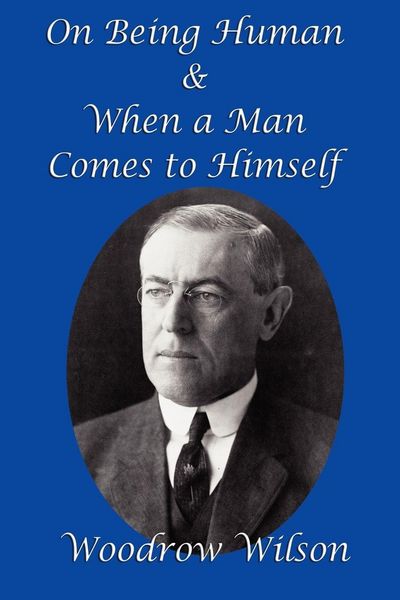
On Being Human and When a Man Comes to Himself A GR Press Presidential Book
-
- Hardcover
- Taschenbuch ausgewählt
-
Sprache:Englisch
Fr. 12.90
inkl. gesetzl. MwSt.,
-
Kostenlose Lieferung ab Fr. 30 Einkaufswert
Schweiz & Liechtenstein:
Versandkostenfrei ab Fr. 30.00
Versandkosten bis Fr. 30.00: Fr. 3.50Andere Lieferländer
Fr. 18.00 unabhängig vom Warenwert
Beschreibung
Produktdetails
Einband
Taschenbuch
Erscheinungsdatum
20.09.2010
Verlag
GR PressSeitenzahl
38
Maße (L/B/H)
22.9/15.2/0.2 cm
Gewicht
72 g
Sprache
Englisch
ISBN
978-1-61720-056-4
pBefore he became the 28th President of the United States (1913-21), the 34th Governor of New Jersey (1911-13), or even the 13th President of Princeton University (1902-10), Woodrow Wilson (1856-1924) was a scholar and professor. In 1885, he received his Ph.D. in history and political science from Johns Hopkins University, and in 1897, he was granted tenure at Princeton University./ppAs an educator, and a person of deep faith (his father was a Presbyterian reverend), Woodrow Wilson believed firmly in the importance of the humanities to human flourishing and freedom. In "On Being Human," Wilson sets out his vision for the good life, and offers insight into the foundations of his later political policies. "On Being Human" is among the most personal of Wilson's public writings, revealing an enthusiastic nature at odds with his later staid persona. While the essay makes little direct reference to faith, it does reveal Wilson's view of the good life, which is both hopeful and historical, and draws on both Aristotle's notion of "the golden mean" and Augustine's view of the iordo amorum/i (the order of the loves)-specifically, that the good life consists largely in a well-balanced, harmonious ordering of one's passions and priorities. Wilson's ideal is "the truly human man: a man in whom there is a just balance of faculties, a catholic sympathy—no brawler, no fanatic, no Pharisee, not too credulous in hope, not too desperate in purpose, warm, but not hasty, ardent, and full of definite power, but not running about to be pleased and deceived by every new thing."/pp"When a Man Comes to Himself," written just a few years later, reveals the wholesome and regenerating change which a man undergoes when he "comes to himself." It is not only after periods of recklessness or infatuation, when he has played the spendthrift or the fool, that a man comes to himself. He comes to himself after experiences of which he alone may be aware./p
Kundinnen und Kunden meinen
Verfassen Sie die erste Bewertung zu diesem Artikel
Helfen Sie anderen Kund*innen durch Ihre Meinung