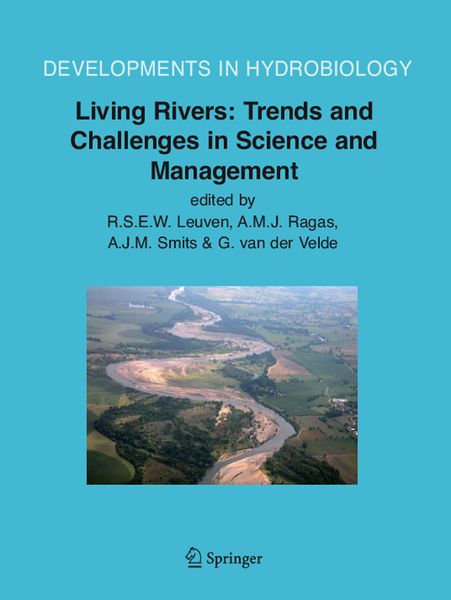
Produktbild: Living Rivers: Trends and Challenges in Science and Management
Band 187

Living Rivers: Trends and Challenges in Science and Management

Fr. 192.00

inkl. gesetzl. MwSt., Versandkostenfrei


Beschreibung

Produktdetails

Einband

Taschenbuch

Erscheinungsdatum

22.11.2010

Herausgeber

R.S.E.W. Leuven + weitere

Verlag

Springer Netherland

Seitenzahl

371

Maße (L/B/H)

28/21/2.1 cm

Gewicht

808 g

Auflage

1. Auflage

Sprache

Englisch

ISBN

978-90-481-7193-4

Beschreibung

Produktdetails

Einband

Taschenbuch

Erscheinungsdatum

22.11.2010

Herausgeber

Verlag

Springer Netherland

Seitenzahl

371

Maße (L/B/H)

28/21/2.1 cm

Gewicht

808 g

Auflage

1. Auflage

Sprache

Englisch

ISBN

978-90-481-7193-4

Herstelleradresse

Springer-Verlag KG
Sachsenplatz 4-6
1201 Wien
AT

Email: GPSR Kontakt

Noch keine Bewertungen vorhanden

Verfassen Sie die erste Bewertung zu diesem Artikel

Helfen Sie anderen Kundinnen und Kunden durch Ihre Meinung.

Kundinnen und Kunden meinen

Bewertungen (0)

Weitere Artikel finden Sie in

  • Produktbild: Living Rivers: Trends and Challenges in Science and Management
  • Linking sedimentation and ecology in riverine landscapes; influences of climate change and physical reconstruction measures.- Pieter Hendrik Nienhuis: aquatic ecologist and environmental scientist.- Functioning of River Systems.- BasinBox: a generic multimedia fate model for predicting the fate of chemicals in river catchments.- Trophic relationships in the Rhine food web during invasion and after establishment of the Ponto-Caspian invader Dikerogammarus villosus.- Seasonal dependent effects of flooding on plant species survival and zonation: a comparative study of 10 terrestrial grassland species.- Succession and rejuvenation in floodplains along the river Allier (France).- Airborne laser scanning as a tool for lowland floodplain vegetation monitoring.- Reproduction, growth, and migration of fishes in a regulated lowland tributary: potential recruitment to the river Meuse.- Amphibian diversity and nestedness in a dynamic floodplain river (Tagliamento, NE-Italy).- Modelling recolonisation of heterogeneous river floodplains by small mammals.- The importance of hydrodynamics for protected and endangered biodiversity of lowland rivers.- Rehabilitation of Riverine Ecosystems.- Biogeochemical constraints on the ecological rehabilitation of wetland vegetation in river floodplains.- Effects of rewetting measures in Dutch raised bog remnants on assemblages of aquatic Rotifera and microcrustaceans.- Biological traits successfully predict the effects of restoration management on macroinvertebrates in shallow softwater lakes.- Analysis of naturalization alternatives for the recovery of moist-soil plants in the floodplain of the Illinois River.- Long-term developments in ecological rehabilitation of the main distributaries in the Rhine delta: fish and macroinvertebrates.- Flood detention, nature development and water quality along the lowland river Sava, Croatia.- Challenges and Obstacles to Sustainable Management.- Water and values: ecological research as the basis for water management and nature management.- Advancing science for water resources management.- Redefinition and elaboration of river ecosystem health: perspective for river management.- Emergent principles for river management.- From river management to river basin management: a water manager’s perspective.- Discursive shifts in Dutch river management: ‘deep’ institutional change or adaptation strategy?.- Changing estuaries, changing views.- Synthesis.- Living rivers: trends and challenges in science and management.