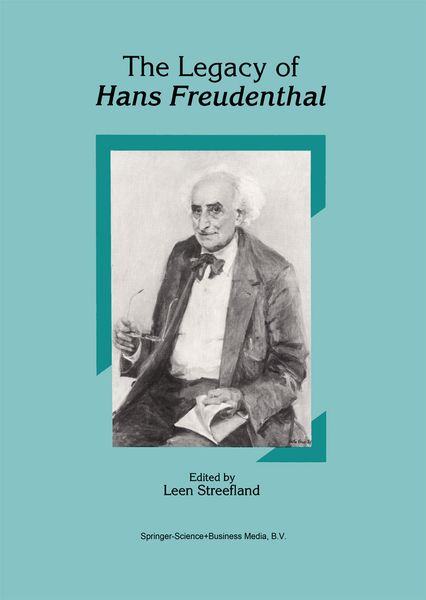
The Legacy of Hans Freudenthal
-
- Hardcover
- Taschenbuch ausgewählt
-
Sprache:Englisch
Fr. 137.00
inkl. gesetzl. MwSt.,
Beschreibung
Produktdetails
Einband
Taschenbuch
Erscheinungsdatum
01.12.2010
Herausgeber
Leen StreeflandVerlag
Springer NetherlandSeitenzahl
164
Maße (L/B/H)
29.7/21/1 cm
Gewicht
474 g
Auflage
Softcover reprint of hardcover 1st ed. 1994
Sprache
Englisch
ISBN
978-90-481-4354-2
The Legacy of Freudenthal pays homage to Freudenthal and his work on mathematics, its history and education. Almost all authors were his scholars or co-workers. They testify to what they learned from him. Freudenthal himself contributes posthumously. His didactical phenomenology of the concept of force is both provocative and revealing in its originality, compared with what is usually found in physics instruction.
Freudenthal is portrayed as a universal human being by Josette Adda. He made considerable contributions to mathematics itself, e.g. on homotopy theory and Lie groups in geometry. The exposition of Freudenthal's mathematical life and work is on Van Est's account. Henk Bos discusses his historical work. The essay review of the 8th edition of Hilbert's Grundlagen der Geometrie serves as a vehicle of thought. The main part of the book, however, concerns Freudenthal's work on mathematics education. Christine Keitel reviews his final book Revisiting Mathematics Education (1991). Fred Goffree describes Freudenthal's `Working on Mathematics Education' both from an historical as well as a theoretical perspective. Adrian Treffers analyses Freudenthal's influence on the development of realistic mathematics education at primary level in the Netherlands, especially his influence on the Wiskobas-project of the former IOWO. Freudenthal once predicted the disappearance of mathematics as an individual subject in education sometime around the year 2000, because it would by then have merged with integrated thematic contexts. Jan de Lange anticipates this future development and shows that Freudenthal's prediction will not come true after all. Reflective interludes unveil how he might have influenced those developments.
Freudenthal contributed a wealth of ideas and conceptual tools to the development of mathematics education -- on contexts, didactical phenomenology, guided reinvention, mathematisation, the constitution of mental objects, the development of reflective thinking, levels in learning processes, the development of a mathematical attitude and so on -- but he did not design very much concrete material. Leen Streefland deals with the question of design from a theoretical point of view, while applying Freudenthal's ideas on changing perspective and shifting.
For teachers, researchers, mathematics educators, mathematicians, educationalists, psychologists and policy makers.
Freudenthal is portrayed as a universal human being by Josette Adda. He made considerable contributions to mathematics itself, e.g. on homotopy theory and Lie groups in geometry. The exposition of Freudenthal's mathematical life and work is on Van Est's account. Henk Bos discusses his historical work. The essay review of the 8th edition of Hilbert's Grundlagen der Geometrie serves as a vehicle of thought. The main part of the book, however, concerns Freudenthal's work on mathematics education. Christine Keitel reviews his final book Revisiting Mathematics Education (1991). Fred Goffree describes Freudenthal's `Working on Mathematics Education' both from an historical as well as a theoretical perspective. Adrian Treffers analyses Freudenthal's influence on the development of realistic mathematics education at primary level in the Netherlands, especially his influence on the Wiskobas-project of the former IOWO. Freudenthal once predicted the disappearance of mathematics as an individual subject in education sometime around the year 2000, because it would by then have merged with integrated thematic contexts. Jan de Lange anticipates this future development and shows that Freudenthal's prediction will not come true after all. Reflective interludes unveil how he might have influenced those developments.
Freudenthal contributed a wealth of ideas and conceptual tools to the development of mathematics education -- on contexts, didactical phenomenology, guided reinvention, mathematisation, the constitution of mental objects, the development of reflective thinking, levels in learning processes, the development of a mathematical attitude and so on -- but he did not design very much concrete material. Leen Streefland deals with the question of design from a theoretical point of view, while applying Freudenthal's ideas on changing perspective and shifting.
For teachers, researchers, mathematics educators, mathematicians, educationalists, psychologists and policy makers.
Noch keine Bewertungen vorhanden
Verfassen Sie die erste Bewertung zu diesem Artikel
Helfen Sie anderen Kundinnen und Kunden durch Ihre Meinung.