• Produktbild: The Taste for Ethics
  • Produktbild: The Taste for Ethics
Band 7

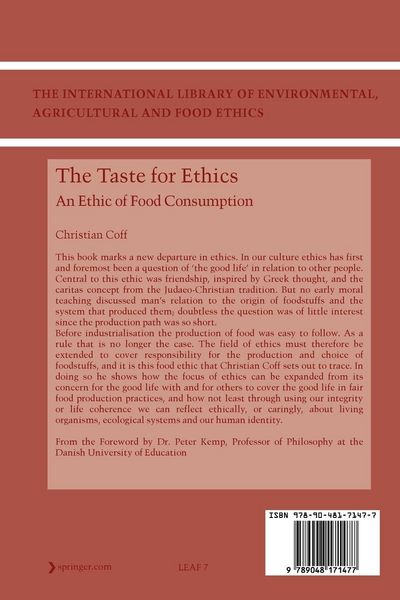
The Taste for Ethics An Ethic of Food Consumption

Fr. 138.00

inkl. gesetzl. MwSt., Versandkostenfrei


Beschreibung

Produktdetails

Einband

Taschenbuch

Erscheinungsdatum

18.11.2010

Verlag

Springer Netherland

Seitenzahl

212

Maße (L/B/H)

24/16/1.3 cm

Gewicht

378 g

Auflage

Softcover reprint of hardcover 1st edition 2006

Sprache

Englisch

ISBN

978-90-481-7147-7

Beschreibung

Rezension

From the reviews:

“This book makes the case for an ethical understanding of food consumption. Christian Coff notes that a growing number of consumers are making ethics a central part of their food consumption choices. … Coff’s arguments and analyses are very intriguing and convincing. I would recommend this book to anyone who has an interest in understanding the difficult and complex nature of creating an ethical and values-based food system.” (Michael A. Long, Journal of Agricultural and Environmental Ethics, Vol. 22, 2009)

Produktdetails

Einband

Taschenbuch

Erscheinungsdatum

18.11.2010

Verlag

Springer Netherland

Seitenzahl

212

Maße (L/B/H)

24/16/1.3 cm

Gewicht

378 g

Auflage

Softcover reprint of hardcover 1st edition 2006

Sprache

Englisch

ISBN

978-90-481-7147-7

Herstelleradresse

Springer-Verlag KG
Sachsenplatz 4-6
1201 Wien
AT

Email: ProductSafety@springernature.com

Kundinnen und Kunden meinen

0 Bewertungen

Informationen zu Bewertungen

Zur Abgabe einer Bewertung ist eine Anmeldung im Konto notwendig. Die Authentizität der Bewertungen wird von uns nicht überprüft. Wir behalten uns vor, Bewertungstexte, die unseren Richtlinien widersprechen, entsprechend zu kürzen oder zu löschen.

Die Bewertungen sind nach Format, Anzahl Sterne und Datum sortiert.

Verfassen Sie die erste Bewertung zu diesem Artikel

Helfen Sie anderen Kund*innen durch Ihre Meinung

Kundinnen und Kunden meinen

0 Bewertungen filtern

  • Produktbild: The Taste for Ethics
  • Produktbild: The Taste for Ethics
  • Foreword. Preface. Part I: Food and Ethics. 1. Eating, Society and Ethics. 1.1 The Intimacy of Eating and Digestion. 1.2 Eating in between Life and Death. 1.3 The Social Meaning of the Meal. 1.4 Food and Ethics in History. 1.5 Food Ethics and the Production History. Part II: The Intellectualisation of Food. 2. Food to Science: On the Intellectualisation of Food. 2.1 The Hermeneutic Approach of Early Natural History. 2.2 The Phenomenological Approach of Late Natural History. 2.3 Biology and the Invisible Characteristics of Life. 2.4 The End of Phenomenology in Biology. 3. The Storylessness of Food. 3.1 The History of Industrialisation of Agriculture. 3.2 Food Science and Gastronomy. 3.3 The Powerlessness of the Political Consumer. 3.4 The Hidden Production History of Food. 3.5 Do not Eat what you have not Read. Part III: Food Ethics and the Production History. 4. Tracing the Production History. 4.1 Short-Range and Long-Range Ethics. 4.2 Food as a Trace. 4.3 The Judgement of Taste and Morality. 4.4 The Trace as Presence and Lost Time. 4.5 History of Effect. 4.6 Production History and Mimesis. 5. Food Ethics as the Ethics of the Trace. 5.1 The Reliability of the Production History. 5.2 Food and Ethical Identity. 5.3 Food as a Trace of Nature. 5.4 Food Ethics of the Consumers. 6. Traceability and Food Ethics. 6.1 Fragmentation and Traceability. 6.2 Sociological Survey on Ethical Traceability. 6.3 Consumer Autonomy: Remembering the Other and Informed Choice. 6.4 Recognizing Consumers Recognizing Producers. References. Index. List of Tables and Figures. About the author.