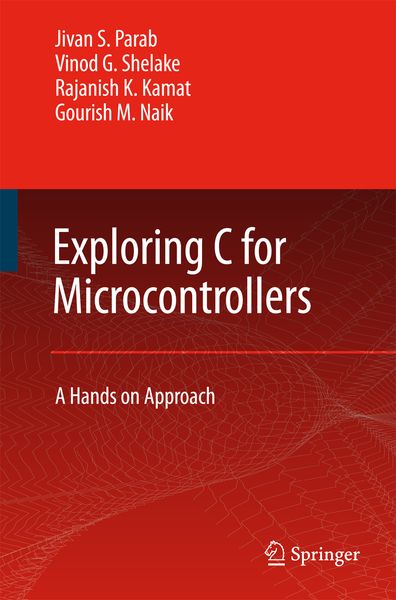

Exploring C for Microcontrollers A Hands on Approach
-
- Hardcover
- Taschenbuch ausgewählt
- eBook
-
Sprache:Englisch
Fr. 138.00
inkl. gesetzl. MwSt.,
Beschreibung
Produktdetails
Einband
Taschenbuch
Erscheinungsdatum
19.10.2010
Verlag
Springer NetherlandSeitenzahl
157
Maße (L/B/H)
23.5/15.5/1 cm
Gewicht
277 g
Auflage
1. Auflage
Sprache
Englisch
ISBN
978-90-481-7525-3
If we accept the premise that an embedded engineer is made rather than born, then how does one go about making a good one? The authors ofthisbookExploring C for Microcontrollers: A Hands-on Approach are certainly “good ones”. Not only do they explore some of the in?uences thatshapedthemselvesbuttheyalsotrytoshape“would-be”embedded engineers. Research and developmental activities in embedded systems has grown in a signi?cant proportion in the recent past. Embedded so- ware design is not new to the world, but with the changing time, it has gained considerable momentum in the recent past, and many young engineers are strongly inclined to pursue their future in this ?eld. The book is mainly targeted to these engineers who would like to understand in great depth the synergetic combination of hardware and software. The book is divided into eight chapters. Chapter 1 introduces a brief background about micro-controllers and explains how they are emb- dedintoproductscommerciallyavailableinthemarkettoemphasizethe importance of these in the daily life of mankind. It also gives an insight into the architectural details and embedded system concepts for s- dents’ projects to motivate them into this exciting ?eld. The rest of the bookconcentratesonsoftwaredevelopment. Theintegrateddevelopment environment (IDE) is introduced in Chapter 2. Again the screen shots and step-by-step procedure will certainly make the students and en- neers fully understand the development process. Chapter 3 di?eren- ates the embedded C paradigm from the conventional ANSI C. Again the authors explain how to successfully overcome the memory and time constraints while developing an embedded C program.
Kundinnen und Kunden meinen
Verfassen Sie die erste Bewertung zu diesem Artikel
Helfen Sie anderen Kund*innen durch Ihre Meinung