
Gutscheinbedingungen

*Gültig bis 05.07.2026 auf (fast) alles. Ausgeschlossen sind Smartboxen, Zeitschriften, Tickets, Lebensmittel, Gaming-Elektroartikel, Tinte/Toner, Gutscheine, Geschenkkarten, Blumen und Abos | Einlösbar in allen Buchhandlungen von Orell Füssli, Barth Bücher, Buchladen Rapunzel, Papeterie Köhler, Schuler Orell Füssli, Stauffacher und ZAP unter Vorweisung des Gutscheins, auf www.orellfüssli.ch durch Eingabe des Gutscheincodes. Beim Service „eBooks verschenken“ und bei eBook-Käufen via eReader nicht einlösbar | Mindesteinkaufswert: Fr. 30.- | Nicht mit anderen Rabatten kumulierbar.

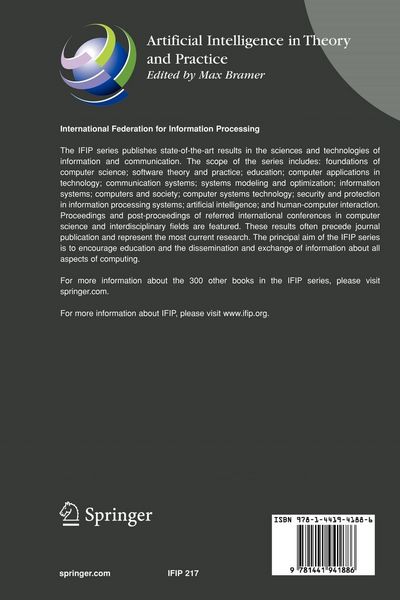
  • Produktbild: Artificial Intelligence in Theory and Practice
  • Produktbild: Artificial Intelligence in Theory and Practice
Band 217

Artificial Intelligence in Theory and Practice IFIP 19th World Computer Congress, TC 12: IFIP AI 2006 Stream, August 21-24, 2006, Santiago, Chile

Fr. 192.00

inkl. gesetzl. MwSt., Versandkostenfrei


Beschreibung

Produktdetails

Einband

Taschenbuch

Erscheinungsdatum

25.11.2010

Herausgeber

Max Bramer

Verlag

Springer Us

Seitenzahl

503

Maße (L/B/H)

23.5/15.5/2.8 cm

Gewicht

779 g

Auflage

Softcover reprint of hardcover 1st ed. 2006

Sprache

Englisch

ISBN

978-1-4419-4188-6

Beschreibung

Produktdetails

Einband

Taschenbuch

Erscheinungsdatum

25.11.2010

Herausgeber

Max Bramer

Verlag

Springer Us

Seitenzahl

503

Maße (L/B/H)

23.5/15.5/2.8 cm

Gewicht

779 g

Auflage

Softcover reprint of hardcover 1st ed. 2006

Sprache

Englisch

ISBN

978-1-4419-4188-6

Herstelleradresse

Springer-Verlag KG
Sachsenplatz 4-6
1201 Wien
AT

Email: GPSR Kontakt

Noch keine Bewertungen vorhanden

Verfassen Sie die erste Bewertung zu diesem Artikel

Helfen Sie anderen Kundinnen und Kunden durch Ihre Meinung.

Kundinnen und Kunden meinen

Bewertungen (0)

  • Produktbild: Artificial Intelligence in Theory and Practice
  • Produktbild: Artificial Intelligence in Theory and Practice
  • Knowledge and Information Management.- Can Common Sense uncover cultural differences in computer applications?.- Artificial Intelligence and Knowledge Management.- Agents 1.- The IONWI Algorithm: Learning when and when not to interrupt.- Formal Analysis of the Communication of Probabilistic Knowledge.- Detecting and Repairing Anomalous Evolutions in Noisy Environments: Logic Programming Formalization and Complexity Results.- Adding Semantic Web Services Matching and Discovery Support to the MoviLog Platform.- Learning Browsing Patterns for Context-Aware Recommendation.- Applying Collaborative Filtering to Reputation Domain: a model for more precise reputation estimates in case of changing behavior by rated participants.- Integration of AI with other Technologies.- Combine Vector Quantization and Support Vector Machine for Imbalanced Datasets.- Ontology Support for Translating Negotiation Primitives.- Statistical Method of Context Evaluation for Biological Sequence Similarity.- Biological inspired algorithm for Storage Area Networks (ACOSAN).- Neural Nets.- Radial Basis Functions Versus Geostatistics in Spatial Interpolations.- Neural Networks applied to wireless communications.- Anomaly Detection using prior knowledge: application to TCP/IP traffic.- A study on the ability of Support Vector Regression and Neural Networks to Forecast Basic Time Series Patterns.- Neural Plasma.- Knowledge Acquisition and Data Mining.- Comparison of SVM and Some Older Classification Algorithms in Text Classification Tasks.- An automatic graph layout procedure to visualize correlated data.- Knowledge Perspectives in Data Grids.- On the Class Distribution Labelling Step Sensitivity of CO-TRAINING.- Two new feature selection algorithms with Rough Sets Theory.- Evolutionary Computation.- Global Convexity in the Bi-Criteria Traveling Salesman Problem.- Evolutionary Algorithm for State Encoding.- Hypercube FrameWork for ACO applied to timetabling.- Multitree-Multiobjective Multicast Routing for Traffic Engineering.- Speech and Natural Language.- Road Segment Identification in Natural Language Text.- Learning Discourse-new References in Portuguese Texts.- Analysing Definition Questions by Two Machine Learning Approaches.- Fuzzy Rule-Based Hand Gesture Recognition.- Comparison of distance measures for historical spelling variants.- Industrial Applications of AI.- Patterns in Temporal Series of Meteorological Variables Using SOM & TDIDT.- Applying Genetic Algorithms to Convoy Scheduling.- A GRASP algorithm to solve the problem of dependent tasks scheduling in different machines.- A support vector machine as an estimator of mountain papaya ripeness using resonant frequency or frequency centroid.- FieldPlan: Tactical Field Force Planning in BT.- An Agent Solution to Flexible Planning and Scheduling of Passenger Trips.- Machine Vision.- Facial expression recognition using shape and texture information.- Limited Receptive Area neural classifier for texture recognition of metal surfaces.- A Tracking Framework for Accurate Face Localization.- A Combination of Spatiotemporal ICA and Euclidean Features for Face Recognition.- Agents 2.- Three Technologies for Automated Trading.- Modeling Travel Assistant Agents: a graded BDI approach.- e-Tools: An agent coordination layer to support the mobility of persons with disabilities..- Expert Systems.- Conceptualization Maturity Metrics for Expert Systems.- Toward developing a tele-diagnosis system on fish disease.- A new method for fish-disease diagnostic problem solving based on parsimonious covering theory and fuzzy inference model.- Effective Prover for Minimal Inconsistency Logic.- Identification of Important News for Exchange Rate Modeling.- Planning and Scheduling.- Autonomous Search and Rescue Rotorcraft Mission Stochastic Planning with Generic DBNs.- Solving multi-objective scheduling problems—An integrated systems approach.