Gutscheinbedingungen

*Gültig bis 20.07.2026 auf alle Bücher. Ausgeschlossen sind Zeitschriften, Prozentbücher und Abos | Einlösbar in allen Buchhandlungen von Orell Füssli, Barth Bücher, Buchladen Rapunzel, Papeterie Köhler, Schuler Orell Füssli, Stauffacher und ZAP unter Vorweisung des Gutscheins, auf www.orellfüssli.ch durch Eingabe des Gutscheincodes. Beim Service „eBooks verschenken“ und bei eBook-Käufen via eReader nicht einlösbar | Mindesteinkaufswert: Fr. 30.- | Nicht mit anderen Rabatten kumulierbar.

  • Produktbild: Maritime Archaeology and Social Relations
  • Produktbild: Maritime Archaeology and Social Relations

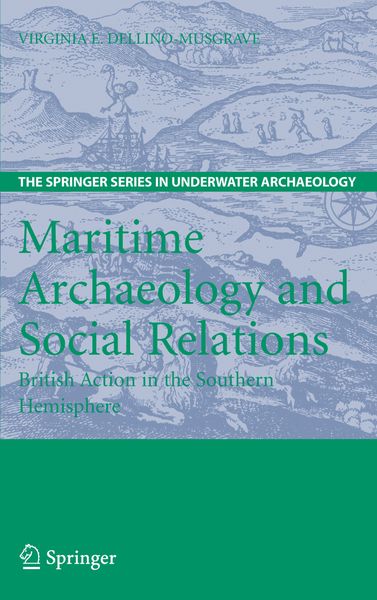
Maritime Archaeology and Social Relations British Action in the Southern Hemisphere

Fr. 172.00

inkl. gesetzl. MwSt., Versandkostenfrei


Beschreibung

Produktdetails

Einband

Taschenbuch

Erscheinungsdatum

19.11.2010

Abbildungen

XVIII, 24 illus., schwarz-weiss Illustrationen

Verlag

Springer Us

Seitenzahl

198

Maße (L/B/H)

23.5/15.5/1.2 cm

Gewicht

335 g

Auflage

Softcover reprint of hardcover 1st edition 2006

Sprache

Englisch

ISBN

978-1-4419-4142-8

Beschreibung

Rezension

From the reviews:


"Maritime Archaeology and Social Relations is an edited version of the author’s doctoral thesis … . The work is extremely well researched, structured, and referenced … . is both a very welcome book and an important one. … The book joins a number of recent works on maritime archaeology that make an extremely important contribution to the broad ‘historical archaeology’ of the modern (i.e. capitalist, consumer-driven) world … ." (Joe Flatman, Journal of Maritime Archaeology, Vol. 3, 2008)


"Springer Press has added yet another fine piece of scholarship to its growing series in underwater archaeology. Virginia Dellino-Musgrave’s book contributes to the quality and calibre of this series as the eleventh monograph. … it explores 18th-century British social relations within the context of maritime archaeology and history. … this book is an excellent piece of scholarship. Dellino-Musgrave should be commended for her contributions to maritime archaeology. This work can certainly be classified as a ‘must read by all’ in current literature." (Jennifer McKinnon, The International Journal of Nautical Archaeology, Vol. 36 (2), 2007)

Produktdetails

Einband

Taschenbuch

Erscheinungsdatum

19.11.2010

Abbildungen

XVIII, 24 illus., schwarz-weiss Illustrationen

Verlag

Springer Us

Seitenzahl

198

Maße (L/B/H)

23.5/15.5/1.2 cm

Gewicht

335 g

Auflage

Softcover reprint of hardcover 1st edition 2006

Sprache

Englisch

ISBN

978-1-4419-4142-8

Herstelleradresse

Springer-Verlag KG
Sachsenplatz 4-6
1201 Wien
AT

Email: GPSR Kontakt

Noch keine Bewertungen vorhanden

Verfassen Sie die erste Bewertung zu diesem Artikel

Helfen Sie anderen Kundinnen und Kunden durch Ihre Meinung.

Kundinnen und Kunden meinen

Bewertungen (0)

  • Produktbild: Maritime Archaeology and Social Relations
  • Produktbild: Maritime Archaeology and Social Relations
  • Preface.- Acknowledgements.- CHAPTER 1: Introduction.- 1.1 Overview .- 1.2 General Historical Context of the 18th Century.- 1.3 Research Context.- 1.3.1 Introduction to Some Concepts.- 1.3.2 The South Atlantic and Australia.- 1.3.3 Research Ideas.- 1.3.4 The Case Studies.- 1.3.5 A Brief Summary.- 1.4 Organisation of this book.- CHAPTER 2: Linking Historical and Maritime Archaeology.- 2.1 Introduction.- 2.2 Historical Archaeology.- 2.3 Historical Archaeology or The Archaeology of the ‘Modern’ World’?.- 2.4 Historical Archaeology and Archaeology of Contact.- 2.5 Maritime Archaeology.- 2.5.1 Two Main Approaches: ‘Pompeii Premise’ versus ‘The Archaeology of the Event’.- 2.6 The Combination of Historical Documents and Archaeological Evidence.- 2.7 Summary.- CHAPTER 3: Historical and Maritime Archaeology: The Argentinean and Australian Case Studies.- 3.1 Introduction.- 3.2 Historical and Maritime Archaeology.- 3.2.1 A Brief Review of the Argentinean Case Study.- 3.2.2 A Brief Review of the Australian Case Study.- 3.3 The Case Studies.- 3.3.1 The Swift Project.- 3.3.2 The Sirius Project.- 3.4 Summary.- CHAPTER 4: Meaning and Social Archaeology.- 4.1 Introduction .- 4.2 Space, Time and Social Beings.- 4.2.1 Space, Landscapes and Places.- 4.2.2 The Interpretation of Social Landscapes. - 4.2.3 Social Time .- 4.2.4 Social Beings.- 4.3 Material Relationships and the Meaning of Things.- 4.3.1 Activities, People and the Material World.- 4.4 Praxis: Constructing Identities through Materiality.- 4.5 Summary.- CHAPTER 5: Consuming Capitalism and Colonialism.- 5.1 Introduction .- 5.2 Capitalism as a Social Process.- 5.2.1 Defining Capitalism .- 5.2.2 Capitalistic Studies in Maritime Archaeology.- 5.2.3 The Capitalistic World: the Modern World? .- 5.3 Colonialism: Shaping Identities.- 5.3.1 Knowledge, Experience and Identities.- 5.4 Production and Consumption of Identities.- 5.5 Summary.- CHAPTER 6: Understanding Places on the South Atlantic and on the Southeast Coastof Australia.- 6.1 Introduction .- 6.2 Environment and Historical Context on the Atlantic Coast of Patagonia.- 6.2.1 Europeans in the Malvinas?Falkland Islands.- 6.2.1.1 HMS Swift.- 6.2.2 Puerto Deseado.- 6.3 Environment and Historical Context.- 6.3.1 New South Wales.- 6.3.2 Norfolk Island and the Wreck of the Sirius .- 6.3.2.1 HMS Sirius.- 6.4 Summary.- CHAPTER 7: British Identities Through Pottery in Praxis.- 7.1 Introduction.- 7.2 Pottery Assemblage and Its General Characteristics.- 7.2.1 Decorative Patterns as Lifestyle Indicators.- 7.2.2 Pottery Imitation and Definition of Ourselves.- 7.3 Production, Consumption and Habitual Actions.- 7.3.1 Memories from the Homeland.- 7.3.2 Interpretation of British Habitual Action Through Storage Wares.- 7.4 Royal Navy Ships and Their Routines.- 7.5 Positioning and Power Structures.- 7.6 Summary.- CHAPTER 8: Interpretation of British Action Through Social Landscapes.- 8.1 Introduction.- 8.2 socialised Physical Landscapes.- 8.2.1 Locating Settlements in the Landscape.- 8.2.2 Understanding British Action Through the Distribution of Resources.- 8.3 Networks and Interactions.- 8.3.1 Settlements, Circulation of Goods and People’s Position in the World.- 8.3.2 Experiencing Landscapes Through the Accumulation of Knowledge.- 8.3.3 Acknowledging Natives: Knowledge as a Powerful Tool.- 8.3.4 Competing Powers.- 8.4 Final Thoughts.- 8.5 Innovations of This Research.- References.- List of Metric Conversions.- List of Abbreviations