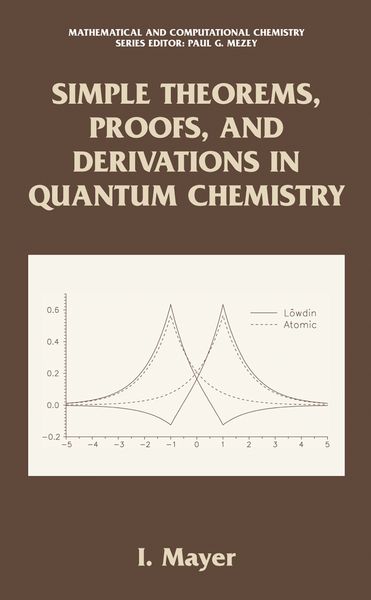
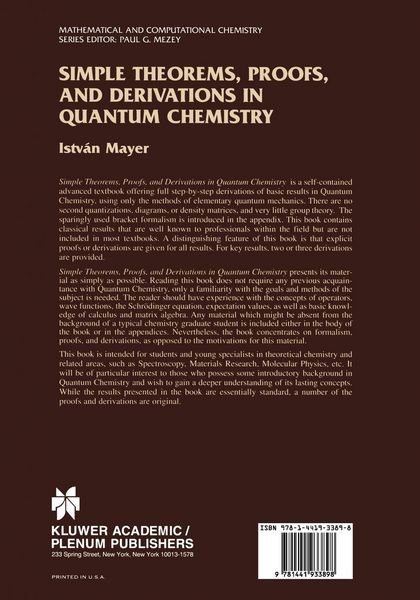
• Produktbild: Simple Theorems, Proofs, and Derivations in Quantum Chemistry
  • Produktbild: Simple Theorems, Proofs, and Derivations in Quantum Chemistry

Simple Theorems, Proofs, and Derivations in Quantum Chemistry

Fr. 242.00

inkl. gesetzl. MwSt., Versandkostenfrei


Beschreibung

Produktdetails

Einband

Taschenbuch

Erscheinungsdatum

06.12.2010

Verlag

Springer Us

Seitenzahl

337

Maße (L/B/H)

25.4/17.8/2 cm

Gewicht

1350 g

Auflage

Softcover reprint of the original 1st ed. 2003

Sprache

Englisch

ISBN

978-1-4419-3389-8

Beschreibung

Produktdetails

Einband

Taschenbuch

Erscheinungsdatum

06.12.2010

Verlag

Springer Us

Seitenzahl

337

Maße (L/B/H)

25.4/17.8/2 cm

Gewicht

1350 g

Auflage

Softcover reprint of the original 1st ed. 2003

Sprache

Englisch

ISBN

978-1-4419-3389-8

Herstelleradresse

Springer-Verlag GmbH
Tiergartenstr. 17
69121 Heidelberg
DE

Email: GPSR Kontakt

Kundinnen und Kunden meinen

0 Bewertungen

Informationen zu Bewertungen

Zur Abgabe einer Bewertung ist eine Anmeldung im Konto notwendig. Die Authentizität der Bewertungen wird von uns nicht überprüft. Wir behalten uns vor, Bewertungstexte, die unseren Richtlinien widersprechen, entsprechend zu kürzen oder zu löschen.

Die Bewertungen sind nach Format, Anzahl Sterne und Datum sortiert.

Verfassen Sie die erste Bewertung zu diesem Artikel

Helfen Sie anderen Kund*innen durch Ihre Meinung

Kundinnen und Kunden meinen

0 Bewertungen filtern

  • Produktbild: Simple Theorems, Proofs, and Derivations in Quantum Chemistry
  • Produktbild: Simple Theorems, Proofs, and Derivations in Quantum Chemistry
  • I. The Born-Oppenheimer Hamiltonian. 1. Separating the center of mass motion in quantum mechanics. 1.1. Reducing the two-body problem to two one-body ones. 1.2. The center of mass in quantum mechanics 1.3. Free atoms and atomcules. 2. The Born--Oppenheimer approximation. 2.1. Introductory remarks. 2.2. The Born-Oppenheimer separation. 2.3. Why the Born-Oppenheimer separation is not exact? 2.4. Approximate decoupling. 2.5. A note on the Born-Oppenheimer separation. II. General Theorems And Principles. 1. The variation principle. 1.1. The Rayleigh quotient. 1.2. The variation principle for the ground state. 1.3. The variation principle as an equivalent of the Schrodinger equation: a useful formulation of the variation principle. 1.4. Eckart's inequality. 1.5. Excited states. 2. The Hellmann - Feynman theorem. 2.1. The differential Hellmann - Feynman theorem. 2.2. The integral Hellmann -Feynman theorem. 3. The virial theorem in quantum mechanics. 3.1. Time dependence of a physical quantity. 3.2. The virial theorem. 3.3. Scaling - a connection with the variation principle. 3.4. The virial theorem in the Born-Oppenheimer approximation. 3.5. The virial theorem and the chemical bonding. III. The Linear Variational Method And Lowdin's Orthogonalization Schemes. 1. The linear variational method (Ritz -method) 2. Lowdin's symmetric orthogonalization. 2.1. Matrix SAND-1/2. 2.2. The S∧-1/2 transformation. 2.3. The Lowdin basis. 2.4. The stationary property of Lowdin's symmetric orthogonalization scheme. 2.5. Lowdin-orthogonalization: a two-dimensional example. 3. Linear independence of the basis and Lowdin's canonic orthogonalization. 3.1. Eigenvalues of the overlap matrix: a measure for the linear. 3.2. Lowdin's canonic orthogonalization. IV. Perturbational Methods. 1. Non-degenerate Rayleigh-Schrodinger perturbation theory. 1.1. The problem. 1.2. `Algebraic' expansion. 1.3. The use of the reduced resolvent in the Rayleigh-Schrodinger perturbation theory. 1.4. Wigner's 2n+1 theorem. 2. Variational-perturbational method: the Hylleraas-functional.3. Degenerate Rayleigh-Schrodinger perturbation theory. 4. Brillouin-Wigner perturbation theory. 4.1. The size-consistency problem. 5. Size consistency of the Rayleigh-Schrodinger perturbation. 5.1. Formal considerations based on the properties of power series. 5.2. Size consistency of the perturbational expansions. 6. Lowdin's partitioning method. V. Determinant Wave Functions. 1. Spin-orbitals. 2. Many-electron spin states. 3. Slater determinants. 3.1. Two-electron examples. 4. The antisymmetrizing operator. 4.1. The projection character of the antisymmetrizing operator. 4.2. Commutation properties of the antisymmetrizing operator. 5. Invariance of the determinant wave function with respect of. 6. Matrix elements between determinant wave functions. 6.1. Overlap. 6.2. One-electron operators. 6.3.