Zitat
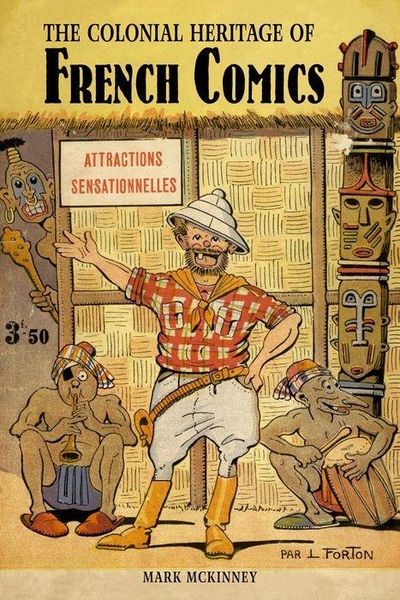
I was delighted with this work. I thought it provocative, intellectually engaging, demonstrative of excellent and broad research both into colonial cultural history and the history of comics (skilfully and engagingly woven together). -- Dr Wendy Michallat, University of Sheffield Although France has changed much in recent decades, colonial-era imagery continues to circulate widely in comics, including the Tintin series by the Herge and Zig et Puce by Alain Saint-Ogan. This important book argues that cartoonists use representations of colonial history as a way of intervening in debates about contemporary France and its relationships to its former colonies. Mark McKinney argues that comics offer opportunities to reproduce and perpetuate colonial ideologies as well as to deconstruct and contest them-and the degree to which they do one or the other reveals much about the heritage of colonialism in French society. French Culture 201202 This important book argues that cartoonists use representations of colonial history as a way of intervening in debates about contemporary France and its relationships to its former colonies. Mark McKinney argues that comics offer opportunities to reproduce and perpetuate colonial ideologies as well as to deconstruct and contest them-and the degree to which they do one or the other reveals much about the heritage of colonialism in French society. French Culture 201202 This book is an important contribution to the history of the Francophone comic strip. It explains how early masters of the form, Herge and Alain Saint-Ogan, produced work that was sympathetic to imperialism. It narrates how these and other artists promoted the colonial idea by drawing work which encouraged readers to take pride in French and Belgian power overseas. However, this is only a part of the story. In addition, McKinney addresses more contempo-rary graphic narratives. He explains that since the 1980s graphic novelists in France, Switzerland, and Belgium have produced works that evoke imperial history. These new publications include some material that is nostalgic for empire, as well as strips that are more critical of it. McKinney admires the work of this latter type, produced by people such as Yvan Alagbe and Joann Sfar, and when he concludes the monograph it is to them that he gives the last word. The Colonial Heritage of French Comics therefore combines detailed historical analysis of material from the 1930s with politically informed literary criticism of more contemporary art and writing. It successfully sweeps from past to present and back again, linking heritage to history and vice versa. This is achieved so elegantly because of the structure that is used. Quite clinically, the book is organized through a prolonged discussion of two dominant themes : comics and representations of the colonial exhibitions, such as the Exposition coloniale internationale (Paris, 1931), and how comics portray colonial expeditions, notably the Citroen sponsored Croisiere Noire (1924-1925). Grosso modo, McKinney's analysis reveals that comics are helpful barometers for understanding their times. Their creators are depic ted as producers of ideas, engaged in promulgating artistic and nar-rative visions of social importance. In this book they are conscious actors on the historical stage. The study confirms that in the colonial period most works supported the dominant ideology of believing in French supremacy overseas. It is also true that the comics from the 1980s-2000s are shown to capture the present mood in France. In these graphic novels there are multiple interpretations that provide different readings of the colonial past for different political audiences. The study is especially fascinating because it also debates those comics that did not entirely conform with their times. Here, McKinney's analysis of Louis Forton's Les Pieds-Nickeles series is pertinent. Some of these strips from the 1930s poked fun at colonia-lism and the bourgeois world. At the same time they contained racist stereotypes and did not manage to make substantive political criticism. McKinney considers Edward Said to be his theoretical inspiration. Nevertheless, the author is far more of an empirical historian than a theorist. Throughout the volume he relies on expansive primary documentation and a good eye for contextual detail, rather than the rhetorical flourish of post-colonial theory. For this reason the chap-ters that analyse the role of comics in the promotion of colonial exhibitions and expeditions stand out as being especially rich. Indeed, little time is given to philosophical or psychological explanations of any of the material. For example, when McKinney speculates as to why the colonial subject returned to comic strips in the 1980s he seems to give short shrift to the idea that they may be some " return of the colonial repressed from a collective uncons-cious " (p. 111). Instead, he prefers to argue that they developed out of trends within the genre of comics themselves. The forgotten comic strip magazine, Metal Aventure, is noted here as sparking the fashion for colonial subject matter. One might add briefly, without diminishing McKinney's thesis, that developments in cinema were probably as influential. After all, it was from the early 1980s onwards, with works such as Swiss director Daniel Schmid's Hecate (1982), that Francophone cinema started using colonial settings, often for romantic backdrop. For what it's worth, contemporary French African policy also likely encouraged the renewed cultural attention on the colonial past. It was in 1978 that the French Foreign Legion was deployed to protect European mine workers from a violent local uprising in Kolwezi, Zaire. This successful military deployment was itself glorified in Raoul Coutard's melodramatic action movie, La Legion saute sur Kolwezi (1979). This is a groundbreaking publication for the field of bande dessinee studies. For far too long some scholars working in this field have tended to overlook the links that exist between comics and colo-nialism. Thanks to McKinney's thoughtful and measured research this issue is brought to the forefront. Historians of empire will also have much to gain from the volume. The book will make for an excellent seminar text on any course treating the subject of Euro-pean colonialism or racism. In short, this is a thoughtful, rigorous, and nuanced account that will be influential for many years to come. It is not lavishly illustrated. The selected, ugly, images of colonial comics are gathered together in a scientific manner in twenty-six carefully reproduced prints. This is an appropriate treatment for a scholarly publication that eschews any hint of nostalgia for the " good old days " of the mission civilisatrice. Etudes Litteraires africaines 201212 This book is an important contribution to the history of the Francophone comic strip. Etudes Litteraires africaines 201112 There has recently been renewed interest in the debate surrounding French colonialism and memory-exemplified by the controversy surrounding the 2011 'Jardin d'Outremer' and by the six-month-long exhibition commemorating 'L'Invention du sauvage' at the Musee du Quai Branly in Paris. Mark McKinney's book connects directly with such contemporary concerns but provides a fresh approach, via a 270-page review of colonial narratives in the francophone bande dessinee. McKinney introduces his study with the assertion that colonialism and imperialism are central both to the recent history of France and to the medium of the bande dessinee, noting that references to French colonial activity in Algeria can be found in the earliest examples of the medium, stretching back to 1830 (p. 14). The work then sets out to illustrate the interconnection of colonialism and the bande dessinee over the course of four chapters, producing a 'critical genealogy of comic-book representations of some key events in French colonial history' (p. 17), the extensive research into which has previously ignored BD depiction and the value of the latter as a socio-historical artistic resource. The first chapter examines a theme which pervades McKinney's work in its entirety-the oeuvre of Alain Saint-Ogan, and the place of this artist as the forefather of French imperial ideology in comics. In the second and third sections of the work McKinney then widens the scope of his study (while still presenting Saint-Ogan as a prominent example), considering representations of colonial exhibitions in the bande dessinee. Chapter 2 examines examples of colonial masquerade and the colonial carnivalesque in a series of narratives depicting and created contemporaneously with the 1931 Exposition Coloniale Internationale. These works are then compared in Chapter 3 to post-1980s strips depicting French colonial displays, with McKinney here contrasting commemorative-nostalgic and critical-historical approaches to the subject-matter within the chosen strips. The final chapter of the work considers bande dessinee narratives depicting trans-African expeditions apparently inspired by the 'Croisiere noire' or similar journeys. This section examines both strips from the colonial era, such as the 'Pieds Nickeles' episode La Vie est belle (1931), and examples from the post-1962 period which rescript, renovate, or replicate narratives of the trans-African expeditions. A product of extensive historical research, The Colonial Heritage of French Comics provides the most expansive consideration of colonial depictions in the francophone bande dessinee currently available. McKinney never focuses for more than a few pages at a time on individual bandes dessinees, and thus his book does not provide a concentrated analysis of the colonial presence in specific strips beyond their historico-geographical context. This is, however, precisely the book's intent, and as a 'critical genealogy' linking key events in French colonialism to the bande dessinee it is wide-ranging, comprehensively presented, and an invaluable resource for further studies on colonial themes in sequential art. Although McKinney's examination of the 'Colonial Heritage' in the French bande dessinee is a temporally wide-ranging overview, he does go beyond presenting a dispassionate survey of colonial representations in comics. He reflects on the post-1980s BD vogue for depictions of colonial themes, and considers the ethics of colonial depictions in bandes dessinees from both the 1930s and the present day. Although necessarily focused on the domain of francophone bande dessinee, the comprehensive, historical approach of The Colonial Heritage of French Comics directs it towards a multidisciplinary academic audience. The text provides an extensive review of a previously understudied visual resource pertinent to the continued research concerning France's colonial past (and present). In this final but essential aspect of the text, it is an original and very useful work. -- Catriona MacLeod Modern Language Review, Vol. 107, Part 4 201210 The Colonial Heritage of French Comics directs it towards a multidisciplinary academic audience. The text provides an extensive review of a previously understudied visual resource pertinent to the continued research concerning France's colonial past (and present). In this final but essential aspect of the text, it is an original and very useful work. -- Catriona MacLeod Modern Language Review, Vol. 107, Part 4 201210 In this extensively researched and thought-provoking book, Mark McKinney performs a 'critical genealogy' of contemporary French comics' imperialist and colonialist prehistory. He contends that colonialist, imperialist, and racist ideologies played a key role in many canonical comics dating from the first part of the twentieth century, and that their legacy has persisted in shaping contemporary work in several important ways. First, these older comics have continued to reappear in popular editions. Secondly, especially since the 1980s, contemporary comic-book artists have turned back towards imperialist themes, treating them with varying degrees of critical attention. Although McKinney traces colonial imagery in comics to the medium's beginnings in the 1860s, he focuses on its presence in later, canon-defining series like Alain Saint-Ogan's Zig et Puce and Herge"s Tintin. These artists, along with many who followed them, took particular inspiration from two widely publicized colonial 'events': the 1924 Croisiere Noire and the 1931 Paris Exposition. In his close readings of the comics' treatments of these colonial spectacles, McKinney convincingly demonstrates that their racist depictions and imperialist narratives were far from incidental; instead, they were central to the comics' humour and ability to make meaning. And while McKinney focuses on canonical artists, he has also assembled an impressive statistical apparatus that demonstrates that these representations appeared across French comics more widely. He finds similarly uncritical representations of colonialism in contemporary comics produced well after the collapse of the French empire. Indeed, he shows that even modern-day comics like Jacques Ferrandez's Carnets d'Orient (1994) and Joann Sfar's Jerusalem d'Afrique (2006), which are critical of French colonialism and the racism that accompanied it, struggle to escape the imperialist visual inheritance left by artists like Saint-Ogan and Herge'. Only a few recent works - Cle'ment Baloup and Mathieu Jiro's Le Chemin de Tuan (2005) and Fre'de'ric Logez and Pierre-Alban Delannoy's Le Roi noir n'est pas noir (2001) - have managed to stand imperialist ideology on its head. McKinney thus effectively shows that, while attitudes towards colonialism have changed over the past century, its legacy continues to trouble the world of comics. The second part of his project - to outline the ways in which comics participated in and helped shape a broader imperial culture - reads as less developed. McKinney explains what this kind of inquiry might contribute to the study of imperial popular culture: comics were aimed at children, distributed across the French empire, and read by both colonizers and colonized. As a result, they offer an exciting new angle through which to examine the questions about the shape and constitution of French imperialist ideology. But on the whole he leaves open for future scholarly investigation the broader question of what comics specifically contributed to the development of colonial and post-colonial culture in both the French metropole and colonies. Overall, McKinney's careful readings illuminate the complexities that continue to underwrite the relationship between comics and imperial ideology, thus offering useful insights to scholars of colonialism and comics alike. French Studies, No. 66, no. 4 201210 In this extensively researched and thought-provoking book, Mark McKinney performs a 'critical genealogy' of contemporary French comics' imperialist and colonialist prehistory. McKinney's careful readings illuminate the complexities that continue to underwrite the relationship between comics and imperial ideology, thus offering useful insights to scholars of colonialism and comics alike. French Studies, Vol. 66, no. 4 201210 Mark McKinney's The Colonial Heritage of French Comics is an important addition to a growing field of scholarship devoted to the legacy of colonialism in comic books. Because of the way it analyzes the visual and the textual, this study attracts literary scholars working on colonialism, as well as being an excellent tool for beginners who wish to get acquainted with reading comic books, and understanding how comics were not only products of colonialism, but also tools in its propagation during the colonial era. Focusing for the most part on Alain Saint-Ogan's work, including his original publications, their more recent reprints and the cartoonist's original scrapbooks, this study also covers an impressive number of other cartoonists. Looking at the representation of colonial exhibitions in French language comics - contemporary as well as from the first half of the twentieth century - McKinney also charts out the important changes in the way colonialism appears in comic books. After an introductory overview where McKinney laments how most studies on comic books pry them 'away from the art, ideology and history of colonialism' (9), he moves on to close readings of 'white supremacism' (35) and 'colonial and racist bases' (31) of Saint-Ogan's work. The first chapter, aptly titled 'Colonialism, Imperialism and Racism in Saint-Ogan's Publications', sets up by example the kind of analyses that are the subject of this book, and that put on display the 'remains of colonialism and racism' in French comics today to understand Saint-Ogan's work as a 'colonialist cultural formation' (29). In an analysis in the second chapter, 'French Colonial Exhibitions in Comics', for instance, in a comic strip about the Paris International Colonial Exhibition of 1931, in the children's magazine Benjamin we see characters 'training a panoptic gaze on the Exposition, consuming the imperial spectacle as a commodity, much as real-life visitors to the Exposition did at the panoramas and human exhibitions' (48). Apart from such readings of the visual in colonial comics we also see how, through an excavation of Saint-Ogan's work, his political and ideological leanings have been situated within his historical context to disprove any suggestions that would explain away Saint-Ogan's colonial violence by presenting him as 'apolitical, naive or simply uninformed' (54). It is these moments of historical readings that are the original feature of The Colonial Heritage of French Comics. McKinney demonstrates effectively how one cannot read this visual art form solely within its aesthetic parameters in order to comprehend its colonial role. In the third chapter, 'Colonial Exhibitions in French Comics: A Renewed Tradition', as the study moves from the colonial era to the renewed interest in colonial exhibitions in post-1980 comics, it analyzes other such factors that are implicated in the production of a colonial identity. From examining the evolving publishing practices to the ease of availability of ever-increasing academic resources, McKinney analyzes a wide range of influencing elements in order to excavate the ideological, social and historical remains of colonialism in comic books, thus demonstrating that these comics, with an obvious colonial backdrop, cannot be understood as innocent representations that uncritically present their times. The last chapter notes a similar pattern of confining the African native within a unidirectional dynamic that affords all power to the colonizer. By contrasting colonial-era comics against those published post-1962, McKinney charts changes in representations of trans-African expeditions that were undertaken during the colonial era. From rescriptings that reproduce the colonizing mission to those that counter colonial values, there are noteworthy analyses of what is reworked and what is challenged by the current generation of cartoonists. The term 'critical nostalgia' (148), which McKinney coins to describe the paradoxical association that the cartoonist Joann Sfar has with the colonial times, might as well present the complicated relationship that French-language comics have with colonization in general. In presenting a mixture of appreciative nostalgia and disapproving criticism, this term also becomes the reason for undertaking its detailed study in comic books as it testifies to the layered complexity of the colonial past in comics. The Colonial Heritage of French Comics is an important beginning to what will, one hopes, become a more comprehensive explanation of this phenomenon. McKinney provides us with very detailed readings that respond ably as a whole to this conundrum in comics published both before and after the liberation of colonies. One does, however, wonder if this study might not have been better served with an engagement with theorists of postcolonial studies, which could have helped situate this work within a dialogue of the larger legacy of colonialism. This should not, however, take away from the contributions of this study. Overall this is an important book for scholars of comic books, and shall be indispensible to future scholars interested in situating colonialism in this ninth art. -- Mohit Chandna International Journal of Francophone Studies Volume 15 Number 1 201208 Mark McKinney's The Colonial Heritage of French Comics is an important addition to a growing field of scholarship devoted to the legacy of colonialism in comic books. ... this is an important book for scholars of comic books, and shall be indispensible to future scholars interested in situating colonialism in this ninth art. International Journal of Francophone Studies Volume 15 Number 1 201208 Published in Liverpool University Press's consistently engaging series, "Contemporary French and Francophone Cultures," Mark McKinney's The Colonial Heritage of French Comics establishes a clear rationale for attending to representations of colonialism throughout the history of twentieth-century comic albums and journals produced primarily in France. Situating his investigation into the often side-lined undertakings of generations of comic artists in capturing or revisiting key moments in French colonial history alongside Edward Said's "themes of proximity versus distance and elite versus ... popular culture" (16), he points to the socio-cultural role that comics have played, and continue to play, in refracting these themes across national priorities, opening up scope for exploring the secrets and obsessions of French colonial mind-sets. The result is a scholarly genealogy that charts evolving attitudes to colonialism over time, fascinating in its range of burlesque narratives and visually arresting images, and thought-provoking in its counterpoising of each example alongside debates informing transnational historical contexts. Perhaps the book's most sustained and distinctive contribution is the way that it actualizes the twin imperatives of establishing cultural dominance over distance and reinforcing the project at home, as emblematic of the colonial enterprise, in line with what McKinney calls the "recurring cycle of colonial travel out and back" (24). Indeed, the book's major organizing principle reinforces the constant interplay between these two vectors, in that its initial sections consider the "human zoo" aspects of French colonial exhibitions in Paris, while the following sections are, in turn, concerned with the territorializing processes of mechanized expeditions to the colonies. In each instance, McKinney begins by interrogating serialized popular representations produced contemporaneously with the events they recount, before considering more recent reinterpretations, whether these reinforce colonial attitudes or challenge them. The diverse and wide-ranging survey therefore enables McKinney to include detailed analyses of the narrative structures and representational ploys and strategies subtending many of the adventures of Alain Saint-Ogan's Zig et Puce and Louis Forton's Les Pieds-Nickeles. Disguise, dislocation, impersonation, and subterfuge figure markedly in his readings, enabling parallels to be drawn between modernity and colonialism. Visualization becomes a prominent trope, as models such as the diorama, panopticon, and spectacle inform both colonial ideologies and their reproductions (exhibitions and comics both bring the exotic to a domestic public), with an emphasis on two events prominent in shaping the graphic imagination of the nation: the Paris 1931 "Exposition coloniale internationale" and the "Croisiere noire" across Africa (1924-1925). In each instance, McKinney links these events to presentday re-scriptings of the colonial moment and captures live debates about exoticism, representation, and the roles and responsibilities of the chronicler, demonstrating how the history of French comics has been synonymous with the legacies of colonialism. Public memory and the lived legacies of colonial exhibitions extend beyond the African colonies, and he includes discussion of Kanak representations, as well as providing readings of contemporary works with a focus on Vietnamese experience, such as Le chemin de Tuan. McKinney admits there are fewer representations of expeditions, although his dedicated archive research uncovers wonderful examples of grandiose trans-African rallies, with burlesque "autochenilles" traversing deserts with a peculiar admixture of self-righteousness and incompetence. His decision to include these in his book to counterpoise the exhibitions is productive, in that it moves the earlier debates regarding representations towards more politically charged discussions about sexual exploitation, ommercialization, links between colonialism and anti-Semitism, and troubling tendencies to dismiss resistance fighters as lawless bandits. This sequence also enables a return, albeit fleetingly, to the Tintin legacy sketched during the introduction. A further Tintin au Congo reference crops up in one of the more recent re-visitings of French colonial histories that McKinney charts, to be precise, within his discussion of Joann Sfar's 2006 Jerusalem d'Afrique (the fifth volume of Sfar's Le Chat du rabbin). McKinney pinpoints the contrast Sfar introduces between his protagonist's "benevolent" appropriation of the images of wild animals in photographs and Tintin's infamous blunderbuss attitude to the local fauna. Here the author notes that Sfar's broader narrative objectives in the album constitute a critique of many of the received attitudes associated with the colonialist enterprise, but at the same time he queries the extent to which more recent depictions are able to move beyond a nostalgia-based rationale. In sum, Mark McKinney has produced an informative and detailed mapping of the terrains of colonial expeditions and exhibitions in French comics, supplemented by annotated appendices. He has then drawn on the material brought together to build a compelling essay with relevance to historians, (graphic) artists and their commentators, and students, scholars, and researchers with an interest in understanding how France has constructed and projected its places in the world, and the questions it asks itself about this enterprise today. -- Murray Pratt Contemporary French Civilization, Vol. 37, nos 2-3 201210 Mark McKinney has produced an informative and detailed mapping of the terrains of colonial expeditions and exhibitions in French comics, supplemented by annotated appendices. He has then drawn on the material brought together to build a compelling essay with relevance to historians, (graphic) artists and their commentators, and students, scholars, and researchers with an interest in understanding how France has constructed and projected its places in the world, and the questions it asks itself about this enterprise today. -- Murray Pratt Contemporary French Civilization, Vol. 37 201210