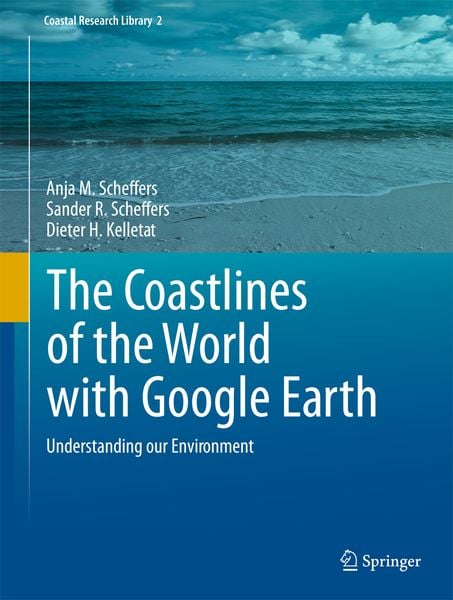
The Coastlines of the World with Google Earth Understanding our Environment
-
- Hardcover ausgewählt
- Taschenbuch
- eBook
-
Sprache:Englisch
Fr. 191.00
inkl. gesetzl. MwSt.,
Beschreibung
Produktdetails
Einband
Gebundene Ausgabe
Erscheinungsdatum
23.03.2012
Verlag
Springer NetherlandSeitenzahl
293
Maße (L/B/H)
28.5/21.5/2.2 cm
Gewicht
989 g
Auflage
1. Auflage
Sprache
Englisch
ISBN
978-94-007-0737-5
Far away shores, exotic islands or adventurous sea voyages - coasts are the destination of dreams for millions of people around the globe. Large numbers of people also call coasts their home; in many countries a narrow coastal strip is densely populated making these places vulnerable to marine natural hazards such as storms or tsunamis. The book Coastlines of the World with Google Earth aims to draw people's attention (within and outside of the science community) towards coastal sciences and spark interest for the extraordinary diversity and beauty of coastal environments. The book illustrates the fascinating variety of coastal landscapes using images from Google Earth's virtual globe that allow us to explore the world and demonstrate knowledge and applications of coastal science in many different fields in an engaging visual tour.
The book of Anja and Sander Scheffers and Dieter Kelletat is a true cornucopia for everyone, both scientists and laymen, interested in coastal geomorphology. On the one hand, it documents the enormous significance of Google Earth for coastal science issues and shows how powerful this tool is for visualizing coastal features and processes. On the other hand, the reader gets a vivid insight in the many varieties of coastal science and its applications. This is especially true with regard to coastal hazards such as extreme events and global sea level rise knowing that the vulnerability of coastal zones has dramatically increased during the past decades. The fact that the book is so attractive and inspiring to both beginners and experts is also due to the huge experience that the authors have gained during their manifold research activities.
Andreas Vött, Johannes Gutenberg-Universität Mainz, Germany
This book will have great appeal to coastal researchers, at both beginning and advanced stages, because it integrates Google satellite imagery with coastal marine classification and in-depthstudies by the authors from many parts of the world. The world’s coastline is well represented in this book which has a truly global perspective of unique, dramatic and commonplace coastal landforms. The authors in collaboration with the publisher have prepared a very handsome volume that will no doubt become a classic in the fullness of time. This book represents one of the first efforts to utilize Google images in a scientific manner to illustrate the diversity of coastal morphologies on a worldwide basis. The plethora of color satellite images, block diagrams, and oblique photography makes this book a valuable resource for a wide array of specialists that will want to have handy access to this unique work. This coastal compendium is an illustrated tour de force that belongs on researchers' bookshelves as well as on coffee tables for casual enjoyment.
Charles Finkl, Florida Atlantic University, Boca Raton, FL, USA
Kundinnen und Kunden meinen
Verfassen Sie die erste Bewertung zu diesem Artikel
Helfen Sie anderen Kund*innen durch Ihre Meinung