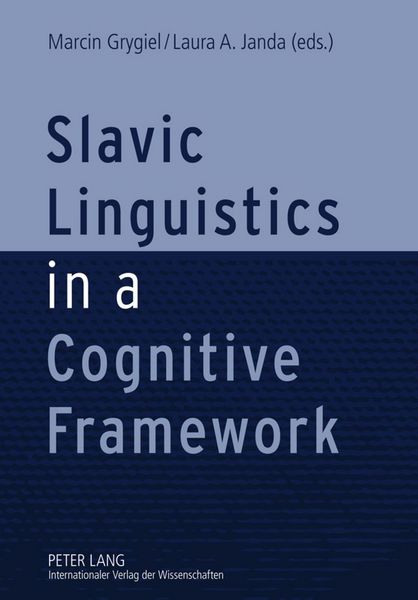
Produktbild: Slavic Linguistics in a Cognitive Framework

Slavic Linguistics in a Cognitive Framework

Fr. 108.00

inkl. gesetzl. MwSt., Versandkostenfrei


Beschreibung

Produktdetails

Einband

Gebundene Ausgabe

Erscheinungsdatum

21.01.2011

Herausgeber

Marcin Grygiel + weitere

Verlag

Peter Lang GmbH, Internationaler Verlag der Wissenschaften

Seitenzahl

328

Maße (L/B/H)

21.6/15.3/2.1 cm

Gewicht

538 g

Auflage

1. Auflage

Sprache

Englisch

ISBN

978-3-631-61239-2

Beschreibung

Portrait

Marcin Grygiel is a researcher at the Department of Comparative Linguistics and teaches at the Institute of Russian Studies at the University of Rzeszów (Poland). His research activities focus on various aspects of cognitive and historical linguistics such as semantic change in the history of English and affirmation in Slavic.
Laura A. Janda, President of the International Cognitive Linguistics Association, is a renowned linguist with training in Russian, Czech, and other Slavic languages.

Produktdetails

Einband

Gebundene Ausgabe

Erscheinungsdatum

21.01.2011

Herausgeber

Verlag

Peter Lang GmbH, Internationaler Verlag der Wissenschaften

Seitenzahl

328

Maße (L/B/H)

21.6/15.3/2.1 cm

Gewicht

538 g

Auflage

1. Auflage

Sprache

Englisch

ISBN

978-3-631-61239-2

EU-Ansprechpartner

Zeitfracht Medien GmbH
Ferdinand-Jühlke-Straße 7
99095 Erfurt
DE
produktsicherheit@zeitfracht.de

Herstelleradresse

Peter Lang
Avenue du Théâtre 7
1005 Lausanne
CH
orders@peterlang.com

Noch keine Bewertungen vorhanden

Verfassen Sie die erste Bewertung zu diesem Artikel

Helfen Sie anderen Kundinnen und Kunden durch Ihre Meinung.

Kundinnen und Kunden meinen

Bewertungen (0)

  • Produktbild: Slavic Linguistics in a Cognitive Framework
  • Contents: Laura A. Janda: Completability and Russian aspect – Stephen M. Dickey: Subjectification and the Russian perfective – Dagmar Divjak: Predicting aspectual choice in modal constructions: a quest for the Holy Grail? – Christoph Rosenbaum/Wolfgang Schulze: Cognitive morphology and the architecture of case in Slovak – Mirjam Fried: The notion of affectedness in expressing interpersonal functions – Ekaterina Rakhilina/Elena Tribushinina: The Russian instrumental-of-comparison: constructional approach – Marcin Grygiel: Constructional realizations of affirmation in Slavic – Liljana Mitkovska: Possessive locative constructions in Macedonian – Mario Brdar/Rita Brdar-Szabó: Not seeing trees for wood: a case study of metonymy-induced polysemy in Germanic and Slavic languages – Diana Prodanović-Stadnić: Metaphors and metonymies in Serbian proverbs containing names of animals – Agnieszka Będkowska-Kopczyk: Emotions as causes of human behavior in Polish and Slovene – Andrej A. Kibrik: Cognitive discourse analysis: local discourse structure – Piotr Twardzisz: Metaphorical expressions in legal language: evidence from Polish – Danko Šipka: Metaphor validation in polysemous structures: a case study of Serbo-Croatian bilingual dictionaries.