
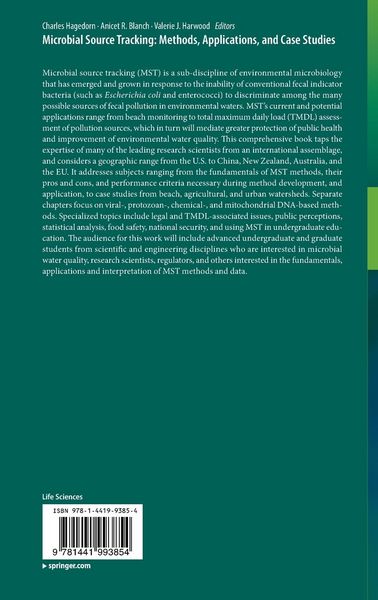
Microbial Source Tracking: Methods, Applications, and Case Studies
-
- Hardcover ausgewählt
- Taschenbuch
-
Sprache:Englisch
Fr. 242.00
inkl. gesetzl. MwSt.,
Beschreibung
Produktdetails
Einband
Gebundene Ausgabe
Erscheinungsdatum
09.06.2011
Herausgeber
Charles Hagedorn + weitereVerlag
Springer UsSeitenzahl
642
Maße (L/B/H)
24.1/16/3.8 cm
Gewicht
1138 g
Auflage
2011
Sprache
Englisch
ISBN
978-1-4419-9385-4
Understanding the origin of fecal pollution is essential in assessing potential health risks as well as for determining the actions necessary to remediate the quality of waters contaminated by fecal matter. As a result, microbial source tracking (MST) has emerged as a field that has evolved and diversified rapidly since the first approaches were described only a decade ago. In response to the emergence of MST, there have been three large multi-laboratory method comparison studies (two in the US and one in Europe), plus numerous workshops, book chapters, and review articles dedicated to synthesizing information on the topic. Furthermore, a federal (USEPA) guide document describing the uses and limitations of MST methods was published in 2005, and a book dedicated to MST as an emerging issue in food safety was published in 2007. These documents provide a collective body of literature on MST that is both conflicting and complementary, often repetitious, and difficult to condense and interpret. In addition, it does not reflect the current diversity of MST approaches with different organisms, newer methodologies such as quantitative PCR, and anthropogenic chemicals, nor does it embrace the scope of MST research being conducted around the world.
The three editors of the book, all with extensive MST expertise, have developed chapters and invited authors who reflect the rich diversity and truly international scope of MST. The unifying theme throughout the book is the design of more standardized approaches to MST that include performance criteria (regardless of method or organism), plus recommendations for field study design and MST implementation. The editors intend that this book will serve as a valuable reference for all those who are involved with
Noch keine Bewertungen vorhanden
Verfassen Sie die erste Bewertung zu diesem Artikel
Helfen Sie anderen Kundinnen und Kunden durch Ihre Meinung.