Band 20
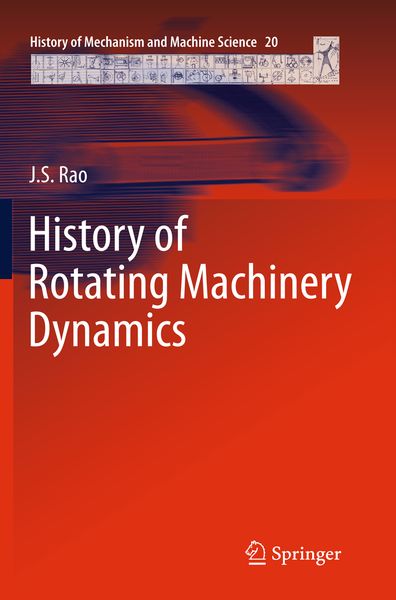
History of Rotating Machinery Dynamics
Aus der Reihe
History of Mechanism and Machine Science
-
- Hardcover ausgewählt
- Taschenbuch
- eBook
-
Sprache:Englisch
Fr. 138.00
inkl. gesetzl. MwSt.,
Beschreibung
Produktdetails
Einband
Gebundene Ausgabe
Erscheinungsdatum
17.02.2011
Verlag
Springer NetherlandSeitenzahl
358
Maße (L/B/H)
24.1/16/2.8 cm
Gewicht
804 g
Auflage
1. Auflage
Sprache
Englisch
ISBN
978-94-007-1164-8
This book starts with the invention of the wheel nearly 5000 years ago, and via Archimedes, Aristotle and Hero describes the first practical applications such as water wheels and grinding wheels, pushing on to more rigorous scientific research by inquiring minds such as Leonardo da Vinci and Copernicus in later ages. Newton and Leibniz followed, and beam structures received maximum attention three centuries ago. As focus shifts and related disciplines such as mathematics and physics also develop, slowly turbomachines and rotor and blade dynamics as we know the subject now take shape.
While the book traces the events leading to Laval and Parsons Turbines, the emphasis is on rotor and blade dynamics aspects that pushed these turbines to their limits in the last century. The tabular and graphical methods developed in the pre-computer era have taken different form in the last fifty years through finite element methods. The methods evolved in the last century are discussed in detail to help modern day designers and researchers.
This book will be useful to young researchers and engineers in industry and educational institutions engaged in rotor and blade dynamics work in understanding the past and the present developments and what is expected in future. Faculty and industry engineers can benefit from this broad perspective history in formulating their developmental plans.
While the book traces the events leading to Laval and Parsons Turbines, the emphasis is on rotor and blade dynamics aspects that pushed these turbines to their limits in the last century. The tabular and graphical methods developed in the pre-computer era have taken different form in the last fifty years through finite element methods. The methods evolved in the last century are discussed in detail to help modern day designers and researchers.
This book will be useful to young researchers and engineers in industry and educational institutions engaged in rotor and blade dynamics work in understanding the past and the present developments and what is expected in future. Faculty and industry engineers can benefit from this broad perspective history in formulating their developmental plans.
Noch keine Bewertungen vorhanden
Verfassen Sie die erste Bewertung zu diesem Artikel
Helfen Sie anderen Kundinnen und Kunden durch Ihre Meinung.